Product Design, Manufacturing & Innovation Resources
家 » 昇華エンタルピー

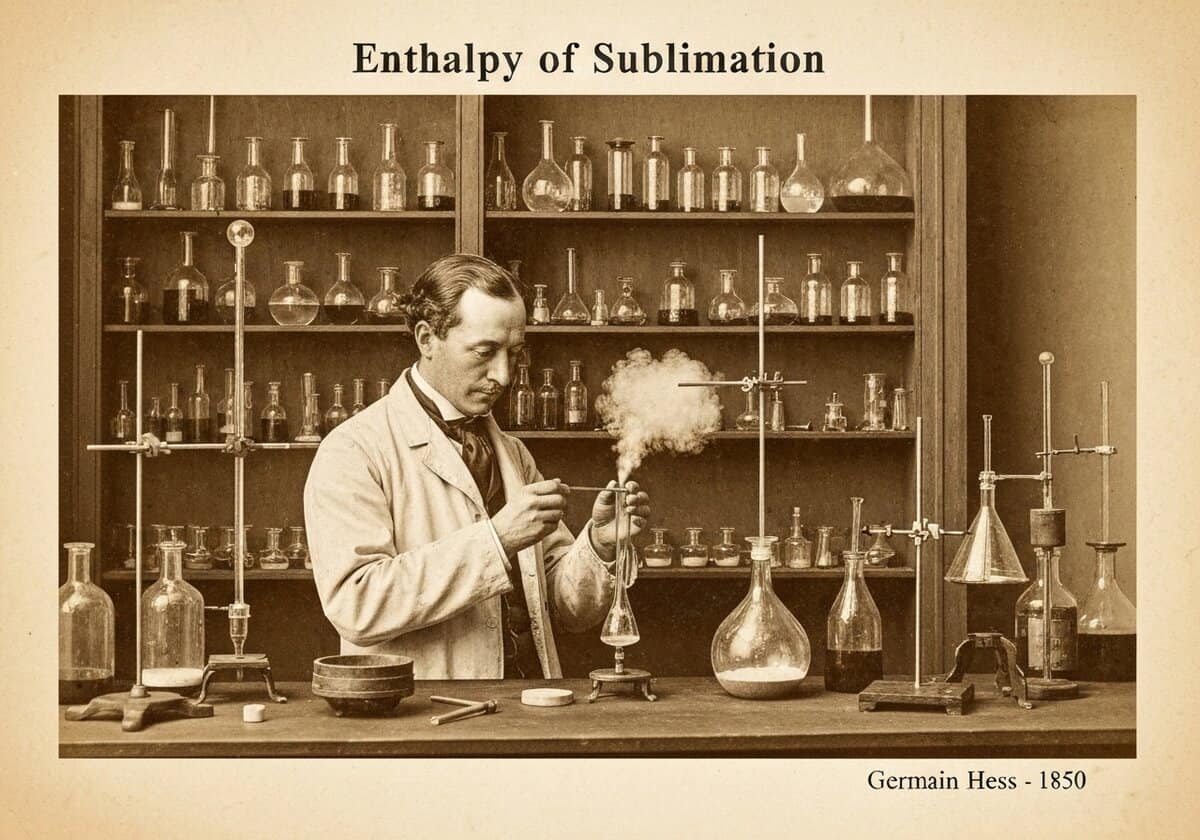
昇華エンタルピー

1850
  • Germain Hess
Scientist measuring sublimation in a vintage laboratory, thermodynamics study.

(画像はイメージです)

The enthalpy of sublimation, [latex]\Delta H_{\text{sub}}[/latex], is the heat required to convert one mole of a substance from solid to gas at a given temperature and pressure. According to Hess’s Law, since enthalpy is a state function, this energy change is the sum of the enthalpy of fusion ([latex]\Delta H_{\text{fus}}[/latex]) and the enthalpy of vaporization ([latex]\Delta H_{\text{vap}}[/latex]).

The relationship [latex]\Delta H_{\text{sub}} = \Delta H_{\text{fus}} + \Delta H_{\text{vap}}[/latex] is a direct application of Hess’s Law of Constant Heat Summation, a fundamental principle in thermochemistry. This law states that the total enthalpy change during a chemical or physical process is the same regardless of the pathway taken, as long as the initial and final states are the same. In this context, the initial state is the solid phase and the final state is the gas phase. One can imagine two pathways to get from solid to gas: a direct one-step path (sublimation) or a two-step path (melting the solid to a liquid, then vaporizing the liquid to a gas).

The enthalpy change for the direct path is the enthalpy of sublimation, [latex]\Delta H_{\text{sub}}[/latex]. The enthalpy change for the two-step path is the sum of the enthalpy of fusion ([latex]\Delta H_{\text{fus}}[/latex], for the solid-to-liquid transition) and the enthalpy of vaporization ([latex]\Delta H_{\text{vap}}[/latex], for the liquid-to-gas transition). Since the initial and final states are identical for both pathways, Hess’s Law dictates that their total enthalpy changes must be equal. This principle is incredibly useful because it allows for the calculation of an unknown enthalpy change from known values. For instance, if the enthalpies of fusion and vaporization are experimentally easier to measure than the enthalpy of sublimation, the latter can be calculated accurately. This data is crucial for chemical engineers and physicists in designing processes and modeling physical phenomena where sublimation is a key factor, such as in material deposition, 極低温工学、 そして 天体物理学.

UNESCO Nomenclature: 2210
熱力学

タイプ

物理法則

混乱

基礎

使用法

広く普及している

前駆物質

  • アントワーヌ・ラヴォアジエとピエール=シモン・ラプラスによる、熱量測定と化学反応における熱変化に関する研究
  • エンタルピー(熱量)の概念の発展
  • の 第一法則 熱力学の(エネルギー保存の法則)

アプリケーション

  • 工業用凍結乾燥プロセスのエネルギー必要量の計算
  • 大気圏再突入時の宇宙船の耐熱シールドのアブレーションをモデル化する
  • 彗星が太陽に接近する際の挙動を予測する
  • 昇華に基づく化学精製装置の設計
  • 熱力学 材料科学のためのデータベース開発

特許:

NA

潜在的なイノベーションのアイデア

  • developing novel refrigerants that use the sublimation-deposition cycle for high-efficiency cooling
  • creating self-regulating temperature buffers for sensitive cargo using materials with a specific enthalpy of sublimation
  • designing atmospheric 二酸化炭素回収 systems that freeze co2 and then sublime it for collection
  • formulating energetic materials for ロケット propulsion that sublime before combustion for better mixing
  • engineering phase-change materials for 熱エネルギー貯蔵 that utilize the solid-gas transition
  • manufacturing biodegradable packaging that disintegrates via controlled sublimation
  • developing advanced fire suppressants that sublime into an inert gas, smothering flames without residue
  • creating artificial snow for indoor ski slopes with tailored sublimation rates for better texture
  • designing sublimating drones for covert surveillance that leave no physical trace after their mission
  • medical cryoablation tools that use sublimation for precise tissue removal
関連キーワード:昇華エンタルピー、ヘスの法則、熱化学、相転移、融解エンタルピー、蒸発エンタルピー、状態関数、熱力学、昇華熱、エネルギー。

歴史的背景

昇華エンタルピー

1841
1845
1850
1850
1850
1850
1850
1839-01-01
1842
1847
1850
1850
1850
1850
1850

(日付が不明または関連性がない場合、例えば「流体力学」などでは、その注目すべき出現時期の概算値が提示されます。)

10年目 周年

フルサイズの画像とダウンロードは、登録会員のみが100%無料で利用できます。