Product Design, Manufacturing & Innovation Resources
집 » 승화 엔탈피

승화 엔탈피

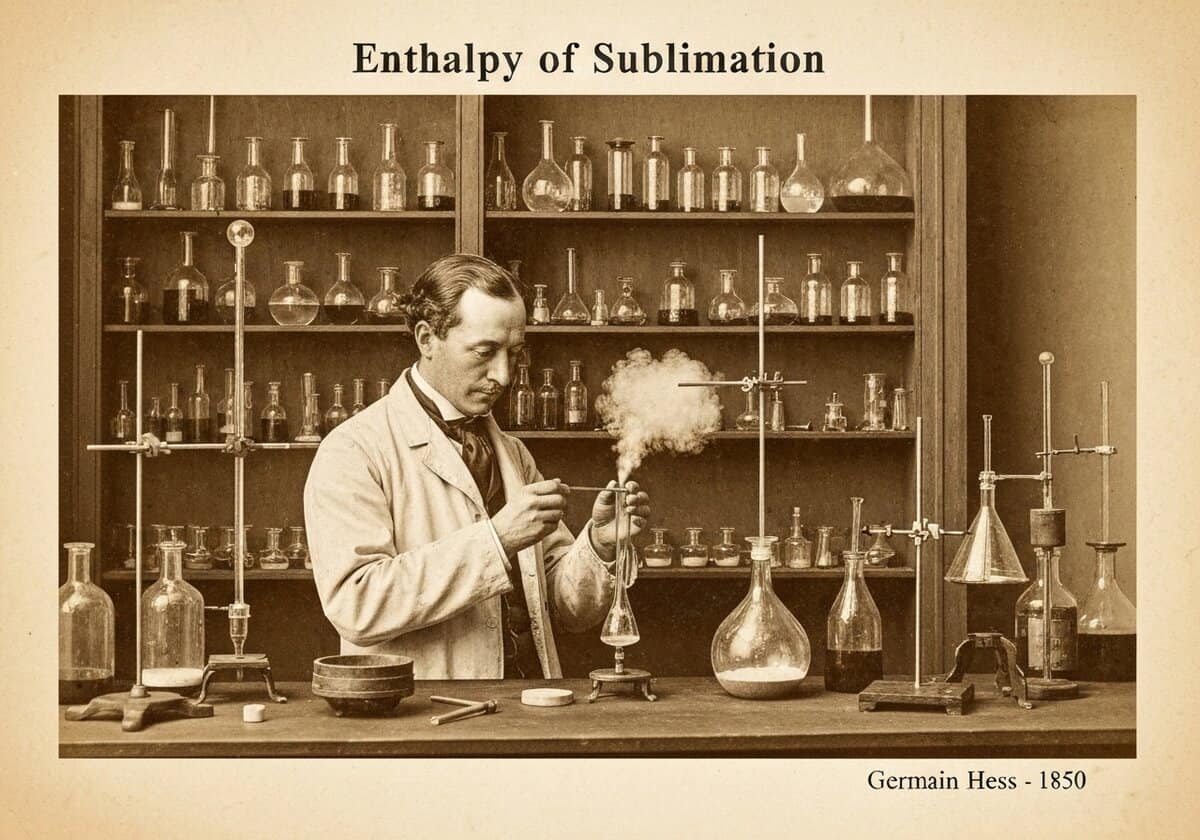
1850
  • Germain Hess
Scientist measuring sublimation in a vintage laboratory, thermodynamics study.

(설명을 위한 생성된 이미지입니다)

The enthalpy of sublimation, [latex]\Delta H_{\text{sub}}[/latex], is the heat required to convert one mole of a substance from solid to gas at a given temperature and pressure. According to Hess’s Law, since enthalpy is a state function, this energy change is the sum of the enthalpy of fusion ([latex]\Delta H_{\text{fus}}[/latex]) and the enthalpy of vaporization ([latex]\Delta H_{\text{vap}}[/latex]).


The relationship [latex]\Delta H_{\text{sub}} = \Delta H_{\text{fus}} + \Delta H_{\text{vap}}[/latex] is a direct application of Hess’s Law of Constant Heat Summation, a fundamental principle in thermochemistry. This law states that the total enthalpy change during a chemical or physical process is the same regardless of the pathway taken, as long as the initial and final states are the same. In this context, the initial state is the solid phase and the final state is the gas phase. One can imagine two pathways to get from solid to gas: a direct one-step path (sublimation) or a two-step path (melting the solid to a liquid, then vaporizing the liquid to a gas).

The enthalpy change for the direct path is the enthalpy of sublimation, [latex]\Delta H_{\text{sub}}[/latex]. The enthalpy change for the two-step path is the sum of the enthalpy of fusion ([latex]\Delta H_{\text{fus}}[/latex], for the solid-to-liquid transition) and the enthalpy of vaporization ([latex]\Delta H_{\text{vap}}[/latex], for the liquid-to-gas transition). Since the initial and final states are identical for both pathways, Hess’s Law dictates that their total enthalpy changes must be equal. This principle is incredibly useful because it allows for the calculation of an unknown enthalpy change from known values. For instance, if the enthalpies of fusion and vaporization are experimentally easier to measure than the enthalpy of sublimation, the latter can be calculated accurately. This data is crucial for chemical engineers and physicists in designing processes and modeling physical phenomena where sublimation is a key factor, such as in material deposition, 극저온 공학, 그리고 천체물리학.

UNESCO Nomenclature: 2210
열역학

유형

물리 법칙

분열

기초적인

용법

널리 사용됨

전구체

  • 앙투안 라부아지에와 피에르 시몽 라플라스의 열량 측정 및 화학 반응에서의 열 변화에 대한 연구
  • 엔탈피(열량) 개념의 발전
  • 그만큼 첫 번째 법칙 열역학의 (에너지 보존)

응용 프로그램

  • 산업용 동결건조 공정에 필요한 에너지 계산
  • 대기권 재진입 중 우주선 열 차폐막의 마모 모델링
  • 혜성이 태양에 접근할 때의 움직임을 예측하는 것
  • 승화 현상을 기반으로 한 화학 정제 장치 설계
  • 열역학적 재료과학 분야 데이터베이스 개발

특허:

NA

잠재적 혁신 아이디어

  • developing novel refrigerants that use the sublimation-deposition cycle for high-efficiency cooling
  • creating self-regulating temperature buffers for sensitive cargo using materials with a specific enthalpy of sublimation
  • designing atmospheric 탄소 포집 systems that freeze co2 and then sublime it for collection
  • formulating energetic materials for 로켓 propulsion that sublime before combustion for better mixing
  • engineering phase-change materials for 열에너지 저장 that utilize the solid-gas transition
  • manufacturing biodegradable packaging that disintegrates via controlled sublimation
  • developing advanced fire suppressants that sublime into an inert gas, smothering flames without residue
  • creating artificial snow for indoor ski slopes with tailored sublimation rates for better texture
  • designing sublimating drones for covert surveillance that leave no physical trace after their mission
  • medical cryoablation tools that use sublimation for precise tissue removal
관련 개념: 승화 엔탈피, 헤스의 법칙, 열화학, 상전이, 융해 엔탈피, 기화 엔탈피, 상태 함수, 열역학, 승화열, 에너지.

역사적 맥락

승화 엔탈피

1841
1845
1850
1850
1850
1850
1850
1839-01-01
1842
1847
1850
1850
1850
1850
1850

(날짜를 알 수 없거나 관련이 없는 경우, 예를 들어 "유체역학"의 경우, 주목할 만한 등장 시기를 대략적으로 추정하여 제공합니다.)

10년차 기념일

고화질 이미지 및 다운로드는 등록된 회원에게만 100% 무료로 제공됩니다.

> 로그인 <