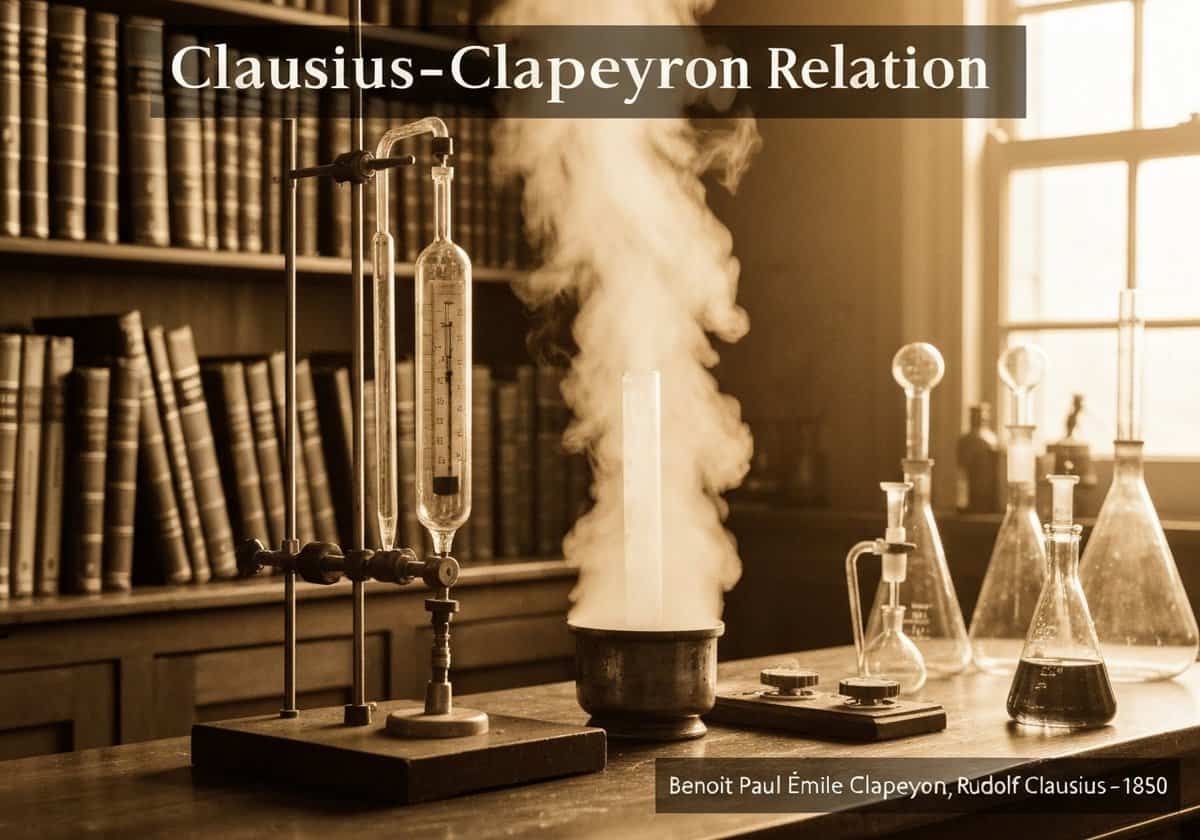
クラウジウス・クラペイロンの関係は、 プレッシャー そして、液体と蒸気などの相転移時の物質の温度。水蒸気の場合、飽和が 蒸気圧 increases exponentially with temperature. The approximate form is [latex]\frac{dp}{dT} = \frac{L}{T(V_v – V_l)} \approx \frac{L p}{R_v T^2}[/latex], where L is latent heat.


(画像はイメージです)
クラウジウス・クラペイロンの関係は、 プレッシャー そして、液体と蒸気などの相転移時の物質の温度。水蒸気の場合、飽和が 蒸気圧 increases exponentially with temperature. The approximate form is [latex]\frac{dp}{dT} = \frac{L}{T(V_v – V_l)} \approx \frac{L p}{R_v T^2}[/latex], where L is latent heat.

The Clausius-Clapeyron relation is a cornerstone of physical chemistry and thermodynamics, providing a quantitative way to understand phase transitions. It is derived from the principle that at phase equilibrium, the specific Gibbs free energy of the two phases is equal. The relation’s most significant implication for humidity is that it mathematically explains why warm air can ‘hold’ significantly more water vapor than cold air. The saturation vapor pressure—the maximum partial pressure water vapor can exert at a given temperature—is not a linear function of temperature but an exponential one. This exponential increase means that a small rise in temperature leads to a large increase in the air’s capacity for moisture. This is fundamental to many weather phenomena. For example, it explains why tropical regions can be so humid and why convection in the atmosphere, where warm, moist air rises and cools, is such an effective mechanism for producing clouds and precipitation. The cooling of the rising air reduces its saturation 蒸気圧, increasing relative humidity until it reaches 100%, triggering condensation. The original work by Clapeyron was based on Carnot’s theory, and it was later put on a firmer theoretical ground by Rudolf Clausius, who introduced the concept of entropy.
クラウジウス・クラペイロンの関係
(日付が不明または関連性がない場合、例えば「流体力学」などでは、その注目すべき出現時期の概算値が提示されます。)

フルサイズの画像とダウンロードは、登録会員のみが100%無料で利用できます。
> ログイン <