Product Design, Manufacturing & Innovation Resources
家 » 理想気体の法則(統計形式)

理想気体の法則(統計形式)

1850
  • Ludwig Boltzmann
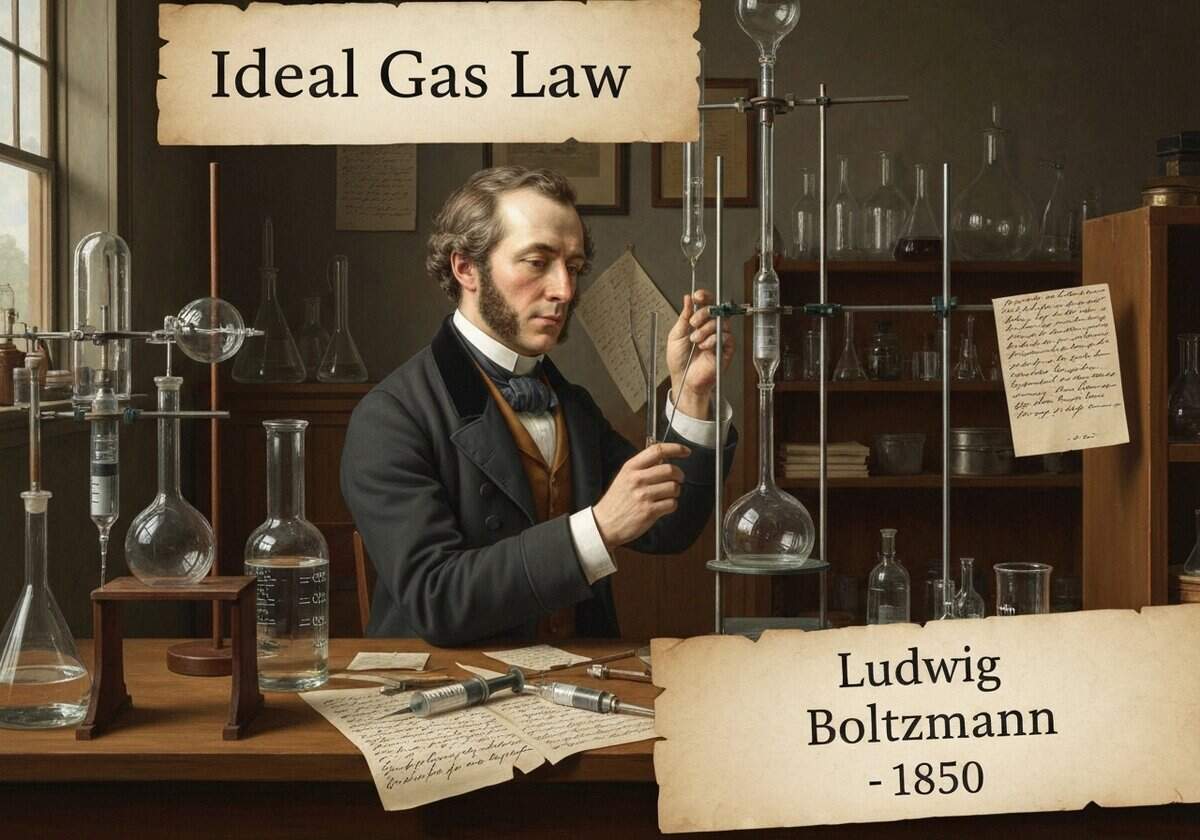
19th-century laboratory scene with Ludwig Boltzmann studying the Ideal Gas Law in statistical thermodynamics.

(画像はイメージです)

The statistical mechanics formulation of the 理想気体の法則 気体の微視的性質の観点から関係性を表す。 プレッシャー 粒子数 ([latex]P[/latex]) と体積 ([latex]V[/latex]) から、ボルツマン定数 ([latex]k_B[/latex]) を介して粒子総数 ([latex]N[/latex]) と絶対温度 ([latex]T[/latex]) に比例します。[latex]PV = Nk_BT[/latex]。

While the molar form of the ideal 気体の法則 ([latex]PV = nRT[/latex]) is convenient for chemistry and macroscopic thermodynamics, the statistical form ([latex]PV = Nk_BT[/latex]) provides a direct link to the microscopic world of atoms and molecules. In this equation, [latex]N[/latex] is the total number of particles (atoms or molecules) in the gas, and [latex]k_B[/latex] is the Boltzmann constant, a fundamental constant in physics named after Ludwig Boltzmann. The Boltzmann constant acts as a bridge between the macroscopic energy scale (related to temperature [latex]T[/latex]) and the microscopic energy scale of individual particles. Its value is approximately [latex]1.38 \times 10^{-23}[/latex] J/K.

This form of the law arises directly from the principles of statistical mechanics and the kinetic theory of gases. It highlights that the macroscopic pressure of a gas is a direct consequence of the collective motion of its constituent particles. The two forms of the ideal gas law are equivalent, connected by the relationship between the universal gas constant ([latex]R[/latex]), the Boltzmann constant ([latex]k_B[/latex]), and Avogadro’s number ([latex]N_A[/latex]), which is the number of particles per mole: [latex]R = N_A k_B[/latex]. The statistical form is preferred in fields like condensed matter physics, plasma physics, and astrophysics, where it is more natural to consider the number of individual particles rather than the number of moles.

UNESCO Nomenclature: 2210
熱力学

タイプ

抽象システム

混乱

基礎

使用法

広く普及している

前駆物質

アプリケーション

  • 統計力学モデリング
  • 分子動力学シミュレーション
  • マクロな接続 熱力学 微粒子挙動の特性
  • プラズマ物理学
  • 天体物理学(恒星大気のモデリング)

特許:

NA

潜在的なイノベーションのアイデア

  • nanoscale engines powered by the controlled thermal motion of a small number of gas particles
  • algorithms for designing new materials by simulating atomic-level behavior and predicting macroscopic properties
  • advanced weather prediction models that incorporate micro-scale atmospheric turbulence effects
  • drug delivery systems using gas-filled microbubbles whose behavior is modeled particle-by-particle
  • fusion reactor simulations that model plasma behavior at the particle level to optimize confinement
  • cosmological simulations of galaxy formation that accurately model interstellar gas clouds
  • semiconductor manufacturing process controls that model the behavior of gases in deposition chambers
  • ai systems for discovering new physical laws by analyzing large-scale molecular dynamics simulation data
  • ultra-sensitive detectors for trace gases that work by observing the statistical behavior of a few captured molecules
  • virtual reality environments with physically accurate rendering of smoke, fog, and other gaseous phenomena
関連分野: 統計力学、ボルツマン定数、気体分子運動論、理想気体、圧力、体積、温度、ルートヴィヒ・ボルツマン、微視的性質、粒子数。

歴史的背景

理想気体の法則(統計形式)

1850
1850
1850
1850
1851
1852
1859
1850
1850
1850
1850
1850
1851
1854
1859

(日付が不明または関連性がない場合、例えば「流体力学」などでは、その注目すべき出現時期の概算値が提示されます。)

10年目 周年

フルサイズの画像とダウンロードは、登録会員のみが100%無料で利用できます。