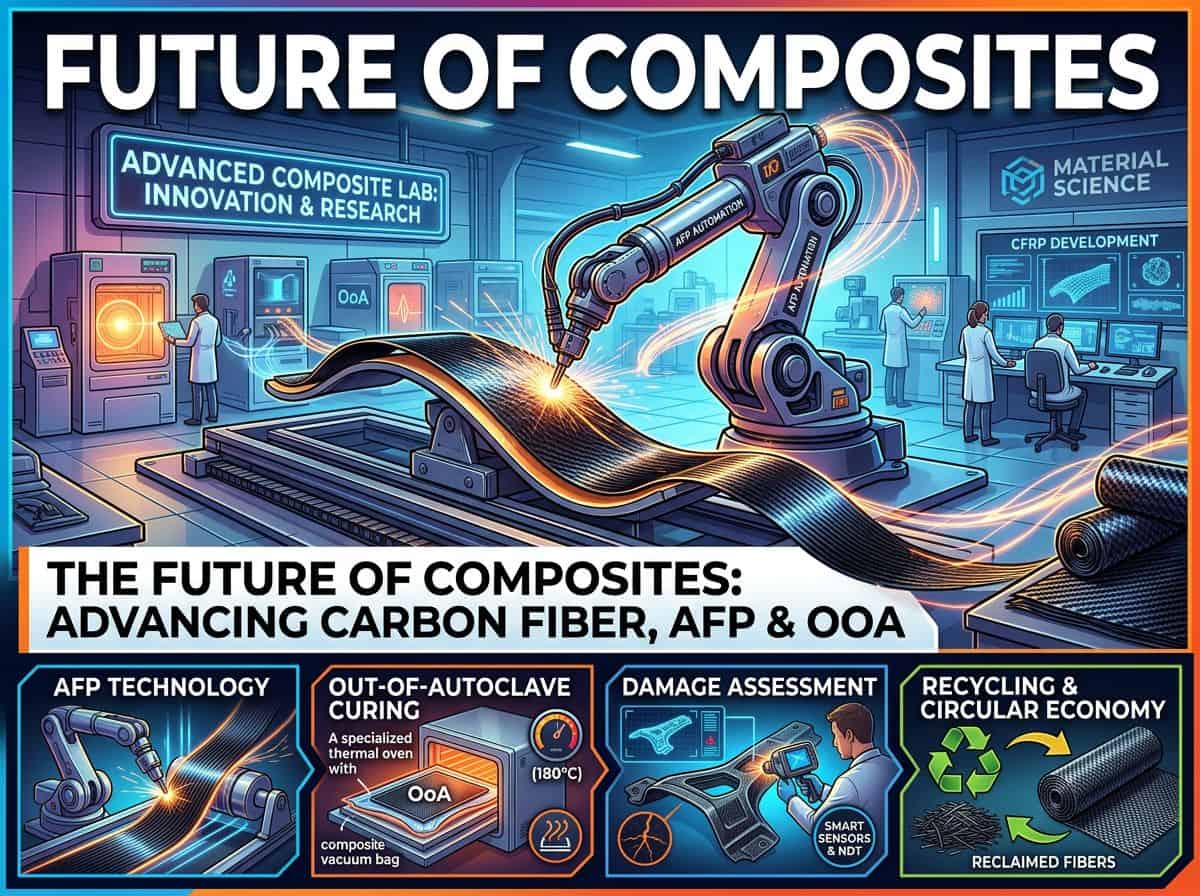

繊維強化複合材料は、高強度の炭素繊維、ガラス繊維、アラミド繊維、または天然繊維をポリマーマトリックスと組み合わせることで、金属では実現できない特定の剛性と強度を実現します。その特性は、繊維の配向、繊維体積率、および界面の品質に依存します。航空宇宙、風力発電、自動車、圧力容器メーカーは、軽量化のためにこれらの材料を使用しています。製造プロセスは、オートクレーブ硬化を伴うプリプレグ積層から、樹脂トランスファー成形、真空注入、フィラメントワインディング、引抜成形まで多岐にわたります。
生産速度と製品寿命が主な制約要因です。自動繊維配置とテープ積層により再現性が向上し、オートクレーブ不要の硬化と連続繊維熱可塑性樹脂によりサイクルタイムが短縮され、溶接が可能になります。剥離、衝撃損傷、疲労は依然として予測と検査が困難です。熱分解、溶媒分解、または機械的処理によるリサイクルでは、特性が低下した繊維が回収されます。以下に索引付けされた出版物と特許は、材料、製造プロセス、損傷メカニズム、検査、およびリサイクル経路を扱っています。
複合材料は、丈夫な繊維と結合マトリックスを組み合わせたものであるため、ポリマーに関する2つのページをこのページの隣に掲載する必要があります。 熱硬化性樹脂 架橋樹脂および 熱可塑性樹脂 リサイクル可能なマトリックス用。航空機およびロケット構造は、 航空学複合材料は接合が難しいため、 溶接と接合 も訪れる価値があり、 耐火性 既知の弱点をカバーする。
これは、繊維強化複合材料に関する英語の世界中の出版物と特許の最新のセレクションです。多数の科学オンラインジャーナルから、繊維強化複合材料、炭素繊維強化ポリマー、ガラス繊維強化、自動繊維配置、自動テープ積層、樹脂トランスファー成形、真空注入、プリプレグ、オートクレーブ外硬化、フィラメントワインディング、プルトルージョン、連続繊維熱可塑性複合材料、複合材料の層間剥離、層間せん断、複合材料のリサイクル、熱分解繊維回収、天然繊維複合材料、繊維体積率、複合材料の疲労、シート成形コンパウンドに分類され、焦点を絞っています。
Vacuum infusion bag film structure for wind turbine blades
Patent published on the 2026-11-11 in EP under Ref EP4837731 by ENVISION ENERGY CO LTD [CN] (Chen Yabo [cn], Chen Weiliang [cn], Yan Xu [cn])
Abstract: The present disclosure discloses a vacuum infusion bag film structure for wind turbine blades. The vacuum infusion bag film structure for the wind turbine blades includes at least one bag film, which includes a substrate layer and a thermochromic layer, where the thermochromic layer is arranged on the substrate layer or embedded within the substrate layer. The thermochromic layer is configured to change color in response to temperature change to monitor local temperature anomaly during a vacuum [...]
Our summary: The vacuum infusion bag film structure includes a substrate layer and a thermochromic layer. The thermochromic layer changes color in response to temperature changes to monitor anomalies. This structure enables real-time visual temperature monitoring during the heating and curing processes of wind turbine blades.
vacuum infusion, thermochromic layer, wind turbine blades, temperature monitoring
Patent
Resin composition, cured product, resin composite sheet, prepreg, metal foil–clad laminate, printed wiring board, and semiconductor device
Patent published on the 2026-10-29 in WO under Ref WO2026225465 by MITSUBISHI GAS CHEMICAL CO [JP] (Inafune Sayaka [jp], Tokunaga Naoya [jp], Yamamoto Katsuya [jp], Kataoka Shunichi [jp], Itoh Syouichi [jp])
Abstract: Provided are a resin composition, a cured product, a resin composite sheet, a prepreg, a metal foil–clad laminate, a printed wiring board, and a semiconductor device. The glass transition temperature is measured by a dynamic mechanical analysis tensile method with a dynamic viscoelasticity analyzer according to the present disclosure. This resin composition comprises a maleimide compound (A1) having a maleimide group equivalent of 280 g/eq or more and 500 g/eq or less, a maleimide compound (A2[...]
Our summary: The resin composition includes maleimide compounds and a crosslinking agent. The cured product exhibits a glass transition temperature between 180-250°C. The method for measurement involves dynamic mechanical analysis using a viscoelasticity analyzer.
resin composition, cured product, prepreg, glass transition temperature
Patent
Glass fiber reinforced exfoliated graphene-polymer composites
Patent published on the 2026-10-15 in WO under Ref WO2026217918 by RUTGERS THE STATE UNIV OF NEW JERSEY [US] (Nosker Thomas J [us], Fei Fan [us], Lehman Richard L [us])
Abstract: The present disclosure provides novel glass fiber reinforced graphene-polymer matrix composites and methods for producing them. The disclosed compositions show improvements in mechanical properties, such as tensile and flexural strengths, while suppressing the negative effect of graphene reinforcement on impact energy absorption compared to a neat polymer or singly- reinforced composite.[...]
Our summary: Glass fiber reinforced graphene-polymer composites enhance mechanical properties. The composites improve tensile and flexural strengths. They mitigate the negative impact of graphene on energy absorption.
composites, graphene, mechanical properties, reinforcement
Patent
Thermoset-based polymer composite material, method of manufacturing and associated uses thereof
Patent published on the 2026-10-07 in EP under Ref EP4818240 by FUNDACION IMDEA MAT [ES] (Wang De-yi [es], Ao Xiang [es], Liu Yunhuan [es])
Abstract: [0001] The present invention relates to a lightweight, high-strength, fire- and ablation-resistant polymer-based composite material comprising a polymer matrix and one or more functional fillers distributed therein, and a fiber reinforcement material. Their method of manufacturing comprises performing wet layup, spray layup, wet compression molding, prepreg compression molding, resin vacuum infusion process, or resin transfer molding. Finally, the invention can be used for automotive application[...]
Our summary: The invention describes a lightweight, high-strength thermoset-based polymer composite material. It includes a polymer matrix with functional fillers and fiber reinforcement. The manufacturing methods include various molding and infusion processes, suitable for automotive battery pack systems.
thermoset, polymer composite, manufacturing method, automotive applications
Patent
Resin composition, prepreg, film with resin, metal foil with resin, metal-clad laminate, and wiring board
Patent published on the 2026-10-01 in WO under Ref WO2026205321 by PANASONIC IP MAN CO LTD [JP] (Washio Teppei, Ishikawa Yuichi, Honma Masafumi)
Abstract: The present disclosure addresses the problem of providing a resin composition capable of giving cured objects having a reduced coefficient of linear expansion, high adhesion, and excellent flame retardancy. The resin composition comprises a maleimide compound (A), a benzoxazine compound (B), an epoxy compound (C), and phosphorus-containing compounds (D). The phosphorus-containing compounds (D) include a reactive phosphorus-containing compound (D1) and an unreacted phosphorus-containing compound [...]
Our summary: The resin composition includes maleimide, benzoxazine, epoxy, and phosphorus compounds. It aims to provide cured objects with reduced linear expansion and high adhesion. The phosphorus compounds are divided into reactive and unreacted types, with a specific mass ratio.
resin composition, prepreg, flame retardancy, linear expansion
Patent
Sheet molding compound and method for producing same, and fiber-reinforced composite material and method for producing same
Patent published on the 2026-09-24 in WO under Ref WO2026197191 by MITSUBISHI CHEMICAL CORP [JP] (Umemoto Kousuke [jp])
Abstract: Provided are a sheet molding compound capable of producing a fiber-reinforced composite material excellent in heat resistance, and a method for producing the sheet molding compound. A sheet molding compound according to the present invention contains an epoxy resin composition which contains an epoxy resin (component (A)), a hydrazide compound (component (B)), and an acid anhydride (component (C)) and reinforcing fibers. The epoxy resin composition contains 5 mass parts or more of the component [...]
Our summary: The content describes a sheet molding compound for producing heat-resistant fiber-reinforced composites. It includes an epoxy resin composition with specific components, including hydrazide and acid anhydride. The method emphasizes the proportion of hydrazide to acid anhydride for optimal performance.
sheet molding compound, fiber-reinforced composite, epoxy resin, hydrazide compound
Patent
Investigating the synergistic effects of hybrid and bimodal filler networks on the out-of-plane thermal conductivity of polymer composites
Published on 2026-06-12 by Yonghyun Albert Kwon, Jaeyeon Kim, Jiseon Choi, Soojeong Jeong, Yunchan Lee, Ho Sun Lim, Jeong Ho Cho @NATURE
Abstract: Polymer Journal, Published online: 12 June 2026; doi:10.1038/s41428-026-01220-2We report a highly effective approach to improve the out-of-plane thermal conductivity of polymer prepregs by optimizing filler networks. Comparing monofiller, hybrid (h-BN/Al2O3), and bimodal (h-BN aggregates/powders) systems reveal that bimodal architectures successfully balance isotropic phonon transport with minimized interfacial thermal resistance. By utilizing chemically identical h-BN fillers with distinct morp[...]
Our summary: The study investigates the impact of hybrid and bimodal filler networks on the thermal conductivity of polymer composites. Bimodal architectures enhance phonon transport while reducing thermal resistance. The optimized prepreg achieves a thermal conductivity of 0.56 W/m·K with 25 wt% filler.
thermal conductivity, polymer composites, filler networks, bimodal systems
Publication
Morphology of poly(ether ether ketone)/poly(ether imide) blends and their application as a matrix for carbon fiber-reinforced plastic
Published on 2026-04-06 by Yusaku Oba, Hideyuki Uematsu, Ayaka Yamaguchi, Fumihiro Nishimura, Shuichi Tanoue @NATURE
Abstract: Polymer Journal, Published online: 06 April 2026; doi:10.1038/s41428-026-01162-9The dispersion state of PEEK and PEI in carbon fiber-reinforced composites with a PEEK/PEI blend matrix was investigated using micro-Raman spectroscopy and scanning electron microscopy. The results revealed a continuous coexistence, on a submicron scale, of crystalline PEEK, amorphous PEEK compatible with PEI, and isolated PEI domains near the carbon fiber surface. This submicron-scale morphology accounts for the enh[...]
Our summary: The study investigates the morphology of PEEK/PEI blends in carbon fiber-reinforced composites. Micro-Raman spectroscopy and scanning electron microscopy reveal a submicron coexistence of PEEK and PEI phases. The findings indicate improved thermal and mechanical properties due to the blending of PEI with PEEK.
polymer blends, carbon fiber, micro-Raman spectroscopy, scanning electron microscopy
Publication