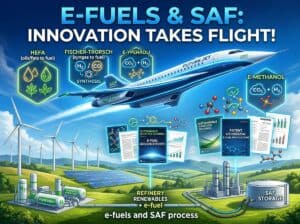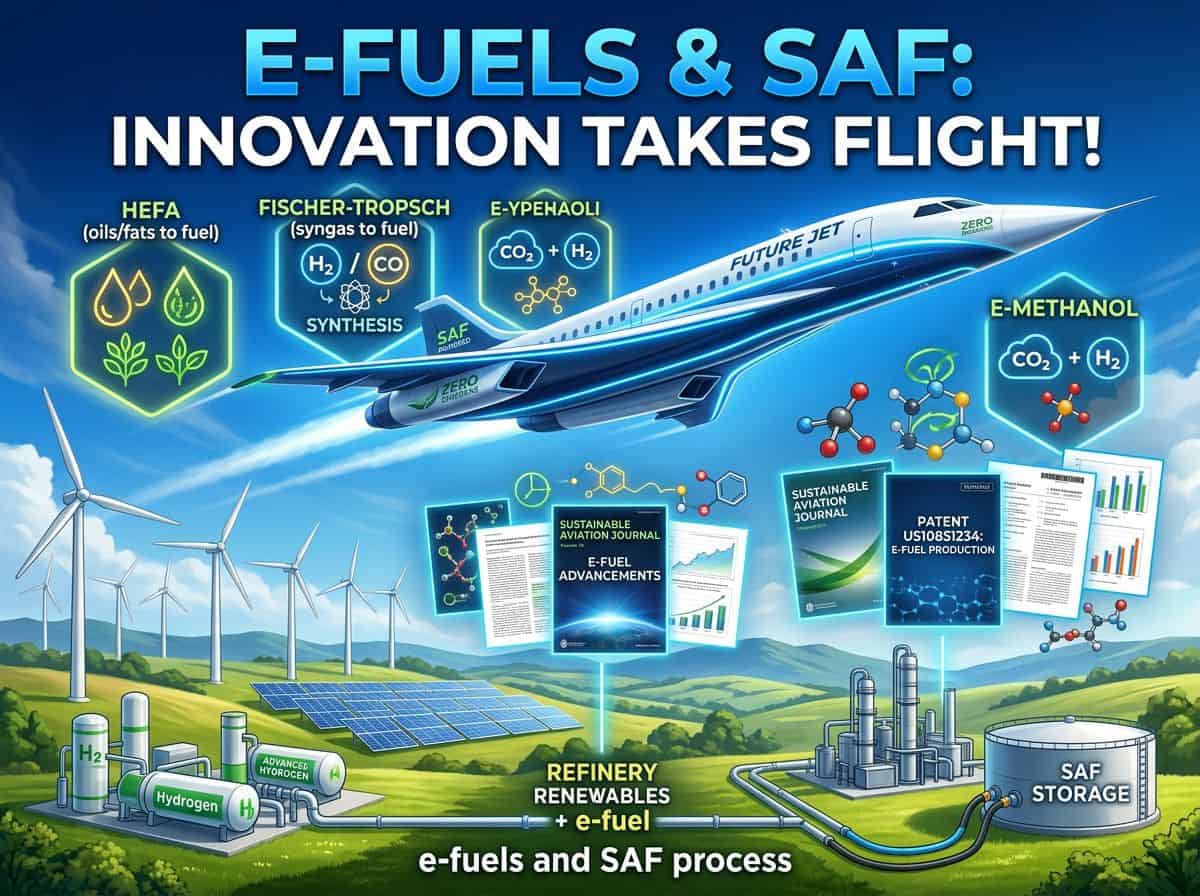

E燃料は、再生可能電力、水、回収された二酸化炭素から製造される合成炭化水素および化学キャリアです。まず電気分解によって水素が供給されます。次に、逆水性ガスシフト反応とフィッシャー・トロプシュ合成、またはメタノール合成を経てジェット燃料に変換される過程で、CO2と結合されます。持続可能な航空燃料(SAF)には、HEFA、アルコールからジェット燃料への変換、バイオマスガス化などのバイオベースの経路も含まれます。どちらの系統も、既存のエンジンやインフラと互換性のあるドロップイン燃料を生成します。
エネルギー効率とコストは依然として中心的な課題です。各変換ステップでエネルギーが失われるため、電力から液体への変換効率は直接電化に比べてはるかに低く、燃料価格は電気料金とCO2供給量に大きく左右されます。触媒の耐久性、固体酸化物電解の統合、プロセス熱管理、スケールアップは、エンジニアリング上のリスクを高めます。ASTM D7566に基づく認証や、ReFuelEU Aviationなどの規制が市場を形成しています。以下に索引付けされた出版物と特許は、合成経路、触媒、反応器、CO2回収、燃料認定、ライフサイクル評価を扱っています。
航空業界には長距離路線向けの電気燃料の選択肢がほとんどないため、CO2と水素から作られる液体燃料が注目されている。原料は グリーン水素 そして 直接大気回収航空機側は 航空学正直な炭素会計のニーズ ライフサイクルアセスメント.
これは、E-Fuelsと持続可能な航空燃料(SAF)に関する英語の世界中の出版物と特許の最新のセレクションです。多数の科学オンラインジャーナルから、e-fuel、power-to-liquid、power-to-X、持続可能な航空燃料、合成灯油、フィッシャー・トロプシュ合成、逆水性ガスシフト、CO2水素化、e-メタノール、メタノール-to-jet、アルコール-to-jet、水素化処理エステルと脂肪酸、HEFA、e-アンモニア、アンモニア合成、固体酸化物電解、バイオマスガス化、ドロップイン燃料、燃料認証、ASTM D7566に分類され、焦点を絞っています。
Processes for use of ammonia synthesis catalysts and related systems
Patent published on the 2026-10-29 in WO under Ref WO2026226822 by COPERNIC CATALYSTS INC [US] (Ramkrishnan Aruna [us], Grose Jacob [us], Radaelli Guido [us])
Abstract: Methods and related systems for producing ammonia are described. The methods and systems may include use of a base metal catalyst (e.g., containing substantially no platinum group metals). The base metal catalyst may facilitate production of ammonia at relatively high conversion percentages and/or capacities at relatively low temperatures and/or pressures. In some instances, a preliminary reactor (e.g., a bolt-on interstage reactor), which may include the base metal catalyst in some instances, i[...]
Our summary: Methods for ammonia production utilize base metal catalysts for high conversion rates at low temperatures. Preliminary reactors may be used upstream of primary reactors to enhance efficiency. The systems described minimize the use of platinum group metals.
ammonia synthesis, base metal catalyst, conversion efficiency, reactor systems
Patent
Energy-saving and high-efficiency biomass gasification and catalytic conversion device
Patent published on the 2026-10-28 in EP under Ref EP4831265 by BEIJING APTBLAZE TECH CO LTD [CN] (Zhang Yanguo [cn], Zhou Hui [cn], Bie Xuan [cn], Chen Xuan [cn])
Abstract: The present disclosure discloses an energy-saving and high-efficiency biomass gasification and catalytic conversion device, and is used to solve the problems of complex process, low conversion efficiency, and thermal energy waste in biomass gasification in existing technologies. The gasification and catalytic conversion device of the present disclosure comprises a feeding unit, a gasifier, a high-temperature dust removal bag, a decomposition furnace, and air distribution components. The discharg[...]
Our summary: The device improves biomass gasification efficiency and reduces thermal energy waste. It includes a feeding unit, gasifier, high-temperature dust removal bag, and decomposition furnace. The design addresses complex processes and low conversion efficiency in existing technologies.
biomass gasification, catalytic conversion, energy efficiency, thermal management
Patent
Coral-reef-like bifunctional catalyst for biomass gasification to produce green hydrogen with simultaneous decarbonization, and preparation method and
Patent published on the 2026-10-08 in US under Ref US20260307057 by SOUTHEAST UNIV [CN] (Zhang Huiyan [cn], Lu Qiuxiang [cn], Su Yinhai [cn], Xiao Rui [cn])
Abstract: A coral-reef-like bifunctional catalyst for biomass gasification to co-produce green hydrogen and achieve decarbonization. Active metal site regulation optimizes the matching between active phases and supports to enhance catalytic activity and stability. The unique coral-reef-like structure builds a confined space for bond cleavage and CO2 conversion. Dual active sites respectively drive directional bond cleavage for high-purity green hydrogen production and in-situ CO2 adsorption and conversion[...]
Our summary: A coral-reef-like bifunctional catalyst enables biomass gasification for green hydrogen production and decarbonization. The structure enhances catalytic activity through active metal site regulation and bond cleavage. The catalyst demonstrates excellent stability and efficiency in producing high-purity syngas with CO2 conversion.
bifunctional catalyst, biomass gasification, green hydrogen, decarbonization
Patent
Catalysis aids for direct co2 hydrogenation to methanol, methods and products thereof
Patent published on the 2026-10-08 in WO under Ref WO2026207616 by VOLTA ENERGY INC [CA] (Zou Fenglou [ca], Singh Gursaran [ca])
Abstract: The present application relates to CO2 utilization. More specifically, the present application relates to catalysis aids for direct CO2 hydrogenation to methanol and methods using the same. Included is a catalysis aid for use in a catalytic CO2 hydrogenation, the catalysis aid comprising at least one component selected from superabsorbent polymers, silica gels, clay-based absorbents, cellulose-based materials and hydrogels.[...]
Our summary: The application focuses on catalysis aids for direct CO2 hydrogenation to methanol. It includes various materials such as superabsorbent polymers and silica gels. The methods aim to enhance CO2 utilization and improve product yield.
Catalysis, CO2 hydrogenation, methanol production, superabsorbent polymers
Patent
Ammonia production apparatus
Patent published on the 2026-10-01 in WO under Ref WO2026204931 by IDEMITSU KOSAN CO [JP] (Jia Qingxin [jp], Matsumoto Hiroto [jp], Yabukami Minoru [jp], Gong Bo [jp], Shinohara Yuki [jp])
Abstract: The purpose of the present disclosure is to provide an ammonia production apparatus capable of efficiently producing ammonia and suppressing production cost. The present disclosure relates to an ammonia production apparatus comprising: an anode chamber which has an anode electrode having a water electrolysis catalyst and to which water is supplied; a cathode chamber which has a cathode electrode having an ammonia synthesis catalyst and to which gaseous nitrogen is supplied; a diaphragm provided [...]
Our summary: The ammonia production apparatus efficiently synthesizes ammonia using a water electrolysis catalyst and an ammonia synthesis catalyst. It features an anode chamber for water supply and a cathode chamber for nitrogen supply. A diaphragm separates the chambers, and a drying mechanism is included for the cathode electrode.
Ammonia production, electrolysis, synthesis catalyst, cost efficiency
Patent
Process for preparing a catalyst for the production of syngas by the reverse water-gas shift reaction
Patent published on the 2026-09-30 in EP under Ref EP4813513 by CO2CO S R L [IT] (Milanese Marco [it], Rizzo Alessio [it], De Risi Arturo [it])
Abstract: [0001] The present invention relates to a catalyst comprising stainless steel elements, to the process for preparing said catalyst and to the catalyst obtainable by said process. In particular, the catalyst is generated on the surface of stainless steel elements through a thermochemical process at 850°C, by interaction with cerium oxide nanoparticles (ceria, CeO) under a flow of CO, capable of modifying the surface elemental chemical composition and the specific surface area, thereby maximising[...]
Our summary: The invention describes a catalyst made from stainless steel elements for syngas production via the reverse water-gas shift reaction. It is prepared through a thermochemical process at 850°C using cerium oxide nanoparticles. The process enhances the catalyst s performance and selectivity by modifying its surface composition and area.
catalyst preparation, syngas production, reverse water-gas shift, cerium oxide
Patent
Feasibility and Characteristics Study on Direct Ignition of High-Temperature Biomass Gasification Syngas with Ambient Air
Published on 2026-01-29 by Yao Xu, Yejian Qian, Yu Zhang, Taotao Zhou, Juye Wan, Ming Zhai @MDPI
Abstract: To advance the engineering application of the fusion decoupling combustion technology previously proposed by our research group, this work focuses on its second stage—the high-temperature syngas combustion stage—and specifically addresses the critical issue of whether high-temperature gasified syngas can achieve direct and stable ignition when mixed with ambient air. For this purpose, a high-temperature syngas combustion experimental system was established, utilizing [...]
Our summary: This study investigates the direct ignition of high-temperature biomass gasification syngas mixed with ambient air. A high-temperature combustion experimental system was established to analyze the effects of syngas temperature and composition on ignition limits. Results show that increased syngas temperature and H2 content broaden the ignition range, while CO narrows it, confirming the feasibility of direct ignition for engineering applications.
Biomass Gasification, Syngas Combustion, Ignition Limits, Reaction Kinetics
Publication
Electro-Reforming of Biomass Gasification Tar with Simultaneous Hydrogen Evolution
Published on 2026-01-27 by Umberto Calice, Francesco Zimbardi, Nadia Cerone, Vito Valerio @MDPI
Abstract: In this study, an electrochemical valorization strategy on liquid byproducts from hazelnut shell gasification was developed to couple waste remediation with energy-efficient hydrogen production. The aqueous phase, rich in organic compounds, is processed in an anion exchange membrane (AEM) cell, where pure hydrogen evolved at the cathode while organic pollutants are oxidized at the anode. First, the feedstock is thoroughly characterized using gas chromatography–mass spectrometry (GC[...]
Our summary: This study presents an electrochemical method for valorizing liquid byproducts from hazelnut shell gasification while producing hydrogen. The process utilizes an anion exchange membrane cell, optimizing conditions with Nickel oxide-hydroxide electrodes. Results show significant organic compound reduction and efficient hydrogen generation at low energy consumption.
Electro-Reforming, Biomass Gasification, Hydrogen Production, Anion Exchange Membrane
Publication