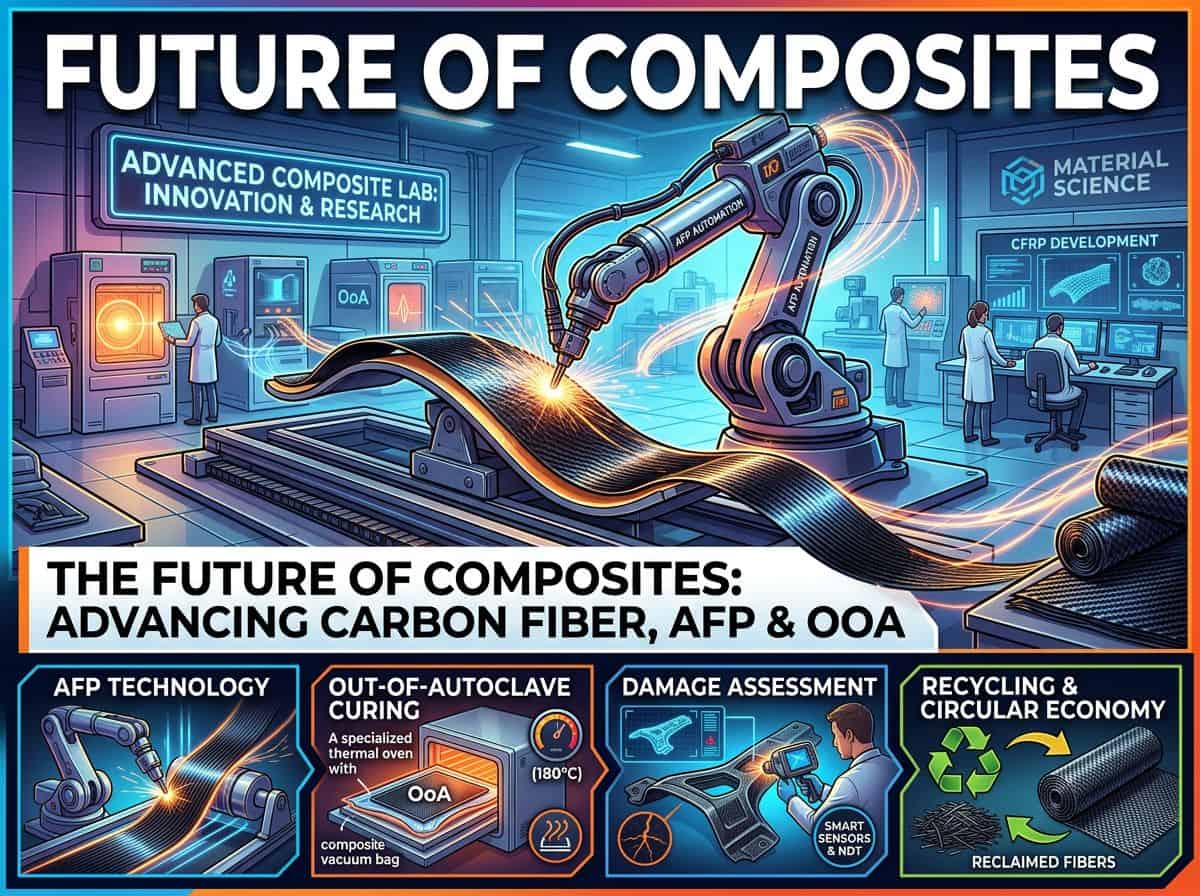

I compositi rinforzati con fibre combinano fibre di carbonio, vetro, aramide o naturali ad alta resistenza con una matrice polimerica per raggiungere una rigidità e una resistenza specifiche che i metalli non possono eguagliare. Le proprietà dipendono dall'orientamento delle fibre, dalla frazione volumetrica delle fibre e dalla qualità dell'interfaccia. Vengono utilizzati nei settori aerospaziale, dell'energia eolica, automobilistico e dei recipienti a pressione per ridurre la massa. I processi spaziano dalla laminazione di preimpregnati con polimerizzazione in autoclave allo stampaggio a trasferimento di resina, all'infusione sottovuoto, all'avvolgimento di filamenti e alla pultrusione.
La velocità di produzione e la fine del ciclo di vita rappresentano i principali vincoli. Il posizionamento automatizzato delle fibre e la deposizione del nastro migliorano la ripetibilità, mentre la polimerizzazione fuori autoclave e i termoplastici a fibra continua riducono i tempi di ciclo e consentono la saldatura. Delaminazione, danni da impatto e fatica rimangono difficili da prevedere e ispezionare. Il riciclo tramite pirolisi, solvolisi o lavorazione meccanica consente di recuperare fibre con proprietà ridotte. Le pubblicazioni e i brevetti indicizzati di seguito trattano materiali, processi di produzione, meccanica del danno, ispezione e percorsi di riciclo.
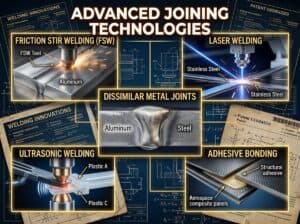
I materiali compositi combinano una fibra resistente con una matrice legante, quindi accanto a questa dovrebbero esserci due pagine dedicate ai polimeri: termoindurenti per resine reticolate e termoplastici per matrici riciclabili. Le strutture di aerei e razzi sono seguite in aeronauticaPoiché i materiali compositi sono difficili da unire, saldatura e giunzione vale anche la pena visitarlo, e resistenza al fuoco copre una debolezza nota.
Questa è la nostra ultima selezione di pubblicazioni e brevetti mondiali in inglese sui compositi rinforzati con fibre, provenienti da numerose riviste scientifiche online, classificati e focalizzati su compositi rinforzati con fibre, polimeri rinforzati con fibre di carbonio, rinforzati con fibre di vetro, posizionamento automatico delle fibre, deposizione automatica del nastro, stampaggio a trasferimento di resina, infusione sottovuoto, preimpregnati, polimerizzazione fuori autoclave, avvolgimento di filamenti, pultrusione, compositi termoplastici a fibra continua, delaminazione dei compositi, taglio interlaminare, riciclaggio dei compositi, recupero delle fibre tramite pirolisi, compositi a fibra naturale, frazione volumetrica delle fibre, fatica dei compositi e composti per stampaggio a foglio.
Vacuum infusion bag film structure for wind turbine blades
Patent published on the 2026-11-11 in EP under Ref EP4837731 by ENVISION ENERGY CO LTD [CN] (Chen Yabo [cn], Chen Weiliang [cn], Yan Xu [cn])
Abstract: The present disclosure discloses a vacuum infusion bag film structure for wind turbine blades. The vacuum infusion bag film structure for the wind turbine blades includes at least one bag film, which includes a substrate layer and a thermochromic layer, where the thermochromic layer is arranged on the substrate layer or embedded within the substrate layer. The thermochromic layer is configured to change color in response to temperature change to monitor local temperature anomaly during a vacuum [...]
Our summary: The vacuum infusion bag film structure includes a substrate layer and a thermochromic layer. The thermochromic layer changes color in response to temperature changes to monitor anomalies. This structure enables real-time visual temperature monitoring during the heating and curing processes of wind turbine blades.
vacuum infusion, thermochromic layer, wind turbine blades, temperature monitoring
Patent
Resin composition, cured product, resin composite sheet, prepreg, metal foil–clad laminate, printed wiring board, and semiconductor device
Patent published on the 2026-10-29 in WO under Ref WO2026225465 by MITSUBISHI GAS CHEMICAL CO [JP] (Inafune Sayaka [jp], Tokunaga Naoya [jp], Yamamoto Katsuya [jp], Kataoka Shunichi [jp], Itoh Syouichi [jp])
Abstract: Provided are a resin composition, a cured product, a resin composite sheet, a prepreg, a metal foil–clad laminate, a printed wiring board, and a semiconductor device. The glass transition temperature is measured by a dynamic mechanical analysis tensile method with a dynamic viscoelasticity analyzer according to the present disclosure. This resin composition comprises a maleimide compound (A1) having a maleimide group equivalent of 280 g/eq or more and 500 g/eq or less, a maleimide compound (A2[...]
Our summary: The resin composition includes maleimide compounds and a crosslinking agent. The cured product exhibits a glass transition temperature between 180-250°C. The method for measurement involves dynamic mechanical analysis using a viscoelasticity analyzer.
resin composition, cured product, prepreg, glass transition temperature
Patent
Glass fiber reinforced exfoliated graphene-polymer composites
Patent published on the 2026-10-15 in WO under Ref WO2026217918 by RUTGERS THE STATE UNIV OF NEW JERSEY [US] (Nosker Thomas J [us], Fei Fan [us], Lehman Richard L [us])
Abstract: The present disclosure provides novel glass fiber reinforced graphene-polymer matrix composites and methods for producing them. The disclosed compositions show improvements in mechanical properties, such as tensile and flexural strengths, while suppressing the negative effect of graphene reinforcement on impact energy absorption compared to a neat polymer or singly- reinforced composite.[...]
Our summary: Glass fiber reinforced graphene-polymer composites enhance mechanical properties. The composites improve tensile and flexural strengths. They mitigate the negative impact of graphene on energy absorption.
composites, graphene, mechanical properties, reinforcement
Patent
Thermoset-based polymer composite material, method of manufacturing and associated uses thereof
Patent published on the 2026-10-07 in EP under Ref EP4818240 by FUNDACION IMDEA MAT [ES] (Wang De-yi [es], Ao Xiang [es], Liu Yunhuan [es])
Abstract: [0001] The present invention relates to a lightweight, high-strength, fire- and ablation-resistant polymer-based composite material comprising a polymer matrix and one or more functional fillers distributed therein, and a fiber reinforcement material. Their method of manufacturing comprises performing wet layup, spray layup, wet compression molding, prepreg compression molding, resin vacuum infusion process, or resin transfer molding. Finally, the invention can be used for automotive application[...]
Our summary: The invention describes a lightweight, high-strength thermoset-based polymer composite material. It includes a polymer matrix with functional fillers and fiber reinforcement. The manufacturing methods include various molding and infusion processes, suitable for automotive battery pack systems.
thermoset, polymer composite, manufacturing method, automotive applications
Patent
Resin composition, prepreg, film with resin, metal foil with resin, metal-clad laminate, and wiring board
Patent published on the 2026-10-01 in WO under Ref WO2026205321 by PANASONIC IP MAN CO LTD [JP] (Washio Teppei, Ishikawa Yuichi, Honma Masafumi)
Abstract: The present disclosure addresses the problem of providing a resin composition capable of giving cured objects having a reduced coefficient of linear expansion, high adhesion, and excellent flame retardancy. The resin composition comprises a maleimide compound (A), a benzoxazine compound (B), an epoxy compound (C), and phosphorus-containing compounds (D). The phosphorus-containing compounds (D) include a reactive phosphorus-containing compound (D1) and an unreacted phosphorus-containing compound [...]
Our summary: The resin composition includes maleimide, benzoxazine, epoxy, and phosphorus compounds. It aims to provide cured objects with reduced linear expansion and high adhesion. The phosphorus compounds are divided into reactive and unreacted types, with a specific mass ratio.
resin composition, prepreg, flame retardancy, linear expansion
Patent
Sheet molding compound and method for producing same, and fiber-reinforced composite material and method for producing same
Patent published on the 2026-09-24 in WO under Ref WO2026197191 by MITSUBISHI CHEMICAL CORP [JP] (Umemoto Kousuke [jp])
Abstract: Provided are a sheet molding compound capable of producing a fiber-reinforced composite material excellent in heat resistance, and a method for producing the sheet molding compound. A sheet molding compound according to the present invention contains an epoxy resin composition which contains an epoxy resin (component (A)), a hydrazide compound (component (B)), and an acid anhydride (component (C)) and reinforcing fibers. The epoxy resin composition contains 5 mass parts or more of the component [...]
Our summary: The content describes a sheet molding compound for producing heat-resistant fiber-reinforced composites. It includes an epoxy resin composition with specific components, including hydrazide and acid anhydride. The method emphasizes the proportion of hydrazide to acid anhydride for optimal performance.
sheet molding compound, fiber-reinforced composite, epoxy resin, hydrazide compound
Patent
Investigating the synergistic effects of hybrid and bimodal filler networks on the out-of-plane thermal conductivity of polymer composites
Published on 2026-06-12 by Yonghyun Albert Kwon, Jaeyeon Kim, Jiseon Choi, Soojeong Jeong, Yunchan Lee, Ho Sun Lim, Jeong Ho Cho @NATURE
Abstract: Polymer Journal, Published online: 12 June 2026; doi:10.1038/s41428-026-01220-2We report a highly effective approach to improve the out-of-plane thermal conductivity of polymer prepregs by optimizing filler networks. Comparing monofiller, hybrid (h-BN/Al2O3), and bimodal (h-BN aggregates/powders) systems reveal that bimodal architectures successfully balance isotropic phonon transport with minimized interfacial thermal resistance. By utilizing chemically identical h-BN fillers with distinct morp[...]
Our summary: The study investigates the impact of hybrid and bimodal filler networks on the thermal conductivity of polymer composites. Bimodal architectures enhance phonon transport while reducing thermal resistance. The optimized prepreg achieves a thermal conductivity of 0.56 W/m·K with 25 wt% filler.
thermal conductivity, polymer composites, filler networks, bimodal systems
Publication
Morphology of poly(ether ether ketone)/poly(ether imide) blends and their application as a matrix for carbon fiber-reinforced plastic
Published on 2026-04-06 by Yusaku Oba, Hideyuki Uematsu, Ayaka Yamaguchi, Fumihiro Nishimura, Shuichi Tanoue @NATURE
Abstract: Polymer Journal, Published online: 06 April 2026; doi:10.1038/s41428-026-01162-9The dispersion state of PEEK and PEI in carbon fiber-reinforced composites with a PEEK/PEI blend matrix was investigated using micro-Raman spectroscopy and scanning electron microscopy. The results revealed a continuous coexistence, on a submicron scale, of crystalline PEEK, amorphous PEEK compatible with PEI, and isolated PEI domains near the carbon fiber surface. This submicron-scale morphology accounts for the enh[...]
Our summary: The study investigates the morphology of PEEK/PEI blends in carbon fiber-reinforced composites. Micro-Raman spectroscopy and scanning electron microscopy reveal a submicron coexistence of PEEK and PEI phases. The findings indicate improved thermal and mechanical properties due to the blending of PEI with PEEK.
polymer blends, carbon fiber, micro-Raman spectroscopy, scanning electron microscopy
Publication