Product Design, Manufacturing & Innovation Resources
Home » Young’s Modulus (Modulus of Elasticity)

Young’s Modulus (Modulus of Elasticity)

1807-01-01
  • Thomas Young
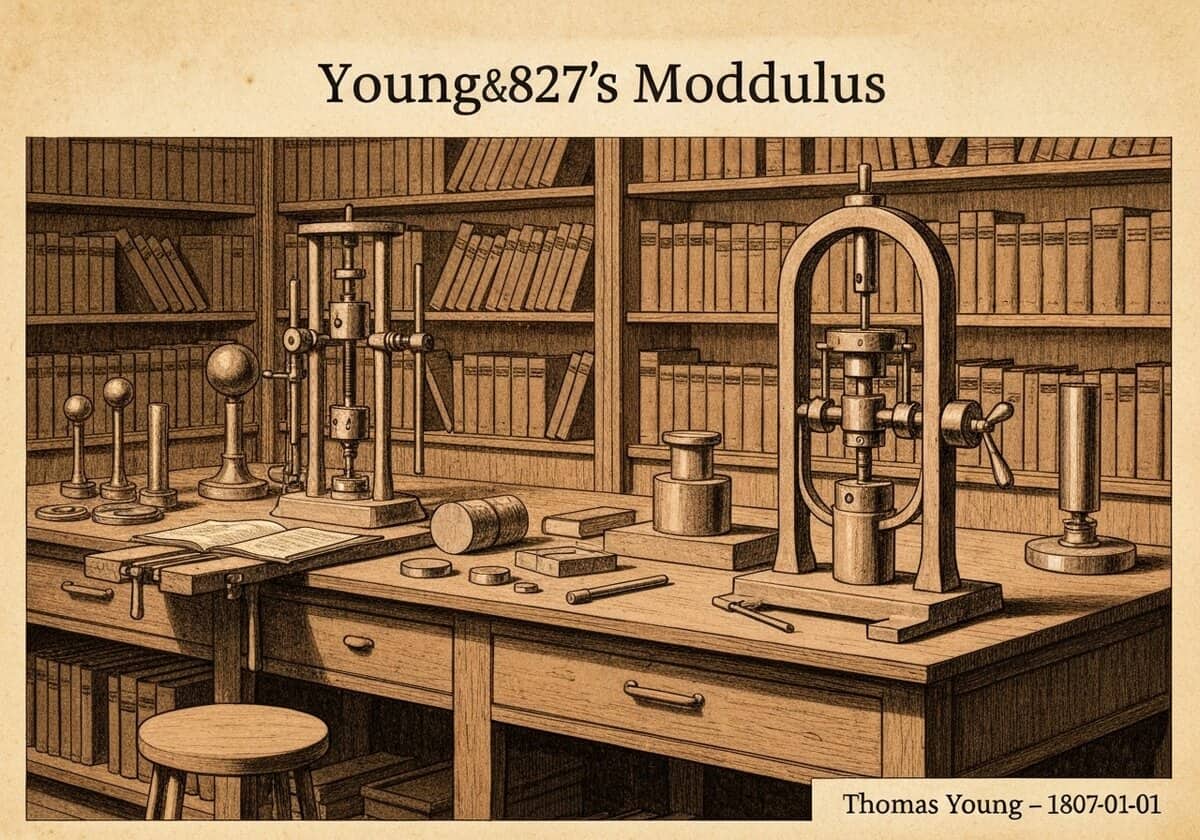
Tensile testing apparatus in a historical materials science laboratory.

(generated image for illustration only)

Young’s Modulus, denoted by E, quantifies a solid material’s stiffness. It is the ratio of tensile stress (\(\sigma\)) to extensional strain (\(\epsilon\)) in the elastic (linear) region of the stress-strain curve. This relationship is defined by Hooke’s Law: \(E = \frac{\sigma}{\epsilon}\). A higher modulus indicates a stiffer material, meaning more stress is required for a given amount of elastic deformation.


Young’s Modulus is a fundamental property intrinsic to a material, assuming it is isotropic and linear elastic. It is determined from the slope of the initial, straight-line portion of a stress-strain curve obtained during tensile testing. This region is known as the elastic region, where the material will return to its original shape if the load is removed. The formula \(E = \frac{\sigma}{\epsilon} = \frac{F/A_0}{\Delta L/L_0}\) relates stress (force F per initial cross-sectional area A₀) to strain (change in length ΔL over original length L₀). The concept originates from Hooke’s Law, which states that for relatively small deformations, the force required to stretch or compress a spring is directly proportional to the distance of that extension or compression. Thomas Young elaborated on this concept in the early 19th century, applying it to the intrinsic properties of materials rather than just the behavior of an object like a spring. This was a crucial step in moving from empirical observations to a quantitative science of materials. The modulus is temperature and pressure dependent, but for many engineering applications at standard conditions, it is treated as a constant. It is a critical parameter for predicting how a component will deform under load, essential for designing safe and reliable structures, from bridges to microchips.

UNESCO Nomenclature: 3313
– Materials science

Type

Physical Property

Disruption

Foundational

Usage

Widespread Use

Precursors

  • Robert Hooke’s law of elasticity (1678)
  • Leonhard Euler’s work on the buckling of columns (1757)
  • development of the concept of stress and strain

Applications

  • structural engineering for calculating beam deflection
  • finite element analysis (FEA) simulations
  • design of springs and fasteners
  • aerospace engineering for material selection
  • biomechanics for modeling bone and tissue

Patents:

NA

Potential Innovations Ideas

Due to scrapping bot traffic, currently more than 40k per day, this content is reserved to community members.
> Login < or > Register < (100% free) to access this, so as all other restricted content and tools.

Related to: Young’s modulus, elasticity, stiffness, stress, strain, Hooke’s law, tensile testing, material property, mechanical engineering, solid mechanics.

Historical Context

Young’s Modulus (Modulus of Elasticity)

-500
1700
1761
1807-01-01
1850
1850
1850
-250
-500
1750
1788
1834
1850
1850
1850

(if date is unknown or not relevant, e.g. "fluid mechanics", a rounded estimation of its notable emergence is provided)

Related Invention, Innovation & Technical Principles

Full size images and downloads are only available, 100% free, for registered members.

> Login <