Product Design, Manufacturing & Innovation Resources
Home » Shear-Thinning (Pseudoplasticity)

Shear-Thinning (Pseudoplasticity)

1925
  • Wilhelm Ostwald
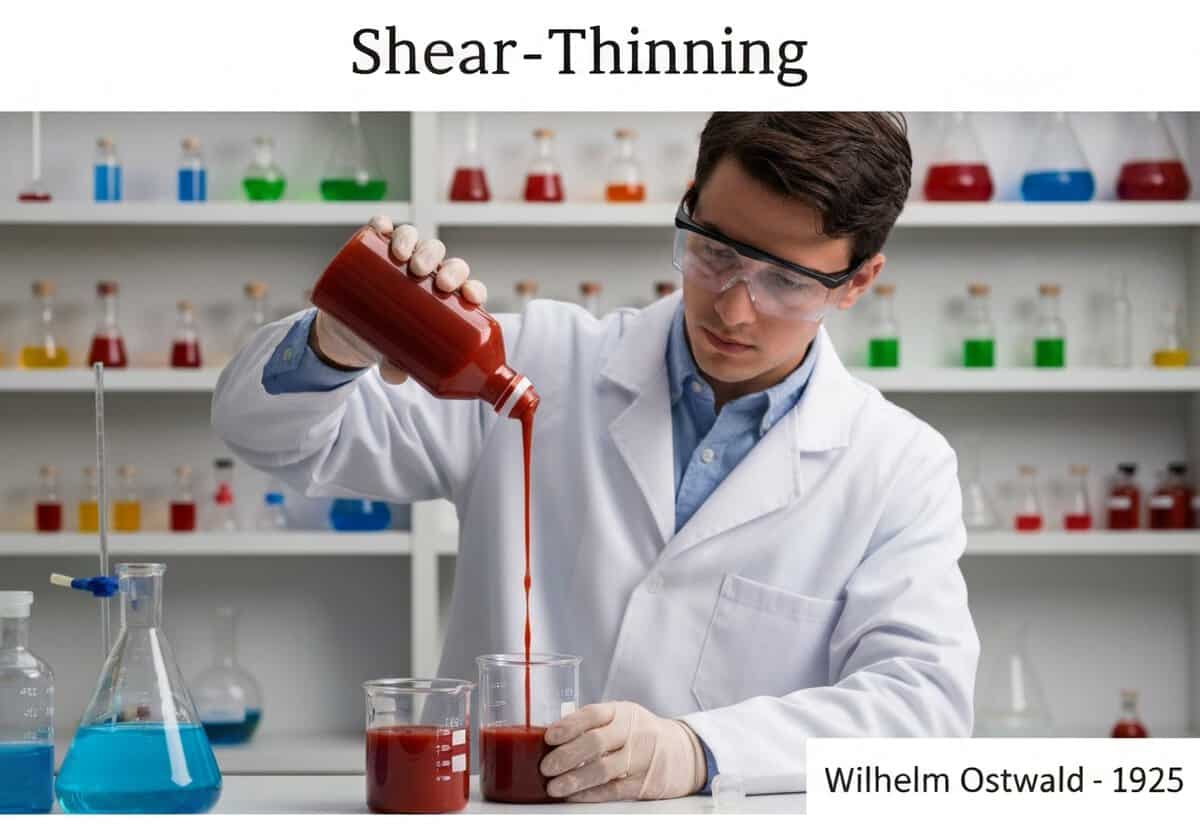
Demonstration of shear-thinning behavior in a laboratory with ketchup.

(generated image for illustration only)

Shear-thinning, or pseudoplasticity, is a non-Newtonian behavior where a fluid’s viscosity decreases with an increasing rate of shear stress. Many common substances, like ketchup or paint, exhibit this property. At rest, they are thick, but they flow more easily when shaken, stirred, or spread. This is often modeled by the Ostwald–de Waele power-law relationship.


Shear-thinning behavior is typically caused by the alignment of the fluid’s internal structure under shear. In polymer solutions, for instance, long-chain molecules are randomly coiled and entangled at rest, leading to high viscosity. When shear is applied, these chains begin to untangle and align in the direction of flow. This alignment reduces the interactions and friction between the molecules, causing a decrease in the apparent viscosity. The more the fluid is sheared, the more aligned the molecules become, and the lower the viscosity gets, until it potentially reaches a lower plateau.

This property is highly desirable in many applications. For example, paint should be thick enough in the can to prevent pigments from settling and to avoid dripping from the brush (low shear), but it must flow easily when brushed onto a surface (high shear). Similarly, printing inks need to flow from the printing press onto the paper but then stay put without smudging. In the food industry, products like yogurt and cream are designed to feel thick in the mouth (low shear) but be easy to swallow (higher shear). The opposite of shear-thinning is shear-thickening, where viscosity increases with shear rate.

UNESCO Nomenclature: 2210
– Mechanics

Type

Physical Property

Disruption

Substantial

Usage

Widespread Use

Precursors

  • Observation of anomalous viscosity in colloids and polymer solutions
  • Development of viscometers capable of measuring viscosity at different shear rates
  • Newton’s law of viscosity as a baseline for comparison

Applications

  • paints that are thick in the can but spread easily with a brush
  • ketchup that flows easily from the bottle when shaken
  • nail polish that applies smoothly but stays on the nail
  • blood circulation, as blood is a shear-thinning fluid
  • drilling muds that are easily pumped but can suspend rock cuttings at rest

Patents:

NA

Potential Innovations Ideas

  • self-leveling floor compounds that flow easily when poured but set quickly
  • sprayable coatings for electronics that are thin during application but form a thick protective layer
  • advanced firefighting foams that can be pumped easily but cling to vertical surfaces
  • cosmetic creams that spread effortlessly on the skin but feel rich and thick
  • injectable hydrogels for tissue engineering that flow through a needle but solidify in place
  • lubricants for high-speed machinery that thin out to reduce friction during operation
  • smart adhesives that are easy to apply but have high holding strength
  • culinary foams that are stable but have a light mouthfeel
Related to: shear-thinning, pseudoplastic, viscosity, rheology, polymer solutions, ketchup, paint, power-law fluid.

Historical Context

Shear-Thinning (Pseudoplasticity)

1921
1922
1924
1925
1926
1926
1927
1920
1921
1924
1924
1925
1926
1927
1927

(if date is unknown or not relevant, e.g. "fluid mechanics", a rounded estimation of its notable emergence is provided)

10th year anniversary

Full size images and downloads are only available, 100% free, for registered members.

> Login <