Rational Numbers
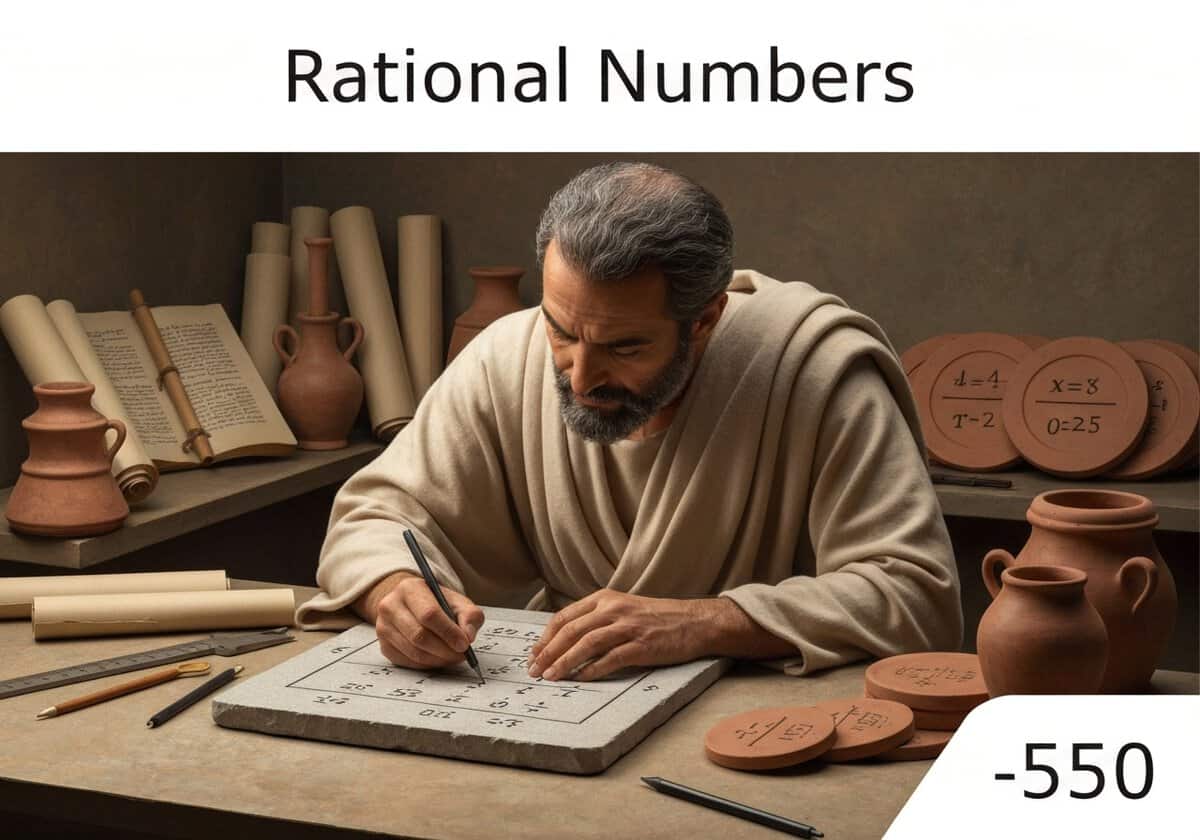
A rational number is any number that can be expressed as a fraction or quotient \(p/q\), where \(p\) is an integer and \(q\) is a non-zero integer. The set of all rational numbers is denoted by \(\mathbb{Q}\). This fundamental concept extends the integers to include fractions, allowing for the representation of parts of a whole.
The concept of a rational number arises from the need to measure quantities that are not whole multiples of a unit. In mathematics, it formalizes the idea of a ratio between two integers. A rational number is formally defined as an equivalence class of ordered pairs of integers \((p, q)\) with \(q \neq 0\). The equivalence relation is defined as \((p_1, q_1) \sim (p_2, q_2)\) if and only if \(p_1 q_2 = p_2 q_1\). This means, for example, that the fractions 1/2, 2/4, and -3/-6 all represent the same rational number.
Every integer is a rational number, since any integer \(n\) can be written as the fraction \(n/1\). The set of rational numbers, denoted by \(\mathbb{Q}\) (for ‘quotient’), is therefore a superset of the integers \(\mathbb{Z}\). Unlike integers, rational numbers are not uniquely represented; each rational number has infinitely many fractional forms. The form where \(p\) and \(q\) are coprime (have no common divisors other than 1) and \(q > 0\) is called the canonical or lowest terms representation.
The development of this concept was not immediate. Ancient Egyptians used a system of unit fractions, but the Greeks, particularly the Pythagoreans, were among the first to systematically study ratios of integers. Their worldview was shaken by the discovery of irrational numbers, such as the square root of 2, which could not be expressed as such a ratio. This discovery highlighted the distinction between rational and irrational numbers, a cornerstone of number theory.
UNESCO Nomenclature: 1101
– Algebra, Number theory and Group theory
Precursors
- concept of integers
- operation of division
- ancient egyptian use of unit fractions
- babylonian sexagesimal system for fractions
Applications
- measurement and scaling in engineering and science
- financial calculations involving fractions of units
- computer programming data types for precise arithmetic
- music theory for representing intervals and harmonies
- probability theory for defining event likelihoods
Potential Innovations Ideas
Due to scrapping bot traffic, currently more than 40k per day, this content is reserved to community members.
> Login < or > Register < (100% free) to access this, so as all other restricted content and tools.
Related to: rational number, fraction, integer, quotient, ratio, number theory, mathematics, p/q, set Q, arithmetic.