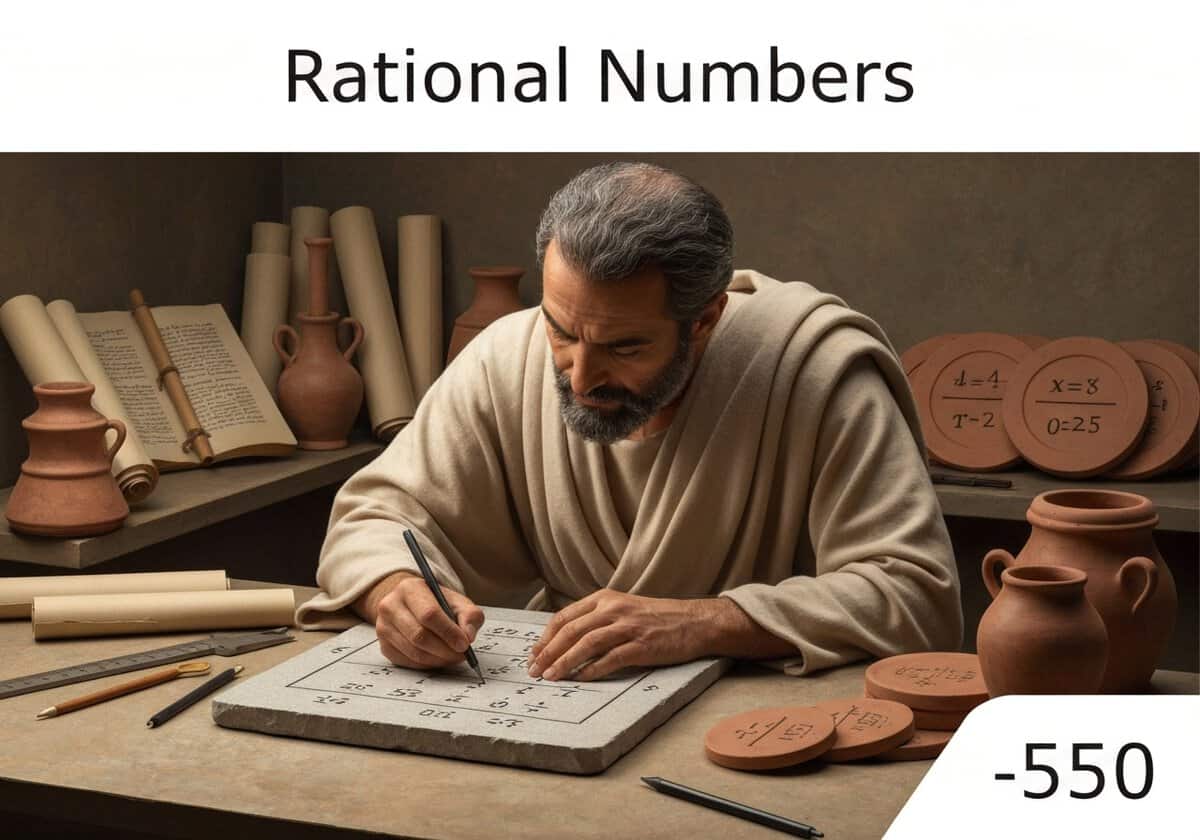
भिन्नात्मक संख्याएं
परिमेय संख्या वह संख्या है जिसे भिन्न या भागफल [latex]p/q[/latex] के रूप में व्यक्त किया जा सकता है, जहाँ [latex]p[/latex] एक पूर्णांक है और [latex]q[/latex] एक गैर-शून्य पूर्णांक है। सभी परिमेय संख्याओं के समुच्चय को [latex]mathbb{Q}[/latex] से दर्शाया जाता है। यह मूलभूत अवधारणा पूर्णांकों को भिन्नों तक विस्तारित करती है, जिससे किसी पूर्ण संख्या के भागों को निरूपित करना संभव हो जाता है।
The concept of a rational number arises from the need to measure quantities that are not whole multiples of a unit. In mathematics, it formalizes the idea of a ratio between two integers. A rational number is formally defined as an equivalence class of ordered pairs of integers [latex](p, q)[/latex] with [latex]q \neq 0[/latex]. The equivalence relation is defined as [latex](p_1, q_1) \sim (p_2, q_2)[/latex] if and only if [latex]p_1 q_2 = p_2 q_1[/latex]. This means, for example, that the fractions 1/2, 2/4, and -3/-6 all represent the same rational number.
Every integer is a rational number, since any integer [latex]n[/latex] can be written as the fraction [latex]n/1[/latex]. The set of rational numbers, denoted by [latex]\mathbb{Q}[/latex] (for ‘quotient’), is therefore a superset of the integers [latex]\mathbb{Z}[/latex]. Unlike integers, rational numbers are not uniquely represented; each rational number has infinitely many fractional forms. The form where [latex]p[/latex] and [latex]q[/latex] are coprime (have no common divisors other than 1) and [latex]q > 0[/latex] is called the canonical or lowest terms representation.
इस अवधारणा का विकास तुरंत नहीं हुआ था। प्राचीन मिस्रवासी इकाई भिन्नों की प्रणाली का उपयोग करते थे, लेकिन यूनानी, विशेषकर पाइथागोरस के अनुयायी, पूर्णांकों के अनुपातों का व्यवस्थित अध्ययन करने वाले पहले लोगों में से थे। 2 के वर्गमूल जैसी अपरिमेय संख्याओं की खोज ने उनके विश्वदृष्टिकोण को झकझोर दिया, क्योंकि इन्हें ऐसे अनुपात के रूप में व्यक्त नहीं किया जा सकता था। इस खोज ने परिमेय और अपरिमेय संख्याओं के बीच अंतर को उजागर किया, जो संख्या सिद्धांत की आधारशिला है।
UNESCO Nomenclature: 1101
बीजगणित, संख्या सिद्धांत और समूह सिद्धांत
शगुन
- पूर्णांकों की अवधारणा
- विभाजन का संचालन
- प्राचीन मिस्रवासियों द्वारा इकाई भिन्नों का उपयोग
- भिन्नों के लिए बेबीलोनियन षट्दशमलव प्रणाली
आवेदन
- इंजीनियरिंग और विज्ञान में मापन और मापन
- इकाइयों के अंशों से संबंधित वित्तीय गणनाएँ
- सटीक अंकगणित के लिए कंप्यूटर प्रोग्रामिंग डेटा प्रकार
- अंतरालों और सामंजस्यों को दर्शाने के लिए संगीत सिद्धांत
- घटनाओं की संभावनाओं को परिभाषित करने के लिए संभाव्यता सिद्धांत
संभावित नवाचार विचार
बॉट ट्रैफिक को कम करने के कारण, जो वर्तमान में प्रति दिन 40,000 से अधिक है, यह सामग्री केवल समुदाय के सदस्यों के लिए आरक्षित है।
> लॉगिन < या > रजिस्टर < इस सामग्री और अन्य सभी प्रतिबंधित सामग्रियों और उपकरणों तक पहुंच (100% निःशुल्क) है।
Related to: rational number, fraction, integer, quotient, ratio, number theory, mathematics, p/q, set Q, arithmetic.