Product Design, Manufacturing & Innovation Resources
Home » Proof Stress

Proof Stress

1920
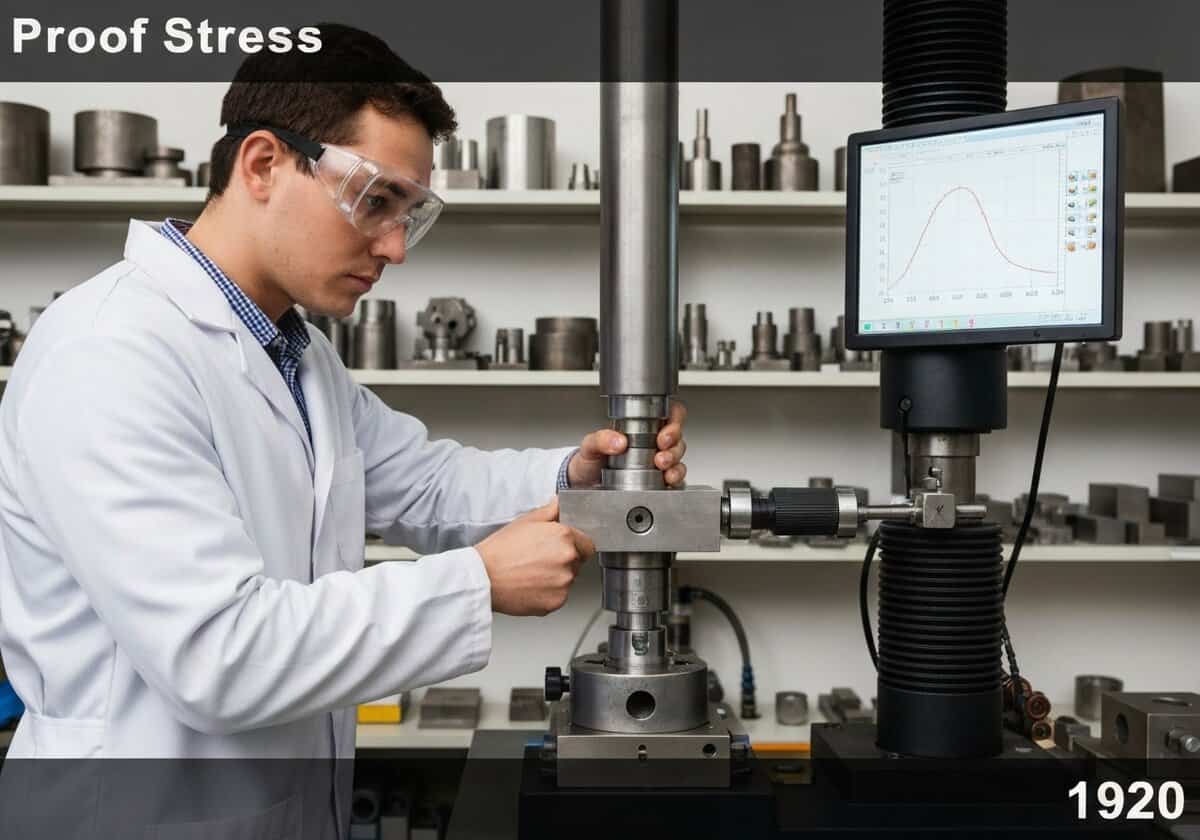
Tensile testing of high-strength steel to determine proof stress in materials science.

(generated image for illustration only)

For materials that do not have a distinct yield point on their stress-strain curve, like aluminum or high-strength steel, ‘proof stress’ is the engineering equivalent. It is defined as the stress required to produce a small, specified amount of permanent (plastic) deformation, typically 0.2% of the original gauge length. This value, \(\sigma_{0.2}\), is used in design calculations as the material’s practical elastic limit.
Many engineering materials, particularly ductile metals like aluminum alloys, copper alloys, and certain types of steel, do not exhibit the clear, sudden yielding behavior seen in mild steel. Their stress-strain curve transitions from elastic to plastic behavior gradually. For design and safety purposes, engineers need a consistent point to define the onset of permanent deformation. This is where proof stress, also known as offset yield strength, becomes crucial. To determine it, a tensile test is performed while plotting stress versus strain. A line is drawn on this graph parallel to the initial linear (elastic) portion of the curve, but offset from the origin by a specified strain value, most commonly 0.2% (or 0.002 strain). The stress at which this offset line intersects the stress-strain curve is defined as the 0.2% proof stress (\(\sigma_{0.2}\)).

This value is a practical and reproducible measure of the material’s elastic limit. It signifies that if the material is loaded to this stress level and then unloaded, it will have undergone a permanent deformation of 0.2%. While some plastic deformation has occurred, it is considered small enough to be acceptable for many structural applications. This convention allows engineers to design components using materials without a sharp yield point with the same safety and reliability principles as those with one, ensuring that structures do not permanently deform under their design loads.

UNESCO Nomenclature: 3322
– Materials science

Type

Material Property

Disruption

Substantial

Usage

Widespread Use

Precursors

  • hooke’s law of elasticity
  • development of the tensile testing machine
  • the concept of stress and strain
  • the need to characterize the mechanical properties of new alloys developed in the late 19th and early 20th centuries

Applications

  • material specification for aerospace alloys
  • design of automotive components
  • structural engineering calculations for buildings and bridges
  • quality control in metal production
  • finite element analysis (fea) material models

Patents:

NA

Potential Innovations Ideas

Due to scrapping bot traffic, currently more than 40k per day, this content is reserved to community members.
> Login < or > Register < (100% free) to access this, so as all other restricted content and tools.

Related to: proof stress, offset yield strength, stress-strain curve, plastic deformation, elastic limit, tensile testing, materials science, ductility, 0.2% offset, yield point.

Historical Context

Proof Stress

1910
1910
1920
1920
1920
1922
1925-01-01
1910
1910
1920
1920
1920
1922
1924
1927

(if date is unknown or not relevant, e.g. "fluid mechanics", a rounded estimation of its notable emergence is provided)

Related Invention, Innovation & Technical Principles

Full size images and downloads are only available, 100% free, for registered members.

> Login <