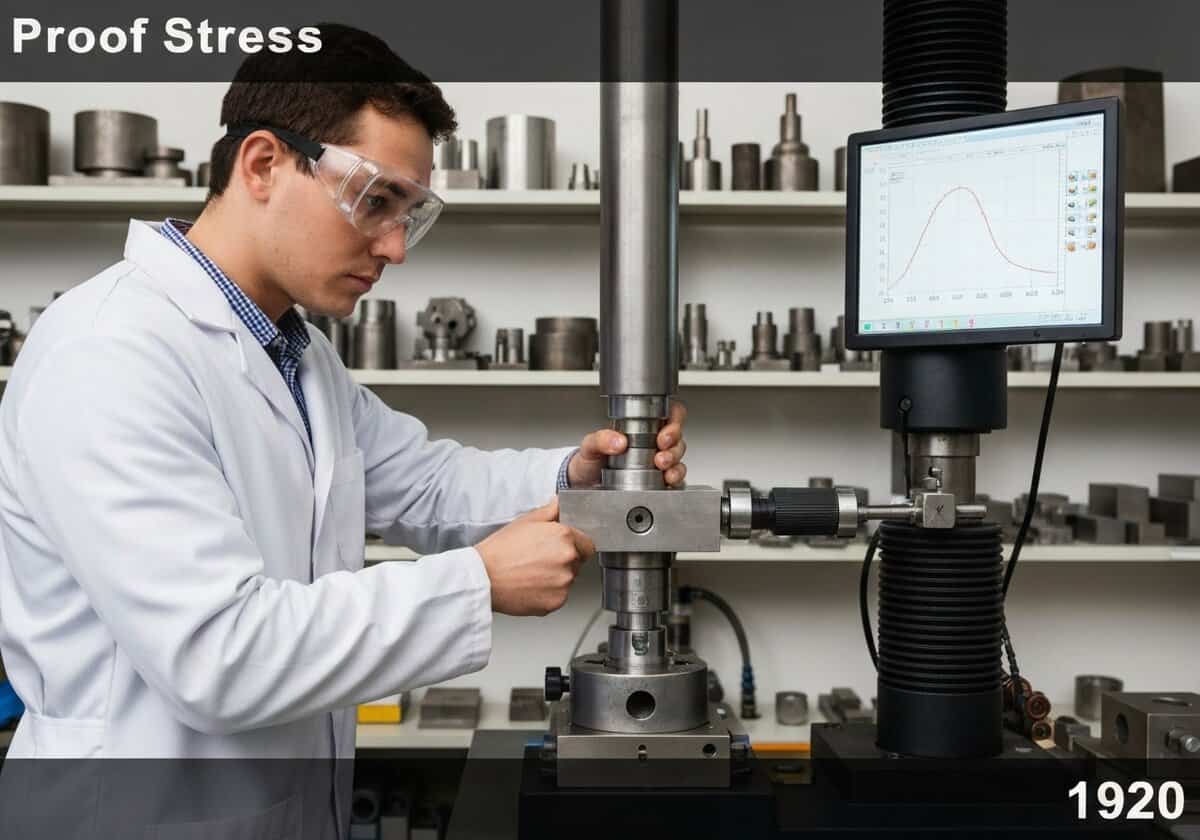
Many engineering materials, particularly ductile metals like aluminum alloys, copper alloys, and certain types of steel, do not exhibit the clear, sudden yielding behavior seen in mild steel. Their stress-strain curve transitions from elastic to plastic behavior gradually. For design and safety purposes, engineers need a consistent point to define the onset of permanent deformation. This is where proof stress, also known as offset yield strength, becomes crucial. To determine it, a tensile test is performed while plotting stress versus strain. A line is drawn on this graph parallel to the initial linear (elastic) portion of the curve, but offset from the origin by a specified strain value, most commonly 0.2% (or 0.002 strain). The stress at which this offset line intersects the stress-strain curve is defined as the 0.2% proof stress ([latex]\sigma_{0.2}[/latex]).