뚜렷한 특징이 없는 재료의 경우 항복점 알루미늄이나 고강도 강철과 같은 재료의 응력-변형률 곡선에서 '항복응력'은 공학적으로 동등한 개념입니다. 항복응력은 다음과 같이 정의됩니다. 스트레스 일반적으로 원래 게이지 길이의 0.2%에 해당하는 작고 지정된 양의 영구적(소성) 변형을 발생시키는 데 필요합니다. 이 값, [latex]sigma_{0.2}[/latex]는 설계 계산에서 재료의 실제 탄성 한계로 사용됩니다.

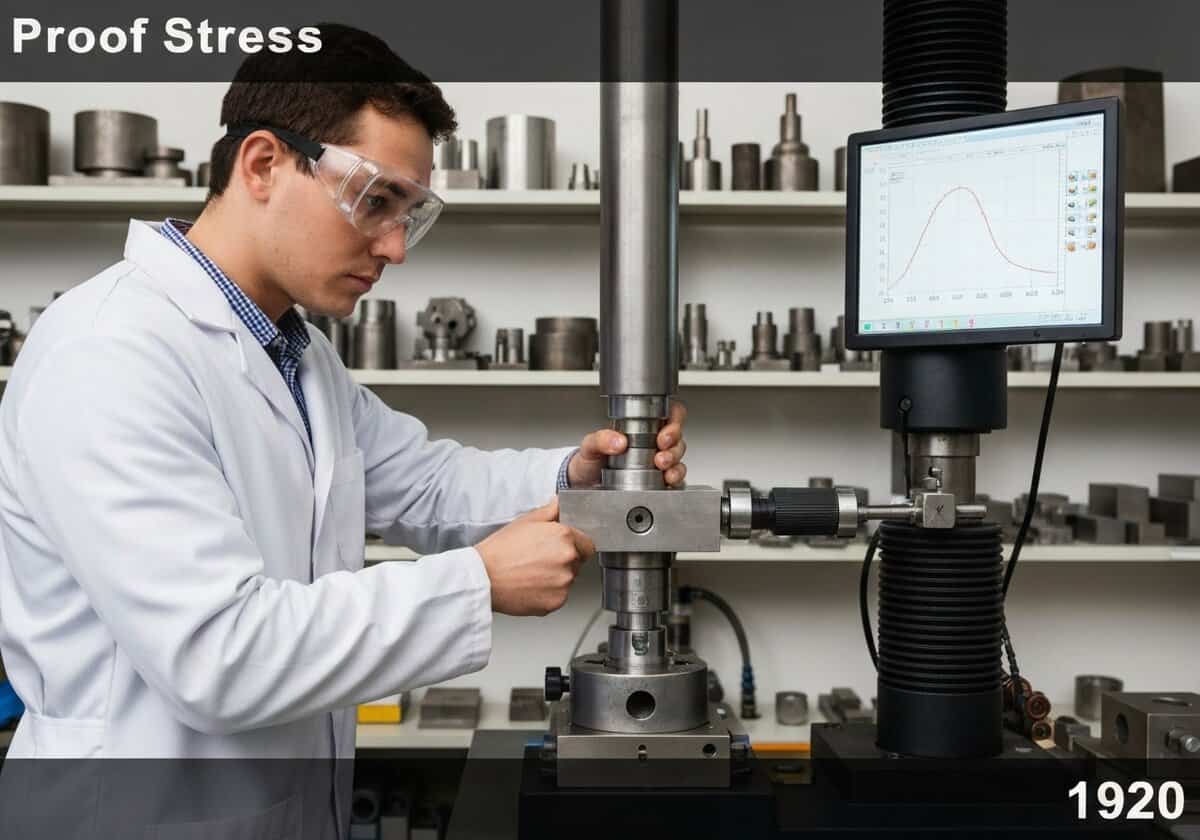
(설명을 위한 생성된 이미지입니다)
뚜렷한 특징이 없는 재료의 경우 항복점 알루미늄이나 고강도 강철과 같은 재료의 응력-변형률 곡선에서 '항복응력'은 공학적으로 동등한 개념입니다. 항복응력은 다음과 같이 정의됩니다. 스트레스 일반적으로 원래 게이지 길이의 0.2%에 해당하는 작고 지정된 양의 영구적(소성) 변형을 발생시키는 데 필요합니다. 이 값, [latex]sigma_{0.2}[/latex]는 설계 계산에서 재료의 실제 탄성 한계로 사용됩니다.

Many engineering materials, particularly ductile metals like aluminum alloys, copper alloys, and certain types of steel, do not exhibit the clear, sudden yielding behavior seen in mild steel. Their stress-strain curve transitions from elastic to plastic behavior gradually. For design and safety purposes, engineers need a consistent point to define the onset of permanent deformation. This is where proof stress, also known as offset yield strength, becomes crucial. To determine it, a tensile test is performed while plotting stress versus strain. A line is drawn on this graph parallel to the initial linear (elastic) portion of the curve, but offset from the origin by a specified strain value, most commonly 0.2% (or 0.002 strain). The stress at which this offset line intersects the stress-strain curve is defined as the 0.2% proof stress ([latex]\sigma_{0.2}[/latex]).
이 값은 재료의 탄성 한계를 나타내는 실용적이고 재현 가능한 척도입니다. 즉, 재료에 이 응력 수준까지 하중을 가한 후 제거하면 0.2%의 영구 변형이 발생한다는 것을 의미합니다. 소성 변형이 발생했지만, 많은 구조물에 적용하기에 허용 가능한 수준입니다. 이러한 기준을 통해 엔지니어는 항복점이 뚜렷하지 않은 재료를 사용하더라도 항복점이 있는 재료와 동일한 안전 및 신뢰성 원칙을 적용하여 구조물이 설계 하중 하에서 영구 변형되지 않도록 설계할 수 있습니다.
현재 하루 4만 건이 넘는 봇 트래픽을 차단하기 위해 이 콘텐츠는 커뮤니티 회원만 이용할 수 있습니다.
> 로그인 < 또는 >등록 < 이 콘텐츠를 비롯한 모든 제한된 콘텐츠와 도구는 (100% 무료로) 이용할 수 있습니다.
응력 증명
(날짜를 알 수 없거나 관련이 없는 경우, 예를 들어 "유체역학"의 경우, 주목할 만한 등장 시기를 대략적으로 추정하여 제공합니다.)
고화질 이미지 및 다운로드는 등록된 회원에게만 100% 무료로 제공됩니다.
> 로그인 <