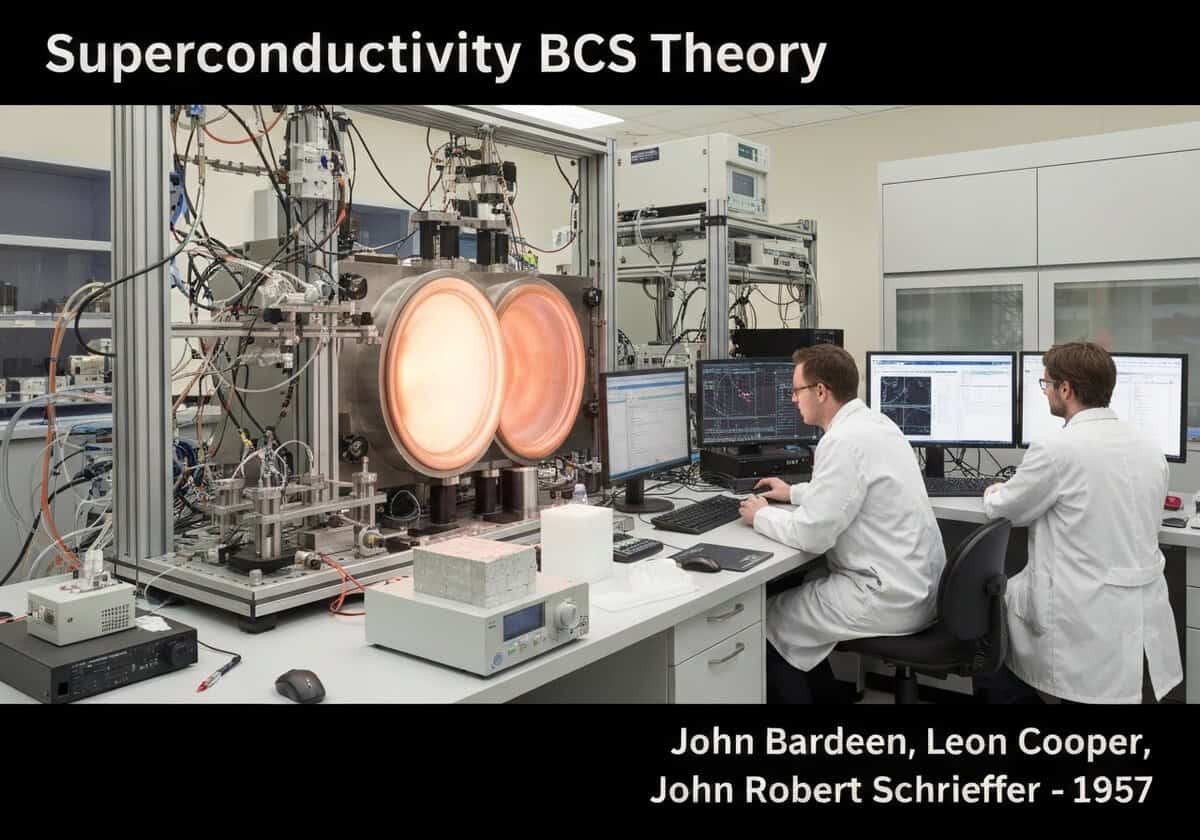
Developed in 1957 by John Bardeen, Leon Cooper, and Robert Schrieffer, the BCS theory provides a microscopic explanation for conventional superconductivity. It posits that below the critical temperature (\(T_c\)), electrons can overcome their electrostatic repulsion and form bound pairs, called Cooper pairs, through interactions with the crystal lattice (phonons). These pairs behave as bosons and can condense into a single macroscopic quantum state.