Product Design, Manufacturing & Innovation Resources
Home » Cleanroom Airflow Principles: Laminar and Turbulent Flow

Cleanroom Airflow Principles: Laminar and Turbulent Flow

1960
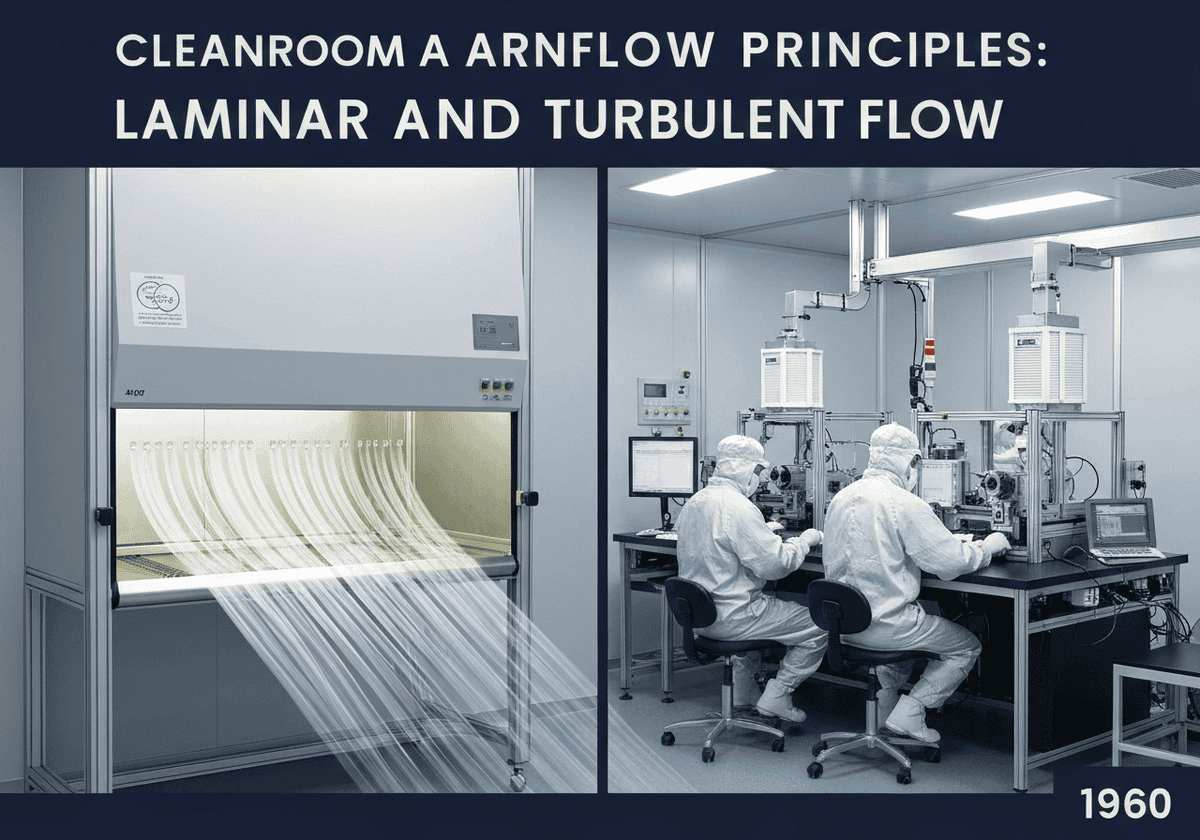
Cleanroom airflow systems demonstrating laminar and turbulent flow principles in semiconductor applications.

(generated image for illustration only)

Cleanrooms utilize two primary airflow principles to control contamination. Turbulent (or non-unidirectional) flow involves mixed air streams, suitable for less stringent classes (ISO 6-9). Laminar (or unidirectional) flow uses parallel, constant-velocity air streams to sweep particles out of the environment, essential for high-purity applications like ISO 1-5, preventing cross-contamination and ensuring rapid particle removal.

The choice between turbulent and laminar airflow is a fundamental design decision in cleanroom engineering, driven by the required cleanliness level and cost constraints. Turbulent flow rooms, the more conventional design, supply HEPA-filtered air from ceiling-mounted diffusers. The air enters the room, mixes with the existing air, and removes contaminants as it exits through low-level exhausts. While effective for many applications, the random air currents can create eddies where particles may linger or settle.

In contrast, laminar flow, also known as unidirectional flow, creates a predictable, uniform movement of air. In a vertical laminar flow room, the entire ceiling is composed of HEPA or ULPA filters, and the air travels straight down to a perforated raised floor, acting like a massive, slow-moving piston that pushes particles out. This design provides the highest level of air cleanliness by minimizing the time a particle can remain airborne and preventing lateral movement of contaminants. Horizontal laminar flow systems are also used, where air moves from a filtered wall to an exhaust wall. While significantly more expensive to build and operate due to the large filter area and high air-change rates, laminar flow is non-negotiable for processes like microchip fabrication where a single sub-micron particle can destroy a device.

UNESCO Nomenclature: 2210
– Mechanics

Type

Physical Device

Disruption

Revolutionary

Usage

Widespread Use

Precursors

  • principles of fluid dynamics (Bernoulli’s principle, Reynolds number)
  • development of HEPA filtration technology
  • Willis Whitfield’s invention of the modern cleanroom
  • understanding of airborne particle transport mechanisms

Applications

  • semiconductor photolithography bays
  • sterile filling lines in pharmaceutical production
  • operating theaters for sensitive surgeries
  • satellite assembly and integration facilities
  • biological safety cabinets

Patents:

  • US3158457A

Potential Innovations Ideas

  • hybrid airflow systems that switch between laminar and turbulent modes to save energy
  • computational fluid dynamics (CFD) software for optimizing airflow in complex cleanroom geometries
  • ‘air curtain’ barriers using focused laminar flow to isolate specific zones without physical walls
  • self-adjusting airflow systems that respond to real-time particle counts
  • ultrasonic airflow modulation for targeted particle manipulation
  • plasma-based air purification integrated directly into laminar flow plenums
  • wearable sensors for personnel that map airflow disruption patterns
  • acoustic dampening materials integrated into filter housings to reduce noise in laminar flow systems
Related to: laminar flow, turbulent flow, unidirectional airflow, contamination control, cleanroom design, fluid dynamics, HEPA filter, particle removal.

Historical Context

Cleanroom Airflow Principles: Laminar and Turbulent Flow

1959-11
1960
1960
1960
1960
1960
1960
1958
1960
1960
1960
1960
1960
1960
1960

(if date is unknown or not relevant, e.g. "fluid mechanics", a rounded estimation of its notable emergence is provided)

10th year anniversary

Full size images and downloads are only available, 100% free, for registered members.

> Login <