Product Design, Manufacturing & Innovation Resources
Home » Kanban System

Kanban System

1950
  • Taiichi Ohno
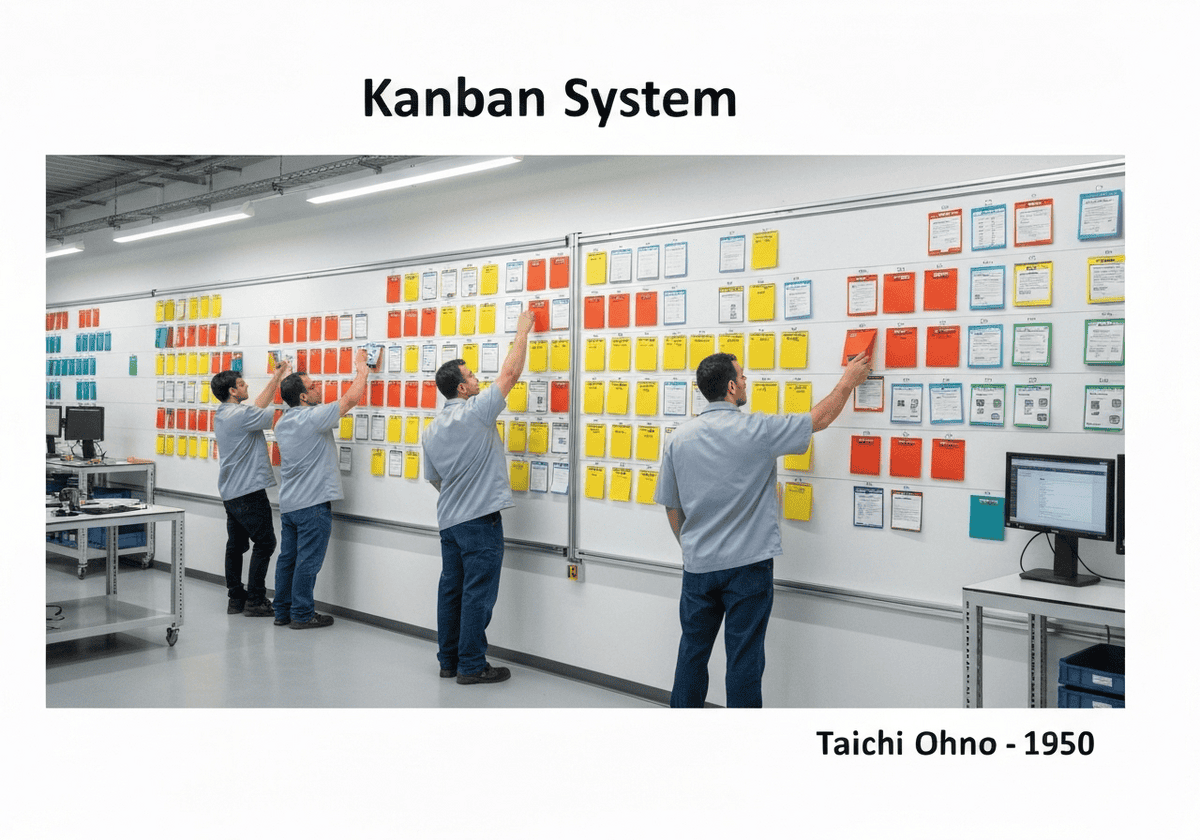
Kanban system in a manufacturing facility with visual cards managing workflow.

(generated image for illustration only)

Kanban, meaning “visual card” or “signboard” in Japanese, is a scheduling system integral to the Toyota Production System. It uses visual cues, typically cards, to trigger action and manage workflow. It is a “pull” system that signals the need to move materials within a manufacturing facility or from an outside supplier into the production facility.


The Kanban system was developed by Taiichi Ohno at Toyota to achieve Just-in-Time (JIT) manufacturing. The core idea is to limit the amount of work-in-progress (WIP) to avoid overproduction, a primary form of waste. In its simplest form, a Kanban card is attached to a container of parts. When a worker at a downstream station begins using parts from that container, they take the Kanban card and place it in a designated collection box. This card then serves as a signal to the upstream process to produce another container of the same parts.

There are two main types of Kanbans: a Production Kanban, which authorizes the production of a new batch of parts, and a Withdrawal (or Conveyance) Kanban, which authorizes the movement of parts from one workstation to another. The number of Kanban cards in circulation for a particular part directly controls the maximum amount of inventory for that part in the system. By carefully managing the number of cards, managers can control the flow and reduce WIP. The system’s visual nature makes it easy for everyone to understand the status of work and identify bottlenecks. This simplicity and visual control are key to its effectiveness in creating a smooth, efficient production flow.

UNESCO Nomenclature: 3306
– Industrial Engineering

Type

Abstract System

Disruption

Revolutionary

Usage

Widespread Use

Precursors

  • american supermarket inventory replenishment methods
  • two-bin inventory systems
  • the need for a simple signaling mechanism for just-in-time

Applications

  • Agile and SCRUM software development (kanban boards like trello, jira)
  • personal task management (to-do, doing, done lists)
  • content marketing workflow management
  • hospital patient flow management
  • supply chain inventory control systems

Patents:

NA

Potential Innovations Ideas

Due to scrapping bot traffic, currently more than 40k per day, this content is reserved to community members.
> Login < or > Register < (100% free) to access this, so as all other restricted content and tools.

Related to: kanban, visual signal, pull system, lean manufacturing, JIT, toyota production system, workflow management, WIP limit.

Historical Context

Kanban System

1940
1948
1950
1950
1950
1950
1950
1940
1945-01-01
1949
1950
1950
1950
1950
1950

(if date is unknown or not relevant, e.g. "fluid mechanics", a rounded estimation of its notable emergence is provided)

Related Invention, Innovation & Technical Principles

Full size images and downloads are only available, 100% free, for registered members.

> Login <