Product Design, Manufacturing & Innovation Resources
Home » Jidoka Autonomation

Jidoka Autonomation

1924
  • Sakichi Toyoda
  • Taiichi Ohno
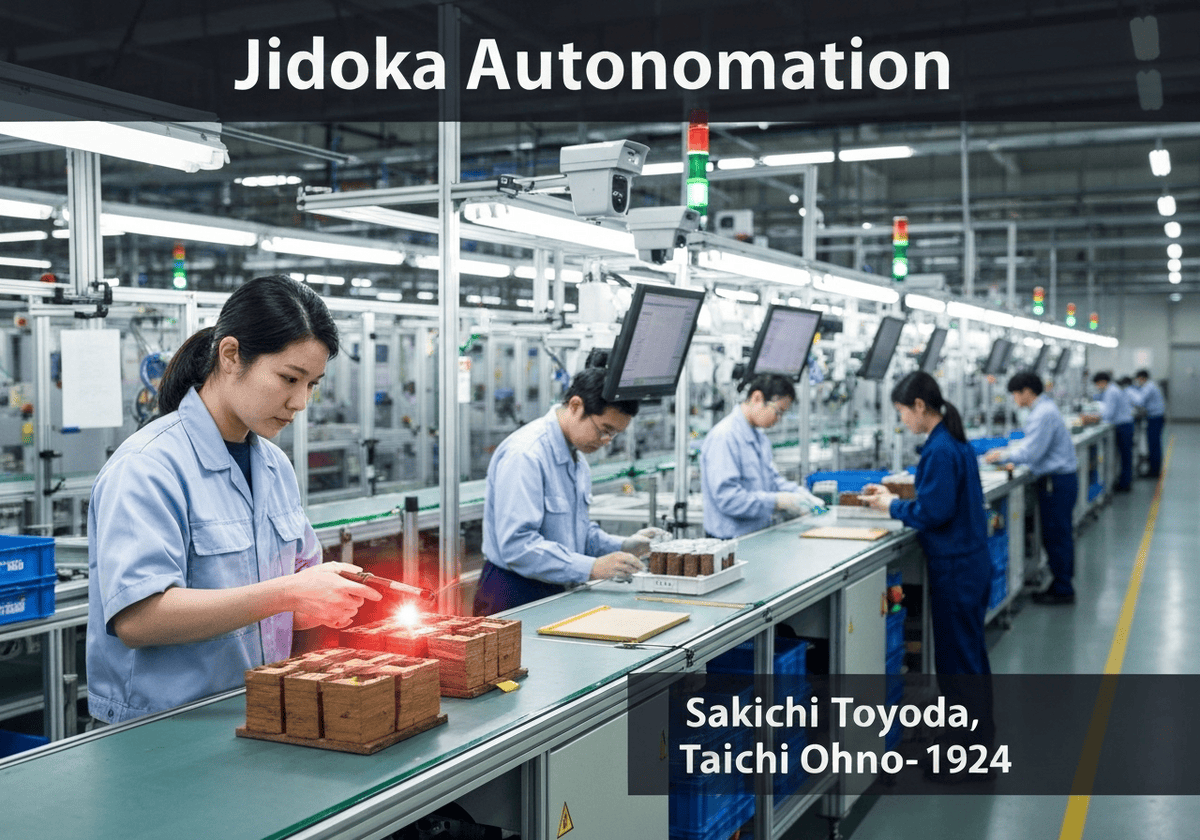
Quality control in industrial engineering with defect detection systems.

(generated image for illustration only)

Jidoka, often translated as “autonomation” or “automation with a human touch,” is a pillar of the Toyota Production System. It empowers any machine or worker to halt the entire production line upon detecting an abnormality or defect. This prevents the mass production of faulty items and immediately highlights problems, enabling root cause analysis and permanent solutions.

The concept of Jidoka is built on four key steps: 1) Detect the abnormality. 2) Stop the process/machine. 3) Fix the immediate condition. 4) Investigate the root cause and install a countermeasure. This cycle is fundamental to building quality into the process rather than inspecting it at the end. The Andon cord or button is a common tool associated with Jidoka, allowing any worker to signal a problem and stop the line.

Jidoka fundamentally separates human work from machine work. Once a machine is set up and running normally, it doesn’t require constant human supervision. The operator is free to manage multiple machines, only intervening when the machine itself calls for help by stopping. This significantly increases labor productivity. The principle originated with Sakichi Toyoda’s invention of an automatic power loom in 1924. This loom could stop itself automatically if a warp or weft thread broke, preventing the production of defective cloth and allowing a single operator to oversee dozens of looms. This core idea was later expanded by Taiichi Ohno and others to encompass all processes within Toyota.

By stopping the line, Jidoka makes problems immediately visible and creates a sense of urgency to solve them. This contrasts with systems where defects are passed downstream, only to be found later, making root cause analysis more difficult and costly.

UNESCO Nomenclature: 3306
– Industrial Engineering

Type

Abstract System

Disruption

Revolutionary

Usage

Widespread Use

Precursors

  • sakichi toyoda’s automatic power loom (1924)
  • early concepts of statistical process control

Applications

  • automated software testing frameworks that halt builds on error detection
  • smart factory sensors that stop machinery before catastrophic failure
  • circuit breakers in electrical systems
  • spell-checkers that highlight errors as you type
  • assembly line quality control cameras that flag defective products

Patents:

  • GB273700A

Potential Innovations Ideas

Due to scrapping bot traffic, currently more than 40k per day, this content is reserved to community members.
> Login < or > Register < (100% free) to access this, so as all other restricted content and tools.

Related to: jidoka, autonomation, quality control, error-proofing, andon, toyota production system, lean manufacturing, root cause analysis.

Historical Context

Jidoka Autonomation

1920
1920
1922
1924
1927
1930
1930
1920
1920
1920
1922
1925-01-01
1930
1930
1930

(if date is unknown or not relevant, e.g. "fluid mechanics", a rounded estimation of its notable emergence is provided)

Related Invention, Innovation & Technical Principles

Full size images and downloads are only available, 100% free, for registered members.

> Login <