Product Design, Manufacturing & Innovation Resources
Home » Fire Extinguishment by Cooling

Fire Extinguishment by Cooling

-500
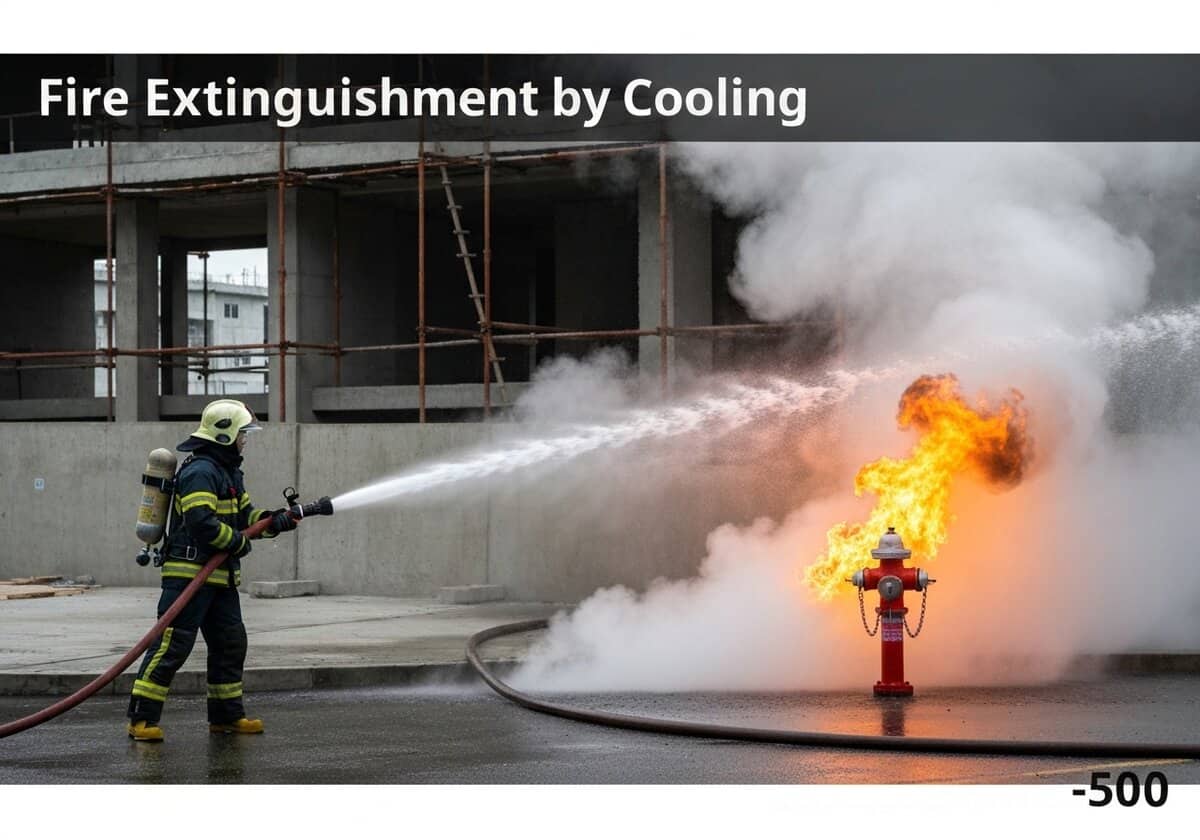
Firefighter extinguishing flames with water hose in a controlled environment, chemical engineering application.

(generated image for illustration only)

A primary method of fire extinguishment involves removing the ‘heat’ component of the fire triangle. This is most commonly achieved by applying a substance that absorbs a large amount of heat, such as water (despite water also have other effects in the fire triangle -refer to dedicated post-). Water’s high specific heat and latent heat of vaporization make it highly effective at cooling a fire below its self-sustaining temperature.

Extinguishment by cooling is a fundamental firefighting tactic that directly targets the ‘heat’ side of the fire triangle. The goal is to reduce the temperature of the burning material to a point where it no longer produces sufficient flammable vapor to sustain combustion. This point is known as the fire point. Water is the most common cooling agent due to its unique thermal properties. It has a high specific heat capacity, meaning it can absorb a significant amount of thermal energy before its own temperature rises substantially. More importantly, it has a very high latent heat of vaporization. When liquid water turns into steam at 100°C, it absorbs a massive amount of energy from the fire without any change in temperature. This phase change is extremely efficient at drawing heat away from the fuel. The resulting steam also helps to displace oxygen, contributing to extinguishment by smothering. However, using water is not always appropriate. It can be ineffective or dangerous on grease fires (it can spread the burning grease) and electrical fires (due to conductivity), and it can react violently with certain metal fires.

UNESCO Nomenclature: 3305
– Chemical engineering

Type

Physical Process

Disruption

Incremental

Usage

Widespread Use

Precursors

  • observation of water’s effect on fire
  • understanding of heat and temperature
  • development of thermodynamics, specifically concepts of specific heat and latent heat
  • invention of pumps and hoses for water delivery

Applications

  • fire hydrants and hoses
  • sprinkler systems in buildings
  • water-dropping aircraft for wildfires
  • personal water fire extinguishers
  • steam inerting systems

Patents:

NA

Potential Innovations Ideas

Due to scrapping bot traffic, currently more than 40k per day, this content is reserved to community members.
> Login < or > Register < (100% free) to access this, so as all other restricted content and tools.

Related to: cooling, extinguishment, water, heat of vaporization, specific heat, fire suppression, sprinkler system, firefighting, heat removal, fire triangle.

Historical Context

Fire Extinguishment by Cooling

-500
1700
1761
1807-01-01
1850
1850
1850
-250
-500
1750
1788
1834
1850
1850
1850

(if date is unknown or not relevant, e.g. "fluid mechanics", a rounded estimation of its notable emergence is provided)

Related Invention, Innovation & Technical Principles

Full size images and downloads are only available, 100% free, for registered members.

> Login <