Product Design, Manufacturing & Innovation Resources
Home » Euler Characteristic

Euler Characteristic

1758
  • Leonhard Euler
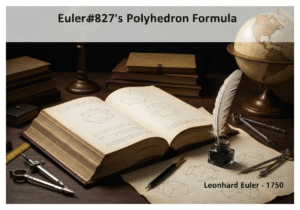
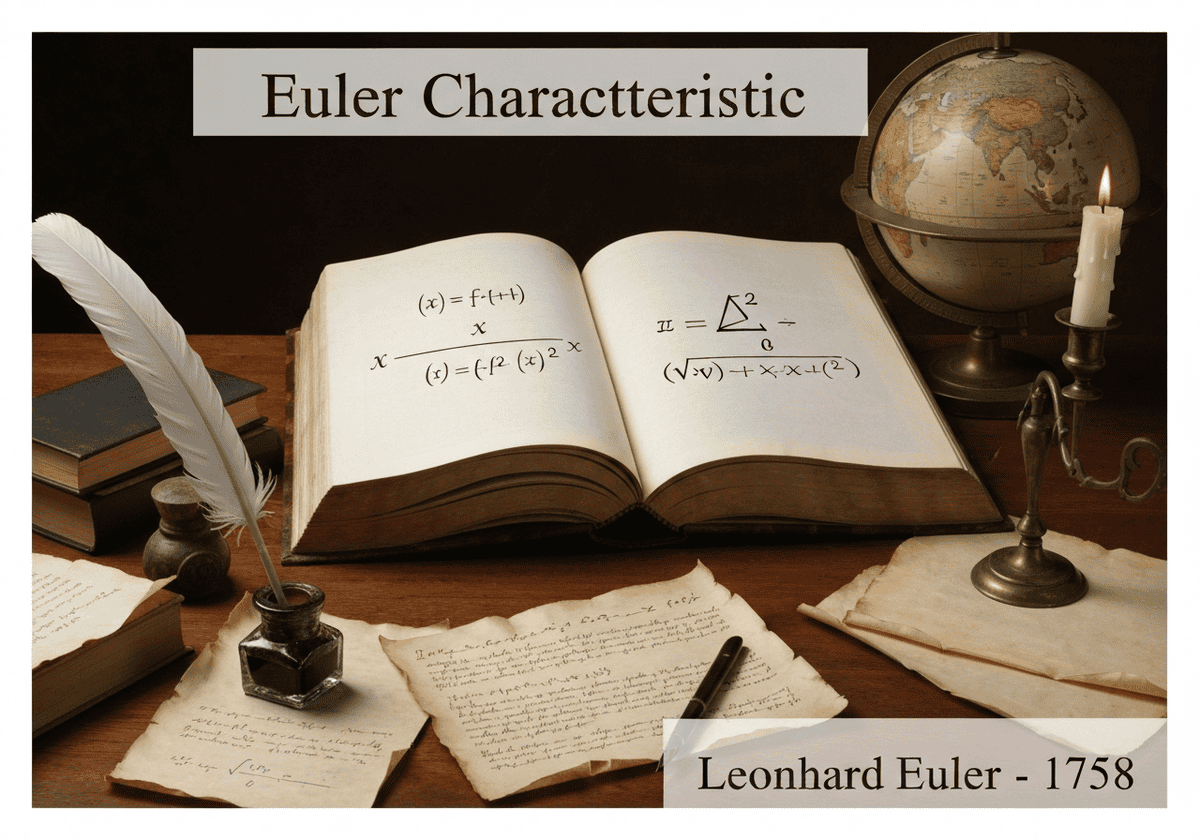
Mathematician's desk with Euler characteristic formula, quill, ink, and parchment.

(generated image for illustration only)

The Euler characteristic is a topological invariant, a number that describes a topological space’s structure or shape regardless of how it is bent. For polyhedra, it is defined by the formula \(\chi = V – E + F\), where V, E, and F are the number of vertices, edges, and faces, respectively. For a sphere, \(\chi = 2\), while for a torus, \(\chi = 0\).
Euler’s original formula was stated for convex polyhedra. For any such shape, the sum of vertices minus edges plus faces is always 2. This discovery was one of the first examples of a topological property. The concept was later generalized to any topological space. For a finite CW-complex, the Euler characteristic can be defined as the alternating sum of the number of cells of each dimension: \(\chi = k_0 – k_1 + k_2 – \dots\), where \(k_n\) is the number of n-dimensional cells. This generalizes the V-E+F formula. A more profound generalization in algebraic topology defines the Euler characteristic in terms of homology groups. Specifically, it is the alternating sum of the Betti numbers \(b_n\) (the rank of the n-th homology group): \(\chi = \sum_{n=0}^{\infty} (-1)^n b_n\). This definition makes it clear that the Euler characteristic is a topological invariant, as homology groups are themselves topological invariants. This number provides a powerful, yet simple, tool to distinguish between different topological surfaces. For example, any surface homeomorphic to a sphere will have \(\chi=2\), and any surface homeomorphic to a torus will have \(\chi=0\).

UNESCO Nomenclature: 1209
– Topology

Type

Abstract System

Disruption

Foundational

Usage

Widespread Use

Precursors

  • Ancient Greek geometry on Platonic solids
  • René Descartes’s unpublished work on polyhedra (Descartes’ theorem on total angular defect)
  • Early work in graph theory

Applications

  • computer graphics for mesh simplification
  • graph theory
  • algebraic topology (as the alternating sum of Betti numbers)
  • cartography (map coloring problems)
  • cosmology (studying the shape of the universe)

Patents:

NA

Potential Innovations Ideas

Due to scrapping bot traffic, currently more than 40k per day, this content is reserved to community members.
> Login < or > Register < (100% free) to access this, so as all other restricted content and tools.

Related to: Euler characteristic, topological invariant, polyhedron, vertices, edges, faces, Betti numbers, homology.

Historical Context

Euler Characteristic

1640
1650
1747
1758
1777
1799
1812
1635
1650
1736
1750
1763-12-23
1780
1805
1822

(if date is unknown or not relevant, e.g. "fluid mechanics", a rounded estimation of its notable emergence is provided)

Related Invention, Innovation & Technical Principles

Full size images and downloads are only available, 100% free, for registered members.

> Login <