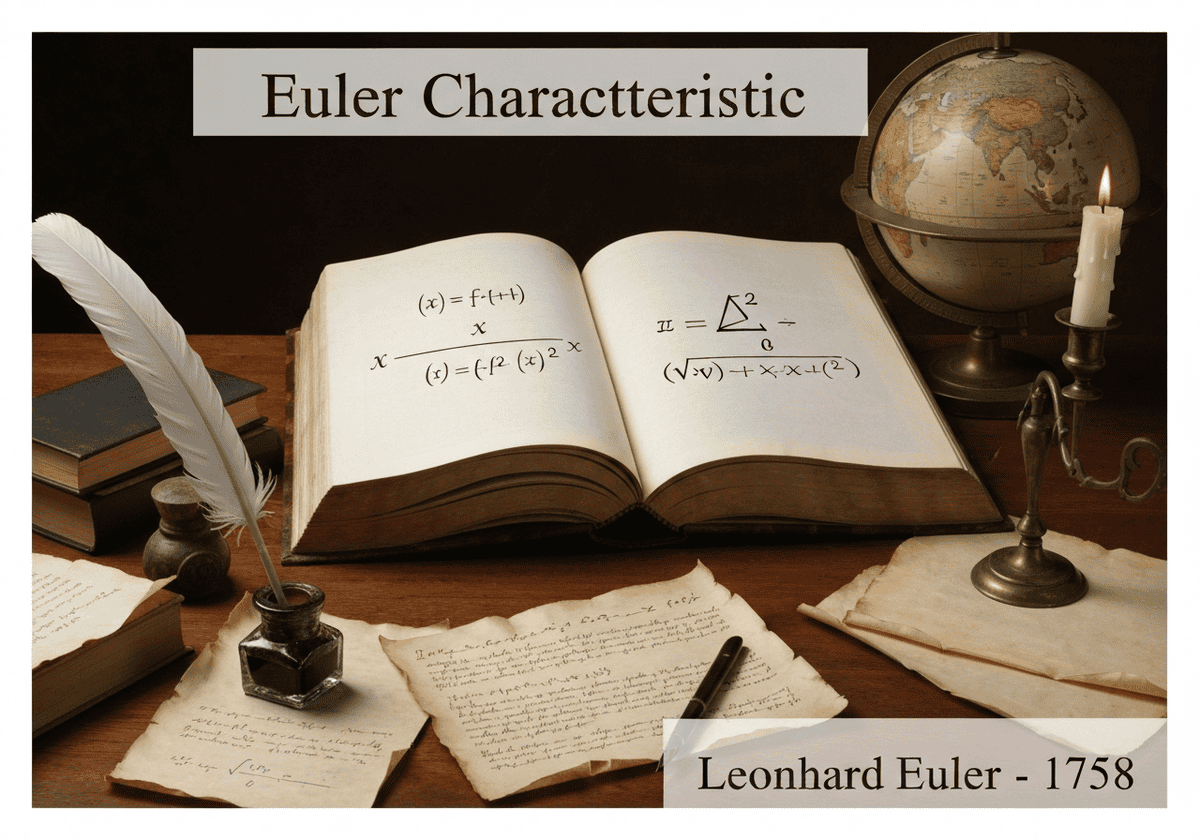
欧拉示性数是一个拓扑不变量,它描述了拓扑空间的结构或形状,而与空间的弯曲方式无关。对于多面体,欧拉示性数由公式 [latex]chi = V �8211; E + F[/latex] 定义,其中 V、E 和 F 分别表示顶点数、边数和面数。对于球面,[latex]chi = 2[/latex],而对于环面,[latex]chi = 0[/latex]。
Euler’s original formula was stated for convex polyhedra. For any such shape, the sum of vertices minus edges plus faces is always 2. This discovery was one of the first examples of a topological property. The concept was later generalized to any topological space. For a finite CW-complex, the Euler characteristic can be defined as the alternating sum of the number of cells of each dimension: [latex]\chi = k_0 – k_1 + k_2 – \dots[/latex], where [latex]k_n[/latex] is the number of n-dimensional cells. This generalizes the V-E+F formula. A more profound generalization in algebraic topology defines the Euler characteristic in terms of homology groups. Specifically, it is the alternating sum of the Betti numbers [latex]b_n[/latex] (the rank of the n-th homology group): [latex]\chi = \sum_{n=0}^{\infty} (-1)^n b_n[/latex]. This definition makes it clear that the Euler characteristic is a topological invariant, as homology groups are themselves topological invariants. This number provides a powerful, yet simple, tool to distinguish between different topological surfaces. For example, any surface homeomorphic to a sphere will have [latex]\chi=2[/latex], and any surface homeomorphic to a torus will have [latex]\chi=0[/latex].