Product Design, Manufacturing & Innovation Resources
Home » The Heat Equation

The Heat Equation

1822
  • Jean-Baptiste Joseph Fourier
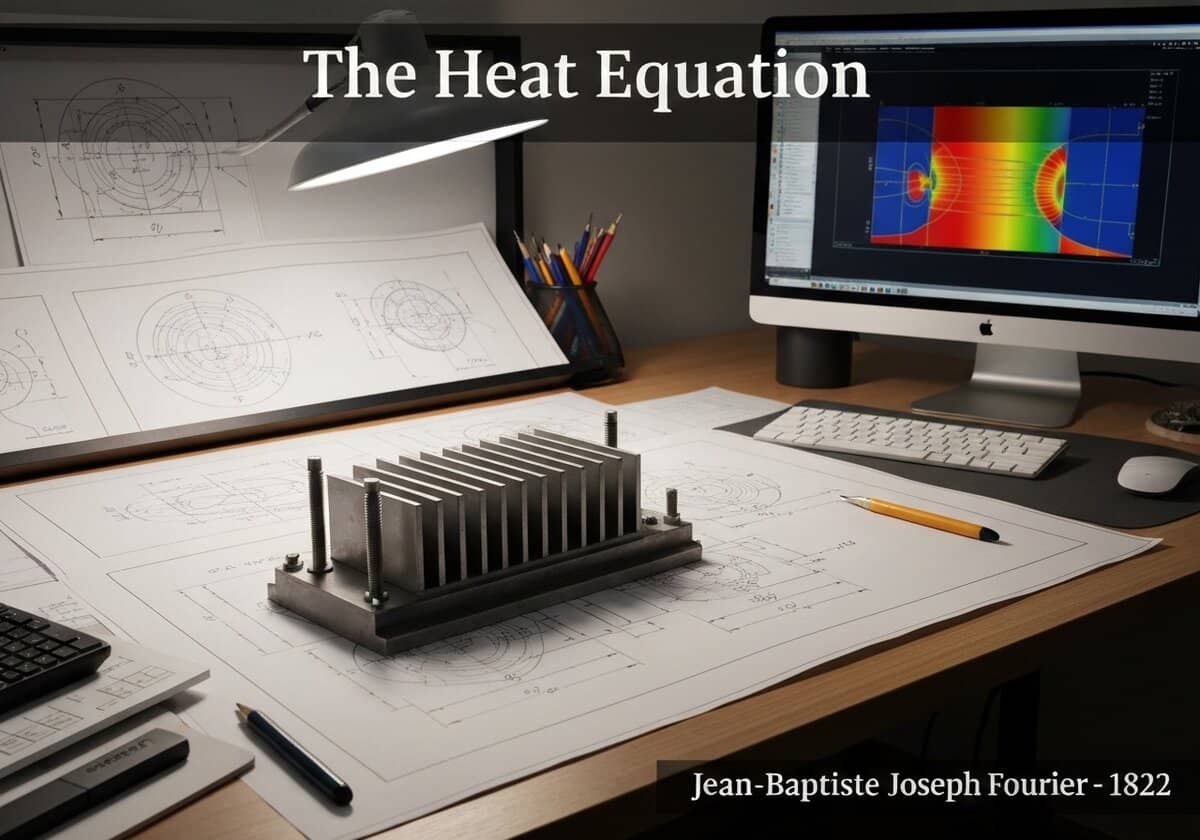
Thermal engineering workspace with heat sink design and simulation tools.

(generated image for illustration only)

A fundamental second-order linear parabolic partial differential equation describing heat distribution or other diffusion processes. Its canonical form is \(\frac{partial u}{partial t} = \alpha \nabla^2 u\), where \(u(\vec{x},t)\) is temperature, \(t\) is time, and \(\alpha\) is thermal diffusivity. Solutions model how an initial temperature distribution evolves, smoothing out irregularities over time and approaching a steady state.

The heat equation is the prototypical example of a parabolic PDE. The term \(\nabla^2\) is the Laplace operator, which in one spatial dimension \(x\) simplifies the equation to \(u_t = \alpha u_{xx}\). The constant \(\alpha\) represents the thermal diffusivity of the material, a measure of how quickly heat spreads. A key property of the heat equation is its ‘infinite speed of propagation’; a change in temperature at any point is felt instantaneously, though infinitesimally, everywhere else in the domain. This is a mathematical idealization of the rapid nature of diffusion.

Another defining characteristic is its smoothing effect. Even if the initial temperature distribution \(u(\vec{x},0)\) is discontinuous (e.g., a sharp jump in temperature), the solution \(u(\vec{x},t)\) for any time \(t > 0\) becomes infinitely differentiable (smooth). This reflects the physical reality that sharp temperature gradients cannot be maintained and will immediately begin to even out. The maximum principle for the heat equation states that the maximum value of \(u\) must occur either at the initial time or on the boundary of the spatial domain, meaning no new hot spots can spontaneously appear inside the material.

Solutions are often found using the method of separation of variables or by employing Fourier transforms, which were developed by Fourier precisely for this purpose. The fundamental solution, known as the heat kernel, represents the temperature distribution resulting from an initial point source of heat.

UNESCO Nomenclature: 1208
– Mathematical physics

Type

Abstract System

Disruption

Foundational

Usage

Widespread Use

Precursors

  • newton’s law of cooling
  • the development of calculus
  • concept of partial derivatives
  • fourier’s work on trigonometric series (fourier series)

Applications

  • thermal engineering for heat sink design
  • financial modeling (the black-scholes equation is a variant)
  • image processing for noise reduction (perona-malik diffusion)
  • neuroscience for modeling neuron signal propagation
  • chemical engineering for modeling molecular diffusion

Patents:

NA

Potential Innovations Ideas

Due to scrapping bot traffic, currently more than 40k per day, this content is reserved to community members.
> Login < or > Register < (100% free) to access this, so as all other restricted content and tools.

Related to: heat equation, diffusion, parabolic pde, fourier analysis, thermal conductivity, brownian motion, black-scholes, mathematical physics.

Historical Context

The Heat Equation

1763-12-23
1780
1805
1822
1822
1828
1848
1758
1777
1799
1812
1822
1827
1829
1850

(if date is unknown or not relevant, e.g. "fluid mechanics", a rounded estimation of its notable emergence is provided)

Related Invention, Innovation & Technical Principles

Full size images and downloads are only available, 100% free, for registered members.

> Login <