Product Design, Manufacturing & Innovation Resources
Home » Proof by Mathematical Induction

Proof by Mathematical Induction

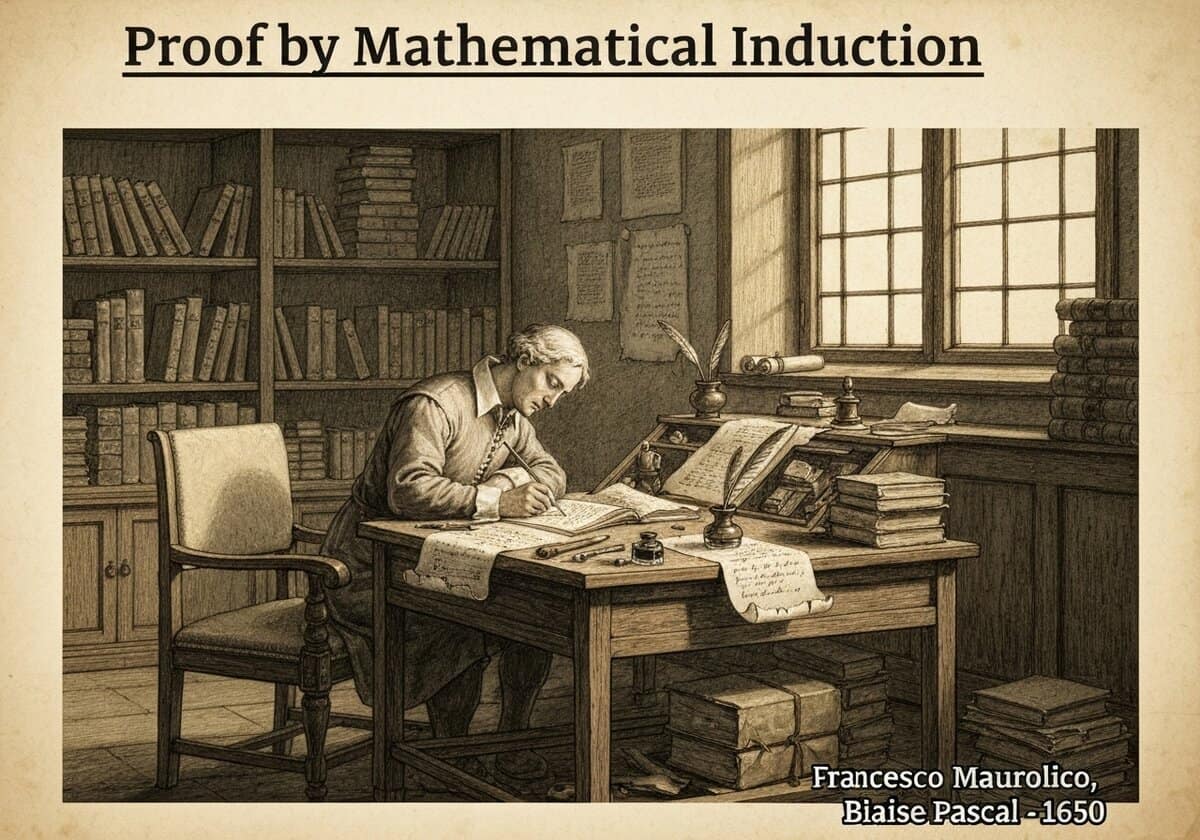
1650
  • Francesco Maurolico
  • Blaise Pascal
Study room with mathematician proving properties using mathematical induction.

(generated image for illustration only)

Mathematical induction is a technique used to prove that a property \(P(n)\) holds for every natural number \(n\). It involves two steps: the base case, proving \(P(0)\) or \(P(1)\) is true, and the inductive step, proving that if \(P(k)\) is true for some natural number \(k\) (the induction hypothesis), then \(P(k+1)\) is also true.
Proof by mathematical induction is analogous to the domino effect. If you can prove the first domino will fall (the base case) and that any falling domino will knock over the next one (the inductive step), you can conclude that all dominoes will fall. The base case establishes the truth of the statement for the initial value, typically \(n=0\) or \(n=1\). The inductive step is the core of the proof. It assumes the statement holds for an arbitrary case \(n=k\), an assumption known as the induction hypothesis. Then, using this assumption, it must be shown that the statement also holds for the next case, \(n=k+1\). For example, to prove the formula for the sum of the first n integers, \(\sum_{i=1}^{n} i = \frac{n(n+1)}{2}\). Base case (n=1): \(1 = \frac{1(1+1)}{2}\), which is true. Inductive step: Assume \(\sum_{i=1}^{k} i = \frac{k(k+1)}{2}\). We need to show \(\sum_{i=1}^{k+1} i = \frac{(k+1)(k+2)}{2}\). We start with the left side: \(\sum_{i=1}^{k+1} i = (\sum_{i=1}^{k} i) + (k+1)\). By the induction hypothesis, this is \(\frac{k(k+1)}{2} + (k+1)\). Factoring out \((k+1)\) gives \((k+1)(\frac{k}{2} + 1) = (k+1)(\frac{k+2}{2}) = \frac{(k+1)(k+2)}{2}\), which completes the proof. This powerful method is indispensable in discrete mathematics and computer science.

UNESCO Nomenclature: 1202
– Algebra

Type

Abstract System

Disruption

Substantial

Usage

Widespread Use

Precursors

  • Euclid’s proof of the infinitude of primes (which has an inductive flavor)
  • The method of infinite descent by Pierre de Fermat
  • Development of algebraic notation

Applications

  • proving correctness of computer algorithms, especially recursive ones
  • analysis of financial models involving sequential steps
  • proving formulas in combinatorics and number theory
  • establishing properties of data structures in computer science

Patents:

NA

Potential Innovations Ideas

Due to scrapping bot traffic, currently more than 40k per day, this content is reserved to community members.
> Login < or > Register < (100% free) to access this, so as all other restricted content and tools.

Related to: mathematical induction, recursion, base case, inductive step, number theory, discrete mathematics, algorithm correctness, series, summation, Peano axioms.

Historical Context

Proof by Mathematical Induction

-500
150
1640
1650
1747
1758
1777
-400
-550
1635
1650
1736
1750
1763-12-23
1780

(if date is unknown or not relevant, e.g. "fluid mechanics", a rounded estimation of its notable emergence is provided)

Related Invention, Innovation & Technical Principles

Full size images and downloads are only available, 100% free, for registered members.

> Login <