Product Design, Manufacturing & Innovation Resources
Heim » Euler-Charakteristik

Euler-Charakteristik

1758
  • Leonhard Euler
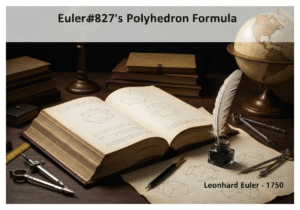
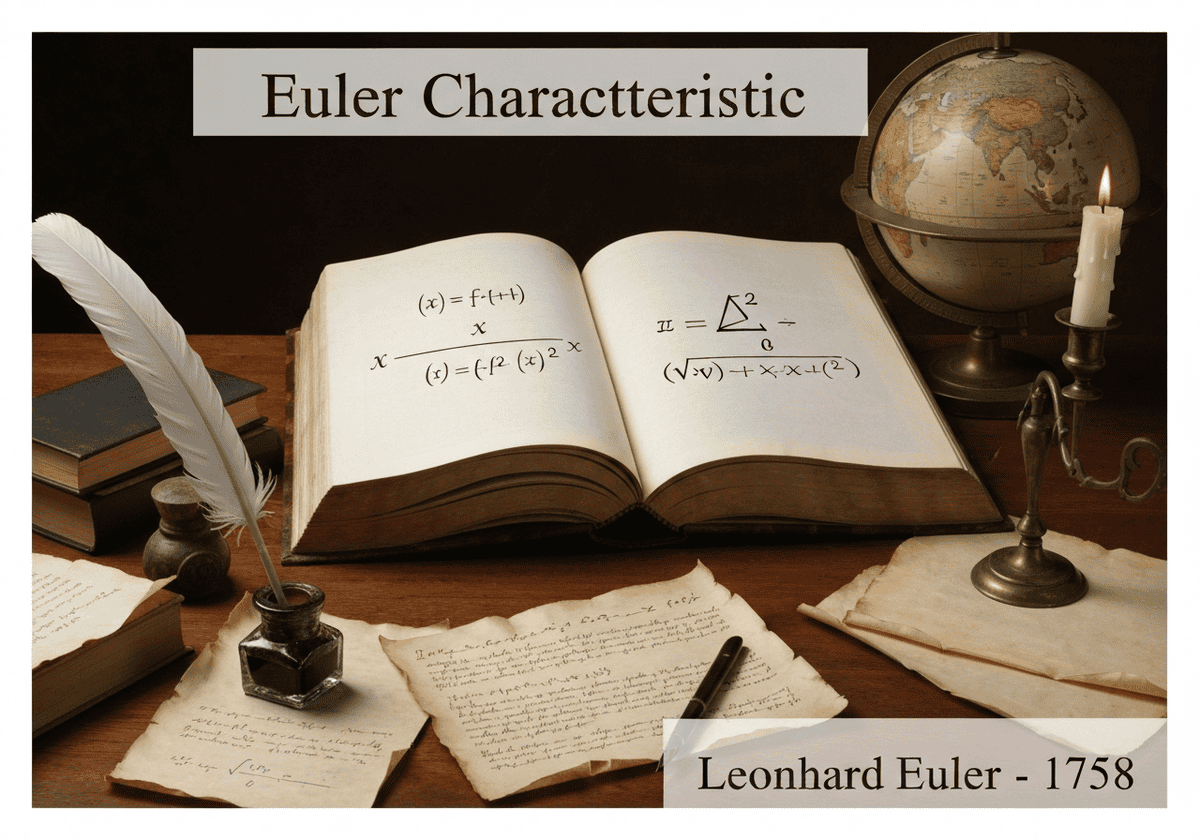
Mathematician's desk with Euler characteristic formula, quill, ink, and parchment.

(Abbildung dient nur zur Veranschaulichung)

Die Euler-Charakteristik ist eine topologische Invariante, eine Zahl, die die Struktur oder Form eines topologischen Raums beschreibt, unabhängig davon, wie er gekrümmt ist. Bei Polyedern wird sie durch die Formel [latex]\chi = V - E + F[/latex] definiert, wobei V, E und F die Anzahl der Ecken, Kanten bzw. Flächen sind. Für eine Kugel ist [latex]\chi = 2[/latex], für einen Torus ist [latex]\chi = 0[/latex].
Euler’s original formula was stated for convex polyhedra. For any such shape, the sum of vertices minus edges plus faces is always 2. This discovery was one of the first examples of a topological property. The concept was later generalized to any topological space. For a finite CW-complex, the Euler characteristic can be defined as the alternating sum of the number of cells of each dimension: [latex]\chi = k_0 – k_1 + k_2 – \dots[/latex], where [latex]k_n[/latex] is the number of n-dimensional cells. This generalizes the V-E+F formula. A more profound generalization in algebraic topology defines the Euler characteristic in terms of homology groups. Specifically, it is the alternating sum of the Betti numbers [latex]b_n[/latex] (the rank of the n-th homology group): [latex]\chi = \sum_{n=0}^{\infty} (-1)^n b_n[/latex]. This definition makes it clear that the Euler characteristic is a topological invariant, as homology groups are themselves topological invariants. This number provides a powerful, yet simple, tool to distinguish between different topological surfaces. For example, any surface homeomorphic to a sphere will have [latex]\chi=2[/latex], and any surface homeomorphic to a torus will have [latex]\chi=0[/latex].

UNESCO Nomenclature: 1209
- Topologie

Typ

Abstraktes System

Störung

Grundlegendes

Verwendung

Weitverbreitete Verwendung

Vorläufer

  • Altgriechische Geometrie auf platonischen Körpern
  • René Descartes' unveröffentlichtes Werk über Polyeder (Descartes' Theorem über den totalen Winkelfehler)
  • Frühe Arbeiten in der Graphentheorie

Anwendungen

  • Computergrafik zur Netzvereinfachung
  • Graphentheorie
  • algebraische Topologie (als alternierende Summe der Betti-Zahlen)
  • Kartographie (Kartenfärbeprobleme)
  • Kosmologie (Untersuchung der Form des Universums)

Patente:

NA

Potenzielle Innovationsideen

Aufgrund des hohen Datenverkehrs durch Web-Scraping-Bots, der derzeit mehr als 40.000 Anfragen pro Tag umfasst, ist dieser Inhalt ausschließlich Community-Mitgliedern vorbehalten.
> Anmelden < oder > Registrieren < (100% kostenlos) Zugriff darauf sowie auf alle anderen eingeschränkten Inhalte und Tools.

Verwandt mit: Euler-Charakteristik, topologische Invariante, Polyeder, Scheitelpunkte, Kanten, Flächen, Betti-Zahlen, Homologie.

Historischer Kontext

Euler-Charakteristik

1640
1650
1747
1758
1777
1799
1812
1635
1650
1736
1750
1763-12-23
1780
1805
1822

(wenn das Datum unbekannt oder nicht relevant ist, z. B. „Strömungsmechanik“, wird eine gerundete Schätzung seines bemerkenswerten Auftretens bereitgestellt)

Verwandte Erfindungen, Innovationen und technische Prinzipien

Bilder in voller Größe und Downloads sind nur für registrierte Mitglieder 100% kostenlos verfügbar.

> Login <