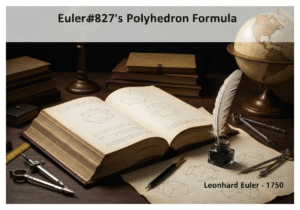
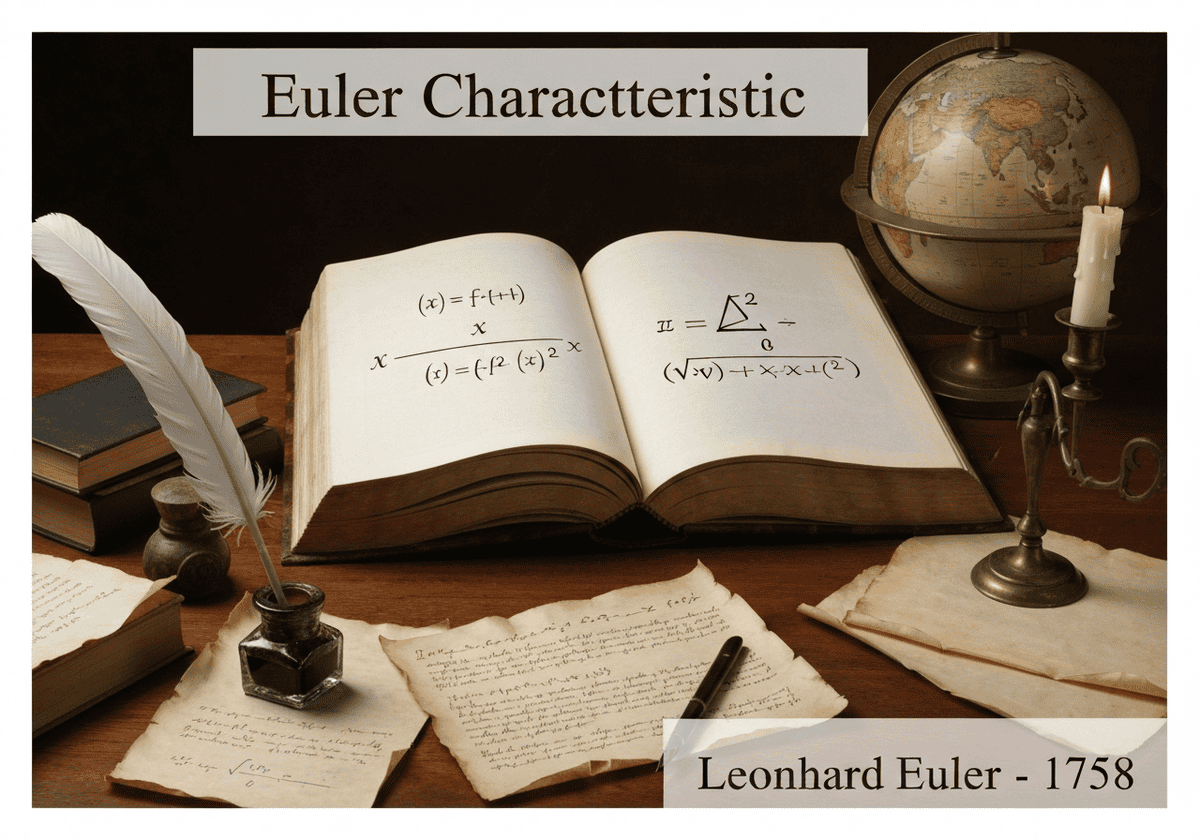
오일러 특성은 위상 불변량으로, 위상 공간이 어떻게 휘어지든 상관없이 그 구조나 모양을 설명하는 숫자입니다. 다면체의 경우, 오일러 특성은 [latex]chi = V �8211; E + F[/latex]라는 공식으로 정의됩니다. 여기서 V, E, F는 각각 꼭짓점, 모서리, 면의 개수입니다. 구의 경우 [latex]chi = 2[/latex]이고, 토러스의 경우 [latex]chi = 0[/latex]입니다.

(설명을 위한 생성된 이미지입니다)
오일러 특성은 위상 불변량으로, 위상 공간이 어떻게 휘어지든 상관없이 그 구조나 모양을 설명하는 숫자입니다. 다면체의 경우, 오일러 특성은 [latex]chi = V �8211; E + F[/latex]라는 공식으로 정의됩니다. 여기서 V, E, F는 각각 꼭짓점, 모서리, 면의 개수입니다. 구의 경우 [latex]chi = 2[/latex]이고, 토러스의 경우 [latex]chi = 0[/latex]입니다.

Euler’s original formula was stated for convex polyhedra. For any such shape, the sum of vertices minus edges plus faces is always 2. This discovery was one of the first examples of a topological property. The concept was later generalized to any topological space. For a finite CW-complex, the Euler characteristic can be defined as the alternating sum of the number of cells of each dimension: [latex]\chi = k_0 – k_1 + k_2 – \dots[/latex], where [latex]k_n[/latex] is the number of n-dimensional cells. This generalizes the V-E+F formula. A more profound generalization in algebraic topology defines the Euler characteristic in terms of homology groups. Specifically, it is the alternating sum of the Betti numbers [latex]b_n[/latex] (the rank of the n-th homology group): [latex]\chi = \sum_{n=0}^{\infty} (-1)^n b_n[/latex]. This definition makes it clear that the Euler characteristic is a topological invariant, as homology groups are themselves topological invariants. This number provides a powerful, yet simple, tool to distinguish between different topological surfaces. For example, any surface homeomorphic to a sphere will have [latex]\chi=2[/latex], and any surface homeomorphic to a torus will have [latex]\chi=0[/latex].
현재 하루 4만 건이 넘는 봇 트래픽을 차단하기 위해 이 콘텐츠는 커뮤니티 회원만 이용할 수 있습니다.
> 로그인 < 또는 >등록 < 이 콘텐츠를 비롯한 모든 제한된 콘텐츠와 도구는 (100% 무료로) 이용할 수 있습니다.
오일러 특성
(날짜를 알 수 없거나 관련이 없는 경우, 예를 들어 "유체역학"의 경우, 주목할 만한 등장 시기를 대략적으로 추정하여 제공합니다.)

고화질 이미지 및 다운로드는 등록된 회원에게만 100% 무료로 제공됩니다.
> 로그인 <