Product Design, Manufacturing & Innovation Resources
Lar » Teoria BCS da Supercondutividade

Teoria BCS da Supercondutividade

1957
  • John Bardeen
  • Leon Cooper
  • John Robert Schrieffer
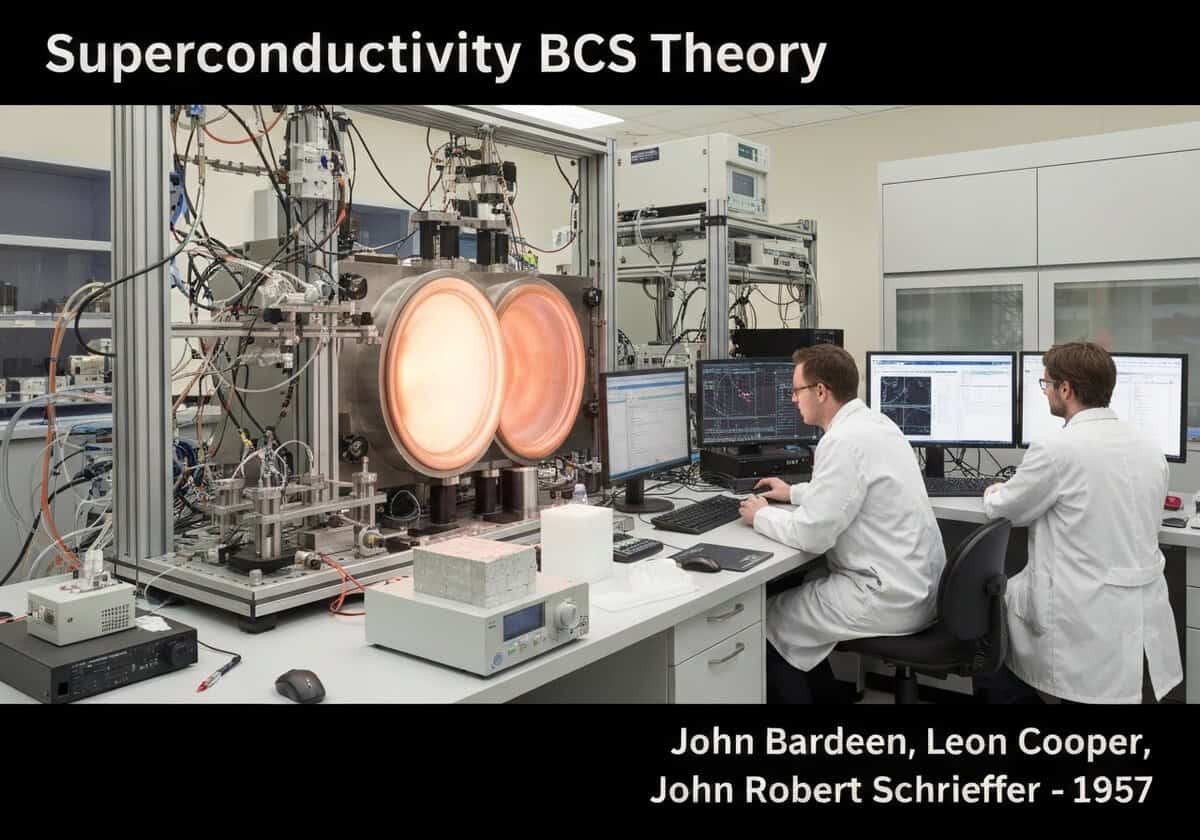
Laboratório de pesquisa focado em supercondutividade com criostato avançado e cientistas analisando dados.

(Imagem gerada apenas para fins ilustrativos)

Developed in 1957 by John Bardeen, Leon Cooper, and Robert Schrieffer, the BCS theory provides a microscopic explanation for conventional supercondutividade. It posits that below the temperatura crítica ([latex]T_c[/latex]), electrons can overcome their electrostatic repulsion and form bound pairs, called Cooper pairs, through interactions with the crystal lattice (phonons). These pairs behave as bosons and can condense into a single macroscopic quantum state.

The BCS theory was a monumental achievement that solved a 46-year-old puzzle in physics. Its central concept is the Cooper pair. In a normal metal, electrons move independently and scatter off impurities and lattice vibrations (phonons), which causes electrical resistance. In the BCS model, an electron moving through the crystal lattice attracts the positive ions, creating a slight distortion or ripple in the lattice. This region of increased positive charge can then attract a second electron. This indirect, phonon-mediated attraction can overcome the direct Coulomb repulsion between the two electrons, binding them into a Cooper pair. These pairs have an integer spin (0 or 1), making them bosons, unlike individual electrons which are fermions. According to quantum statistics, bosons are not subject to the Pauli exclusion principle and can all occupy the same lowest-energy quantum state. Below [latex]T_c[/latex], a significant fraction of Cooper pairs condenses into this single macroscopic ground state, described by a single wave function. This condensate of pairs can move through the lattice without dispersão, pois a dispersão de um único par exigiria energia suficiente para separá-lo e excitar ambos os elétrons, energia essa dada pela diferença de energia supercondutora, Δ. Em baixas temperaturas, essa energia não está disponível, resultando em resistência zero. A teoria previu com sucesso o efeito isotópico, onde Tc ∝ M-1/2 (M é a massa isotópica), e forneceu uma fórmula para a temperatura crítica: kB Tc ≈ 1,13 ħωD exp(-1/N(0)V)], relacionando Tc à Déby frequência [latex]omega_D[/latex], a densidade de estados [latex]N(0)[/latex] e o potencial de interação elétron-fônon [latex]V[/latex].

UNESCO Nomenclature: 2211
Física do estado sólido

Tipo

Modelo Teórico

Interrupção

Revolucionário

Uso

Uso generalizado

Precursores

Aplicações

  • orientações para a busca de novos materiais supercondutores
  • Compreensão da superfluidez no hélio-3
  • fundamentos teóricos para a eletrônica supercondutora
  • models in nuclear physics and física de partículas

Patentes:

NA

Ideias de Inovação Potencial

  • designing “designer” superconductors by engineering phonon spectra
  • creating novel bosonic condensates for quantum information processing
  • developing materials with tunable superconducting gaps for advanced sensors
  • exploring phonon-mediated pairing in other quantum systems like cold atoms
  • creating fault-tolerant quantum computers based on topological superconductors
  • developing bcs-inspired models for social and economic network coherence
  • engineering artificial lattices to test and extend bcs theory
  • creating new forms of matter based on exotic pairing mechanisms
  • developing superconducting materials for thermoelectric energy conversion
  • using bcs principles to enhance catalytic reactions
Relacionado a: teoria BCS, pares de Cooper, supercondutividade, fônons, acoplamento elétron-fônon, mecânica quântica. matéria condensada Teoria, lacuna de energia, estado quântico macroscópico, Bardeen-Cooper-Schrieffer.

Contexto histórico

Teoria BCS da Supercondutividade

1950
1950
1950
1957
1958
1960
1960
1950
1950
1950
1957
1957
1959-11
1960
1960

(Caso a data seja desconhecida ou irrelevante, por exemplo, "mecânica dos fluidos", é fornecida uma estimativa aproximada de seu surgimento notável)

10º ano aniversário

Imagens em tamanho real e downloads estão disponíveis apenas, 100% gratuitos, para membros registrados.