Product Design, Manufacturing & Innovation Resources
집 » 초전도 BCS 이론

초전도 BCS 이론

1957
  • John Bardeen
  • Leon Cooper
  • John Robert Schrieffer
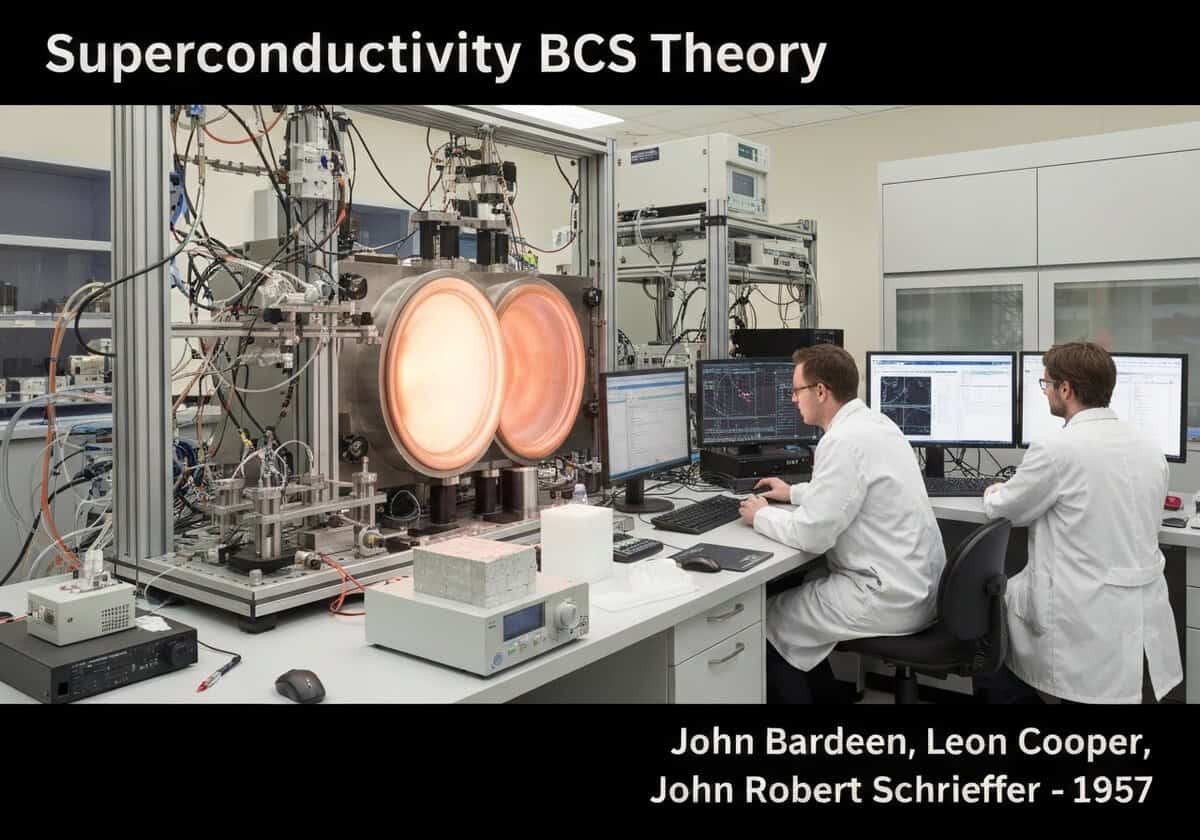
초전도에 초점을 맞춘 연구실에서는 첨단 초저온 장치와 과학자들이 데이터를 분석하고 있습니다.

(설명을 위한 생성된 이미지입니다)

Developed in 1957 by John Bardeen, Leon Cooper, and Robert Schrieffer, the BCS theory provides a microscopic explanation for conventional 초전도성. It posits that below the 임계 온도 ([latex]T_c[/latex]), electrons can overcome their electrostatic repulsion and form bound pairs, called Cooper pairs, through interactions with the crystal lattice (phonons). These pairs behave as bosons and can condense into a single macroscopic quantum state.

The BCS theory was a monumental achievement that solved a 46-year-old puzzle in physics. Its central concept is the Cooper pair. In a normal metal, electrons move independently and scatter off impurities and lattice vibrations (phonons), which causes electrical resistance. In the BCS model, an electron moving through the crystal lattice attracts the positive ions, creating a slight distortion or ripple in the lattice. This region of increased positive charge can then attract a second electron. This indirect, phonon-mediated attraction can overcome the direct Coulomb repulsion between the two electrons, binding them into a Cooper pair. These pairs have an integer spin (0 or 1), making them bosons, unlike individual electrons which are fermions. According to quantum statistics, bosons are not subject to the Pauli exclusion principle and can all occupy the same lowest-energy quantum state. Below [latex]T_c[/latex], a significant fraction of Cooper pairs condenses into this single macroscopic ground state, described by a single wave function. This condensate of pairs can move through the lattice without 산란단일 전자쌍을 산란시키려면 전자쌍을 분리하고 두 전자 모두를 여기시키기에 충분한 에너지가 필요하며, 이 에너지는 초전도 에너지 갭 [latex]Delta[/latex]로 주어집니다. 저온에서는 이 에너지를 사용할 수 없으므로 저항이 0이 됩니다. 이 이론은 동위원소 효과를 성공적으로 예측했으며, 여기서 [latex]T_c propto M^{-1/2}[/latex] (M은 동위원소 질량)이고, 임계 온도에 대한 공식 [latex]k_B T_c approx 1.13 hbar omega_D exp(-1/N(0)V)[/latex]를 [latex]T_c[/latex]와 연결합니다. 안녕 주파수 [latex]omega_D[/latex], 상태 밀도 [latex]N(0)[/latex], 전자-포논 상호 작용 전위 [latex]V[/latex].

UNESCO Nomenclature: 2211
고체물리학

유형

이론적 모델

분열

혁명가

용법

널리 사용됨

전구체

응용 프로그램

  • 새로운 초전도 물질 탐색을 위한 지침
  • 헬륨-3의 초유체성에 대한 이해
  • 초전도 전자공학의 이론적 기초
  • models in nuclear physics and 입자 물리학

특허:

NA

잠재적 혁신 아이디어

  • designing “designer” superconductors by engineering phonon spectra
  • creating novel bosonic condensates for quantum information processing
  • developing materials with tunable superconducting gaps for advanced sensors
  • exploring phonon-mediated pairing in other quantum systems like cold atoms
  • creating fault-tolerant quantum computers based on topological superconductors
  • developing bcs-inspired models for social and economic network coherence
  • engineering artificial lattices to test and extend bcs theory
  • creating new forms of matter based on exotic pairing mechanisms
  • developing superconducting materials for thermoelectric energy conversion
  • using bcs principles to enhance catalytic reactions
관련 개념: BCS 이론, 쿠퍼 쌍, 초전도, 포논, 전자-포논 결합, 양자 역학 응축 물질 이론, 에너지 갭, 거시적 양자 상태, 바딘-쿠퍼-슈리퍼.

역사적 맥락

초전도 BCS 이론

1950
1950
1950
1957
1958
1960
1960
1950
1950
1950
1957
1957
1959-11
1960
1960

(날짜를 알 수 없거나 관련이 없는 경우, 예를 들어 "유체역학"의 경우, 주목할 만한 등장 시기를 대략적으로 추정하여 제공합니다.)

10년차 기념일

고화질 이미지 및 다운로드는 등록된 회원에게만 100% 무료로 제공됩니다.

> 로그인 <