Product Design, Manufacturing & Innovation Resources
Maison » Configuration interne vs. externe dans SMED

Configuration interne vs. externe dans SMED

1960
  • Shigeo Shingo
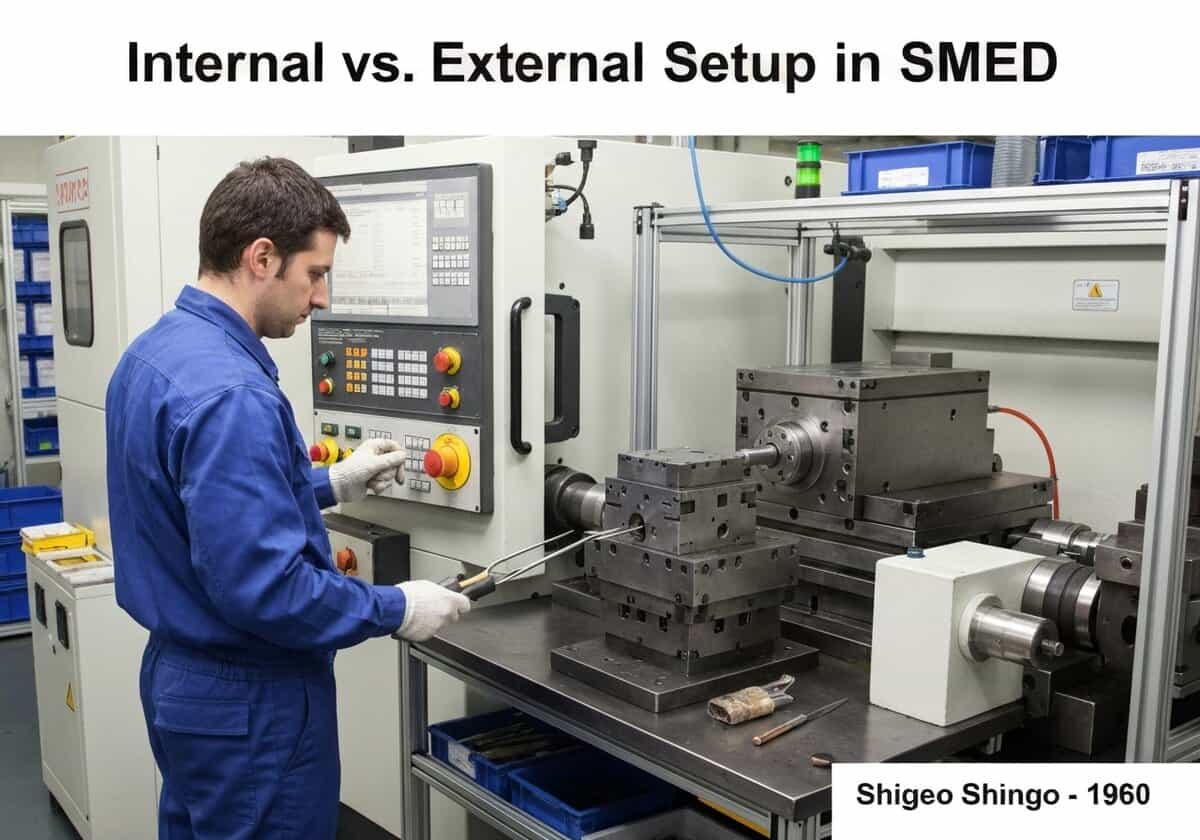
Opération de configuration externe dans la méthodologie SMED au sein du génie industriel.

(Image générée à titre d'illustration uniquement)

Le FORGERON méthodologie fundamentally distinguishes between internal and external setup operations. Internal setup activities can only be performed when a machine is stopped, such as the usual example of mounting a new die. External setup activities can be completed while the machine is still running, like pre-heating tools or fetching the next die. The primary goal is to convert internal setup time to external.


The distinction between internal and external setup is the cornerstone of the FORGERON system. Before its formalization, changeover processes were often treated as a monolithic block of time where the machine was unproductive. Shigeo Shingo’s critical insight was to analyze every single action taken during a changeover and categorize it. Internal setup (Internal Exchange of Die or IED) includes any task that absolutely requires the machine to be shut down. Examples include unbolting the old tool, cleaning the machine bed, and securing the new tool. External setup (External Exchange of Die or OED) encompasses all preparatory and post-processing tasks that can be performed while the machine is still producing the last batch. This includes transporting the next die to the machine, pre-heating molds, preparing clamps and bolts, and moving the finished parts away. The initial stages of a SMED implementation focus heavily on identifying and separating these activities. A simple checklist is often the first tool used. By meticulously preparing all necessary tools, parts, and conditions beforehand (externalizing the setup), the time the machine is actually stopped (internal setup) can be dramatically reduced. This conceptual separation is what enables the subsequent, more technical steps of converting and streamlining.

UNESCO Nomenclature: 3307
- Technologie industrielle

Taper

Système abstrait

Perturbation

Substantiel

Usage

Utilisation généralisée

Précurseurs

  • Études de temps et de mouvement par Frederick Winslow Taylor
  • L'analyse du mouvement de Frank et Lillian Gilbreth (Therbligs)
  • Les principes de la chaîne de montage d'Henry Ford
  • Système de production Toyota (TPS) développement

Applications

Brevets:

NA

Idées d'innovations potentielles

  • véhicules à guidage automatique (AGV) pour le transport de matrices
  • Des armoires à outils intelligentes qui préparent les trousses à outils en fonction des calendriers de production
  • guides de réalité augmentée pour les procédures de changement complexes
  • iot sensors to monitor tool pre-heating status remotely
  • Conception modulaire de la machine avec fixations à connexion rapide
  • Analyse vidéo basée sur l'IA pour identifier et classer automatiquement les activités de configuration
  • Impression 3D de gabarits et de dispositifs de fixation sur mesure pour des changements spécifiques
  • jumeau numérique simulations to practice and optimize changeover sequences offline
  • automatisation des processus robotiques pour les tâches de configuration standardisées
  • alertes de maintenance prédictive pour l'outillage de changement d'outillage
Related to: SMED, internal setup, external setup, changeover, production allégée, Shigeo Shingo, IED, OED, process improvement, industrial engineering.

Contexte historique

Configuration interne vs. externe dans SMED

1960
1960
1960
1960
1962-10-09
1964
1970
1960
1960
1960
1960
1962
1963
1965-12-21
1970

(si la date est inconnue ou non pertinente, par exemple « mécanique des fluides », une estimation arrondie de son émergence notable est fournie)

10e année anniversaire

Les images en pleine résolution et les téléchargements sont uniquement disponibles, et 100% gratuits, pour les membres inscrits.