Product Design, Manufacturing & Innovation Resources
家 » 分子电子学

分子电子学

1974-11-15
  • Ari Aviram
  • Mark Ratner
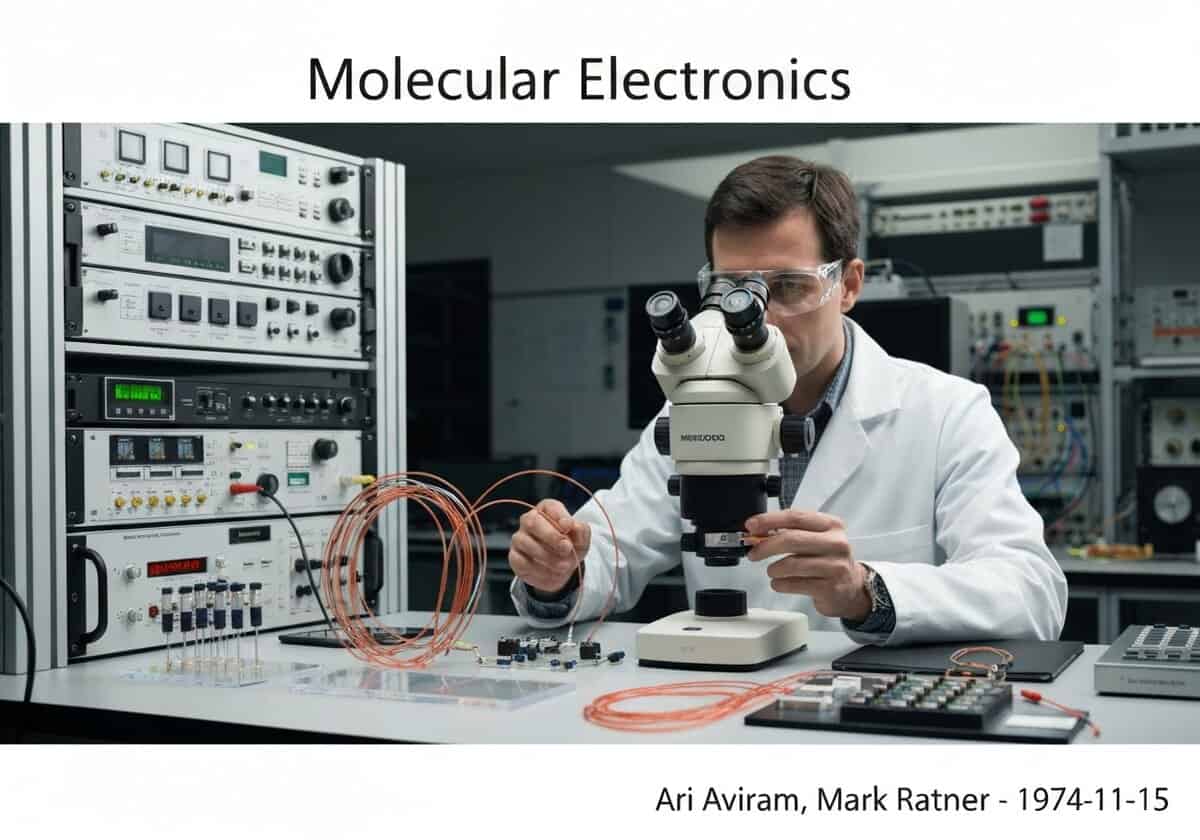
实验室环境中的分子电子元件,包括分子导线和开关。

(图片仅供参考)

分子电子学探索利用单个分子或纳米级分子集合作为基本电子元件。该方法旨在构建微型化极限的电路,远远超越传统的硅基技术。关键元件包括分子线、开关和整流器,它们利用电子隧穿分子轨道等量子力学特性来实现功能。

The concept of molecular electronics, first conceptualized by Ari Aviram and Mark Ratner in 1974, represents a paradigm shift from top-down lithography to bottom-up self-assembly for creating electronic circuits. Their seminal paper proposed a molecular rectifier, a D-σ-A molecule (Donor-sigma bridge-Acceptor), which would allow current to flow preferentially in one direction, analogous to a semiconductor p-n diode. The principle relies on the alignment of molecular energy levels (HOMO and LUMO) under an applied bias voltage. When a voltage is applied, electrons can tunnel from an electrode, through the molecule’s orbitals, to the other electrode. The asymmetry in the D-A structure creates an asymmetric current-voltage (I-V) characteristic, which is the basis of rectification.

Beyond simple rectifiers, researchers have demonstrated molecular wires (e.g., conjugated polymers), switches that can be toggled between ‘on’ and ‘off’ states using light, heat, or electric fields, and even molecular transistors. The primary challenge lies in reliably connecting these tiny molecules to macroscopic electrodes and creating stable, reproducible devices. Techniques like scanning tunneling microscopy (STM) break junctions and mechanically controllable break junctions (MCBJs) are used in laboratory settings to measure the conductance of single molecules. While full-scale molecular computers remain a distant goal, the principles are being applied in areas like molecular sensing, where the electronic properties of a molecule change upon binding to a specific target analyte, and in organic light-emitting diodes (OLEDs), which rely on charge transport through organic molecular films.

该领域是一门高度跨学科的领域,融合了量子化学、材料科学和 condensed matter physics. It promises not only extreme miniaturization but also novel functionalities derived from the unique quantum properties of individual molecules, potentially leading to devices with lower power consumption and entirely new computational models.

UNESCO Nomenclature: 2205
– Electronics

类型

抽象系统

中断

Foundational

用法

Emerging Technology

前体

  • 电子的发现
  • 量子力学的发展
  • 复杂有机分子的合成
  • 半导体二极管的发明
  • 扫描隧道显微镜(STM)的发展

应用程序

  • 分子级传感器
  • 超高密度数据存储
  • 有机发光二极管(OLED)
  • 分子计算架构的潜力

专利:

NA

潜在创新理念

  • 用于体内计算的生物相容性逻辑门
  • self-assembling neural networks for pattern recognition
  • 分子传感器集成到纺织品中用于实时健康监测
  • catalytic surfaces with embedded electronic feedback loops
  • 用于先进光伏的量子点分子混合系统
  • 可编程物质,其中分子开关改变材料特性
  • 基于分子构象变化的超低功耗存储器
  • 用于纳米机器人的化学驱动分子马达
Related to: molecular electronics, single-molecule, aviram-ratner, molecular rectifier, quantum tunneling, bottom-up fabrication, molecular switch, nanoelectronics.

历史背景

分子电子学

1965
1970
1970
1974-11-15
1980
1980
1980
1964
1968
1970
1970
1975
1980
1980
1980

(如果日期未知或不相关,例如“流体力学”,则提供其显著出现的近似估计)

第十年 周年纪念日

只有注册会员才能免费获取完整尺寸的图片和下载内容。

> 登录 <