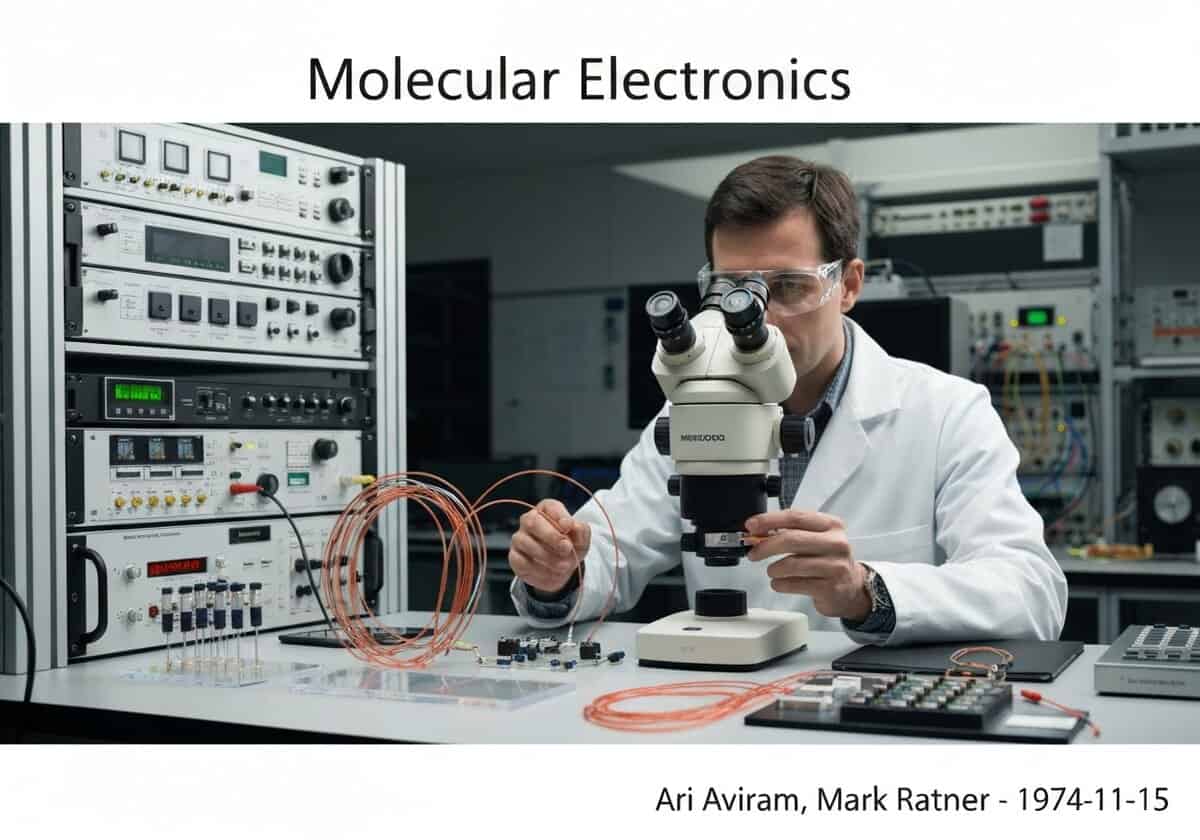
The concept of molecular electronics, first conceptualized by Ari Aviram and Mark Ratner in 1974, represents a paradigm shift from top-down lithography to bottom-up self-assembly for creating electronic circuits. Their seminal paper proposed a molecular rectifier, a D-σ-A molecule (Donor-sigma bridge-Acceptor), which would allow current to flow preferentially in one direction, analogous to a semiconductor p-n diode. The principle relies on the alignment of molecular energy levels (HOMO and LUMO) under an applied bias voltage. When a voltage is applied, electrons can tunnel from an electrode, through the molecule’s orbitals, to the other electrode. The asymmetry in the D-A structure creates an asymmetric current-voltage (I-V) characteristic, which is the basis of rectification.
Beyond simple rectifiers, researchers have demonstrated molecular wires (e.g., conjugated 高分子), switches that can be toggled between ‘on’ and ‘off’ states using light, heat, or electric fields, and even molecular transistors. The primary challenge lies in reliably connecting these tiny molecules to macroscopic electrodes and creating stable, reproducible devices. Techniques like scanning tunneling microscopy (STM) break junctions and mechanically controllable break junctions (MCBJs) are used in laboratory settings to measure the conductance of single molecules. While full-scale molecular computers remain a distant goal, the principles are being applied in areas like molecular sensing, where the electronic properties of a molecule change upon binding to a specific target analyte, and in organic light-emitting diodes (OLEDs), which rely on charge transport through organic molecular films.
この分野は量子化学、材料科学、そして 凝縮系物理学. It promises not only extreme miniaturization but also novel functionalities derived from the unique quantum properties of individual molecules, potentially leading to devices with lower power consumption and entirely new computational models.
Related to: molecular electronics, single-molecule, aviram-ratner, molecular rectifier, quantum tunneling, bottom-up fabrication, molecular switch,
nanoelectronics.