Product Design, Manufacturing & Innovation Resources
Lar » Eletrônica Molecular

Eletrônica Molecular

1974-11-15
  • Ari Aviram
  • Mark Ratner
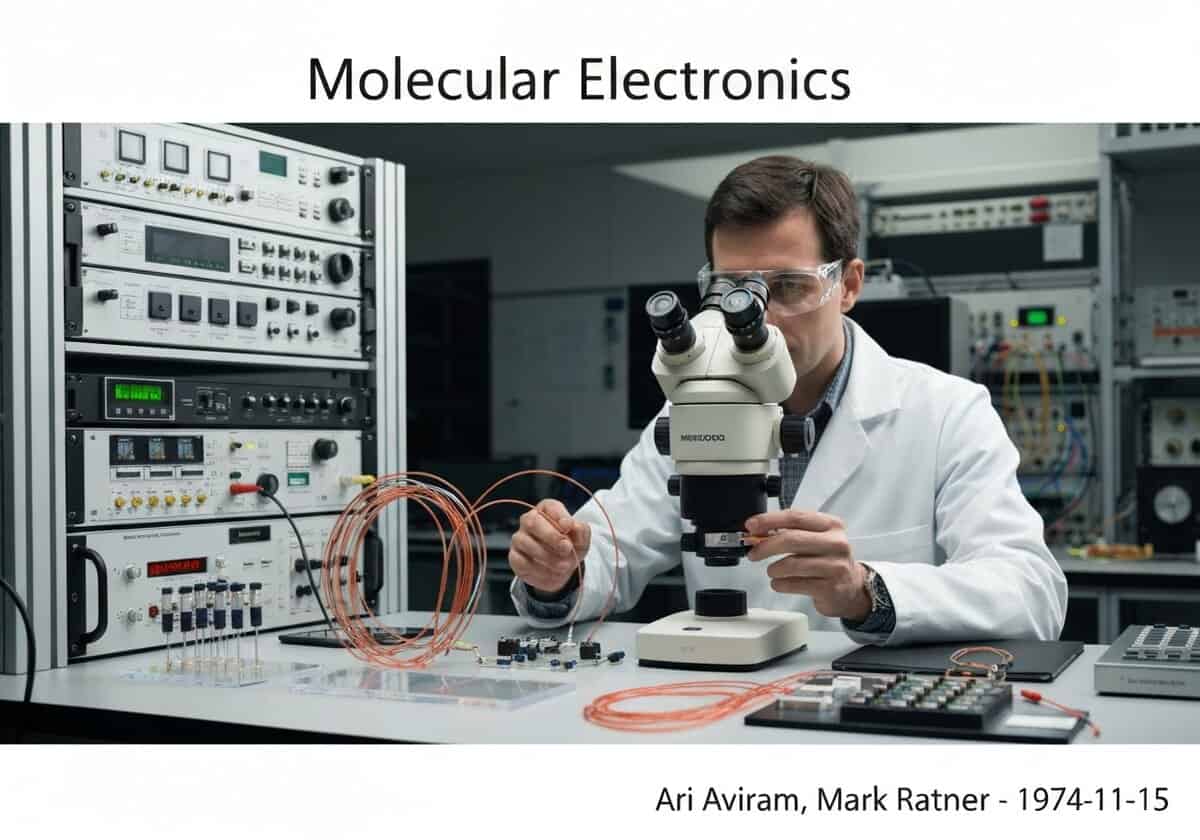
Componentes eletrônicos moleculares em um ambiente de laboratório, incluindo fios e interruptores moleculares.

(Imagem gerada apenas para fins ilustrativos)

A eletrônica molecular explora o uso de moléculas individuais ou conjuntos moleculares em nanoescala como componentes eletrônicos fundamentais. Essa abordagem visa construir circuitos no limite máximo da miniaturização, muito além da tecnologia tradicional baseada em silício. Os principais componentes incluem fios moleculares, interruptores e retificadores, que aproveitam propriedades da mecânica quântica, como o tunelamento de elétrons através de orbitais moleculares, para seu funcionamento.

The concept of molecular electronics, first conceptualized by Ari Aviram and Mark Ratner in 1974, represents a paradigm shift from top-down lithography to bottom-up self-assembly for creating electronic circuits. Their seminal paper proposed a molecular rectifier, a D-σ-A molecule (Donor-sigma bridge-Acceptor), which would allow current to flow preferentially in one direction, analogous to a semiconductor p-n diode. The principle relies on the alignment of molecular energy levels (HOMO and LUMO) under an applied bias voltage. When a voltage is applied, electrons can tunnel from an electrode, through the molecule’s orbitals, to the other electrode. The asymmetry in the D-A structure creates an asymmetric current-voltage (I-V) characteristic, which is the basis of rectification.

Beyond simple rectifiers, researchers have demonstrated molecular wires (e.g., conjugated polímeros), switches that can be toggled between ‘on’ and ‘off’ states using light, heat, or electric fields, and even molecular transistors. The primary challenge lies in reliably connecting these tiny molecules to macroscopic electrodes and creating stable, reproducible devices. Techniques like scanning tunneling microscopy (STM) break junctions and mechanically controllable break junctions (MCBJs) are used in laboratory settings to measure the conductance of single molecules. While full-scale molecular computers remain a distant goal, the principles are being applied in areas like molecular sensing, where the electronic properties of a molecule change upon binding to a specific target analyte, and in organic light-emitting diodes (OLEDs), which rely on charge transport through organic molecular films.

O campo é altamente interdisciplinar, combinando química quântica, ciência dos materiais e física da matéria condensada. It promises not only extreme miniaturization but also novel functionalities derived from the unique quantum properties of individual molecules, potentially leading to devices with lower power consumption and entirely new computational models.

UNESCO Nomenclature: 2205
Eletrônicos

Tipo

Sistema abstrato

Interrupção

Fundamentais

Uso

Tecnologia emergente

Precursores

  • descoberta do elétron
  • desenvolvimento da mecânica quântica
  • síntese de moléculas orgânicas complexas
  • invenção do diodo semicondutor
  • desenvolvimento da microscopia de tunelamento de varredura (STM)

Aplicações

  • sensores em escala molecular
  • armazenamento de dados de ultra-alta densidade
  • diodos orgânicos emissores de luz (OLEDs)
  • potencial para arquiteturas de computação molecular

Patentes:

NA

Ideias de Inovação Potencial

  • biocompatible logic gates for in-vivo computing
  • self-assembling neural networks for pattern recognition
  • molecular sensors integrated into textiles for real-time health monitoring
  • catalytic surfaces with embedded electronic feedback loops
  • quantum dot-molecule hybrid systems for advanced photovoltaics
  • programmable matter where molecular switches alter material properties
  • ultra-low power memory based on molecular conformational changes
  • chemically-powered molecular motors for nanoscale robotics
Related to: molecular electronics, single-molecule, aviram-ratner, molecular rectifier, quantum tunneling, bottom-up fabrication, molecular switch, nanoelectronics.

Contexto histórico

Eletrônica Molecular

1965
1970
1970
1974-11-15
1980
1980
1980
1964
1968
1970
1970
1975
1980
1980
1980

(Caso a data seja desconhecida ou irrelevante, por exemplo, "mecânica dos fluidos", é fornecida uma estimativa aproximada de seu surgimento notável)

10º ano aniversário

Imagens em tamanho real e downloads estão disponíveis apenas, 100% gratuitos, para membros registrados.