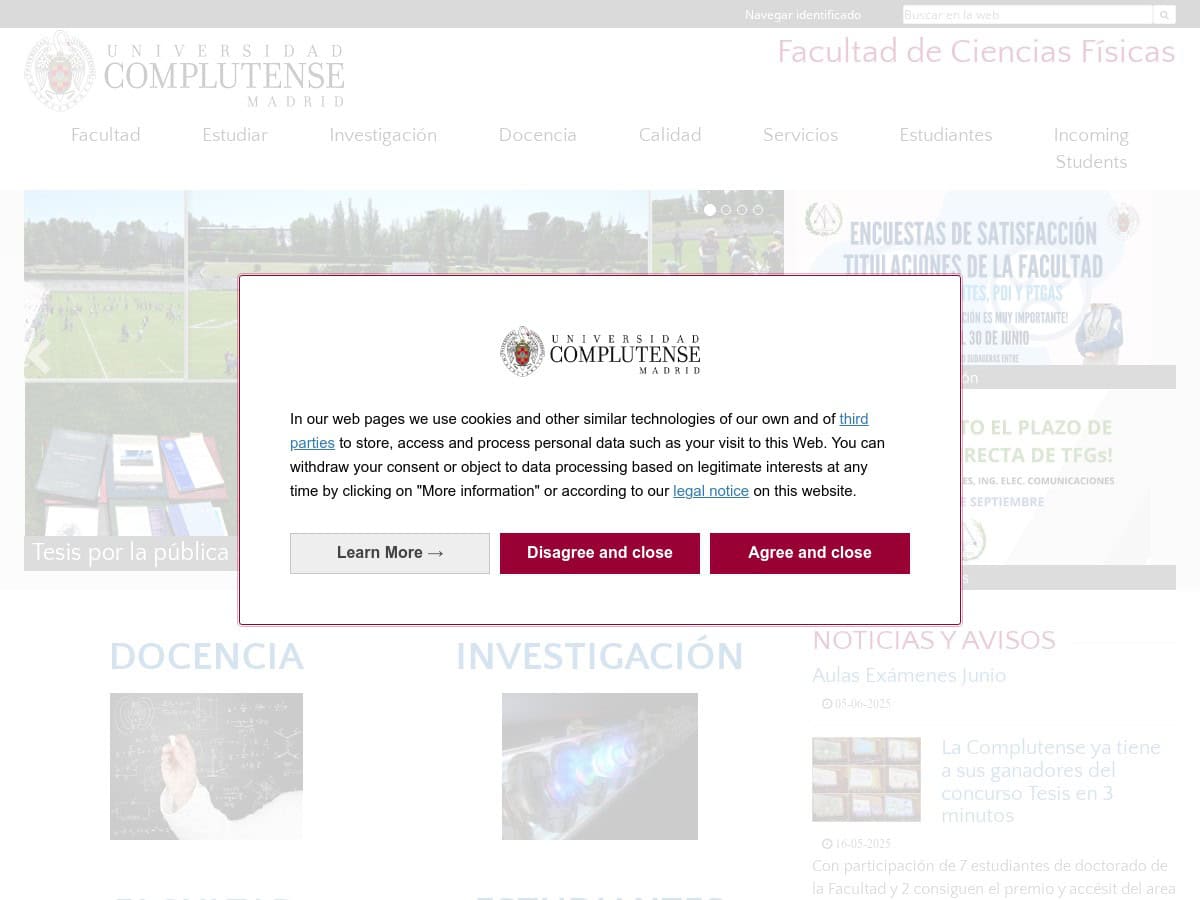
The Faculty of Physical Sciences of the Complutense University of Madrid (UCM) offers degrees in Physics, Meteorology and Geophysics, Materials Engineering, and Electronic Engineering.
The Facultad de Ciencias Físicas of the Universidad Complutense de Madrid is the physics faculty of one of the oldest and largest universities in Spain. The Complutense traces its history to the University of Alcalá de Henares, founded in 1499 by Cardinal Cisneros, and it moved to Madrid in 1836. The faculty stands on the Plaza de las Ciencias in the Ciudad Universitaria, the university district in the north-west of Madrid, which was built in the 1920s and 1930s. It has about 3,000 students and 400 staff, and around one student in ten comes from abroad.
The faculty offers degrees in physics and a double degree with mathematics, together with master’s degrees in fields such as nuclear physics, astrophysics, meteorology, geophysics and photonics. Its departments cover theoretical physics, condensed matter, atomic and nuclear physics, optics, applied physics, earth physics and astrophysics, and materials physics. The building contains lecture halls, laboratories, a library and an astronomical observatory.
Physics research in Madrid is rooted in a long tradition. The Spanish physicists Blas Cabrera and Arturo Duperier were professors in the Central University in the twentieth century, and many Spanish scientists trained in the old faculty. Today the faculty houses the Institute of Particle Physics and the Cosmos, IPARCOS, and groups working with CERN and with astrophysics collaborations. The faculty also trains many of the teachers of physics and the meteorologists of the national weather service.
Admission to bachelor’s degrees uses the national university entrance exam and the cut-off marks of each degree, which vary every year. Public universities in the Community of Madrid set tuition per credit, with prices that are higher for repeated subjects and for students from outside the EU. Check the current tariff. Master’s degrees have separate application rounds and fees, and doctoral candidates are recruited through calls and fellowships.
The Ciudad Universitaria is served by several metro stations. Madrid is expensive for renters, but halls of residence are available for students.
Domains taught:
Aerospace, Astroscience, Data Analytics, Electrical and Electronics, Engineering, Materials, Mathematics, Nanotechnologies, Optics, Physics, Signal Processing, Thermodynamics
Diplomas*:
Bachelor, Doctor, Master
Status:
Public
Partnerships:
Part of UCM, with strong international research collaborations (e.g., CERN, ESA) and links with technology companies and research institutes.
Research:
Cutting-edge research in areas like particle physics, astrophysics, condensed matter physics, materials science, photonics, electronics, and atmospheric physics.
Famous Alumnis:
N/A
International recognition**:
Number of staff***:
400
Current students***:
3000
Foreign students***:
10%
Cumulative former students***:
20000
Pros
Offers excellent physics and related engineering education with strong research opportunities in diverse fields.
Cons
Highly competitive programs.
Best For
Students aiming for a top-tier education and research career in physics or related engineering fields like materials or electronics.
Barcelona School of Telecommunications Engineering shares the core fields of this university, namely nanotechnologies, optics and signal processing; it is smaller, enrolling about 2,000 students against roughly 3,000 here, and is also a public institution.
Facultad de Ciencias Matemáticas offers a comparable education in mathematics, data analytics and engineering: it covers statistics and AI and machine learning as well, and is smaller, enrolling about 2,000 students against roughly 3,000 here.
The comparison with Consejo Superior de Investigaciones Científicas is straightforward on subjects, since both focus on astroscience, aerospace and nanotechnologies, and it does not run the bachelor's programmes found here and covers ergonomics and metrology as well.
The comparison with Escola de Enxeñaría de Telecomunicación is straightforward on subjects, since both focus on signal processing, electrical and electronics and data analytics, and it is also a public institution, and teaches at the same levels, namely bachelor's, master's and doctoral.
Autonomous University of Madrid takes a similar route through physics, mathematics and data analytics, and it is far larger, with about 31,722 students against roughly 3,000 here, and is also a public institution.
Most Similar Schools Abroad
Seen from abroad, Indian Institute of Science (India) is a close relative on subject matter, since aerospace, physics and mathematics are central to both, and it is also a public institution, and runs the same bachelor's, master's and doctoral programmes.
For aerospace, nanotechnologies and physics outside the home country, Moscow Institute of Physics and Technology in Russia is a natural reference; it is also a public institution, and runs the same bachelor's, master's and doctoral programmes.
Ulsan National Institute of Science and Technology, based in South Korea, is built around nanotechnologies, materials and engineering much like this university, and it is larger, enrolling about 5,500 students against roughly 3,000 here, and is also a public institution.
Seen from abroad, Indian Institute of Science Education and Research Pune (India) is a close relative on subject matter, since physics, mathematics and data analytics are central to both, and it is smaller, enrolling about 2,000 students against roughly 3,000 here, and is also a public institution.
Tokyo Tech, based in Japan, is built around astroscience, aerospace and nanotechnologies much like this university, and it is far larger, with about 10,000 students against roughly 3,000 here, and is also a public institution.
*our own picks (our criteria: a mix between domains, diploma delivered, reputation and size), but obviously too many criteria for an apple-to-apple ranking.
FAQ
What is the Facultad de Ciencias Físicas?
The physics faculty of the Universidad Complutense de Madrid.
Where is it?
On Plaza de las Ciencias 1 in the Ciudad Universitaria, Madrid, Spain.
How old is the university?
Its history goes back to the University of Alcalá de Henares, founded in 1499, and it moved to Madrid in 1836.
How large is the faculty?
About 3,000 students and 400 staff.
What does it teach?
Physics, a double degree with mathematics, and master's degrees in nuclear physics, astrophysics, meteorology, geophysics and photonics.
Which departments does it have?
Theoretical physics, condensed matter, atomic and nuclear physics, optics, applied physics, earth physics and astrophysics, and materials physics.
What is IPARCOS?
The Institute of Particle Physics and the Cosmos, housed in the faculty.
How do you apply?
Bachelor's applicants use the national university entrance exam and the cut-off marks of each degree.
What does it cost?
Public universities in the Community of Madrid set tuition per credit. Check the current tariff.
Is there an observatory?
Yes, an astronomical observatory belongs to the faculty.
*: without any judgment of the quality, readers are strongly encouraged to check the official status of the exact diploma envisioned as many universities have a mix of recognized diplomas, not recognized, “co-delivered,” “equivalent to”, “some pathways” (…), can change over time, and can be named differently from one country to another.
**: international reputation: is based on some criteria that do not mean much in some domains or specialties (number of researchers, of scientific publications, on budget ….). Our approximate 1-4 scale:
known locally
known locally and internationally
is listed in some of the world university’s classifications
is listed among the 20 firsts in some of world university’s classifications
***: estimated numbers, based on online sources and/or feedbacks. The numbers can vary greatly depending on school organisation (ex.: school is part of a group, it employs internal staff or external consultants or has public staff without employing them …). Refer to all the links provided to have accurate and updated numbers.
Innovation.world is not affiliated with this school/university. We recommend to contact them directly on their website for any special request.
To complete or correct any information here or share your opinion, please comment below or > send us a direct message <.