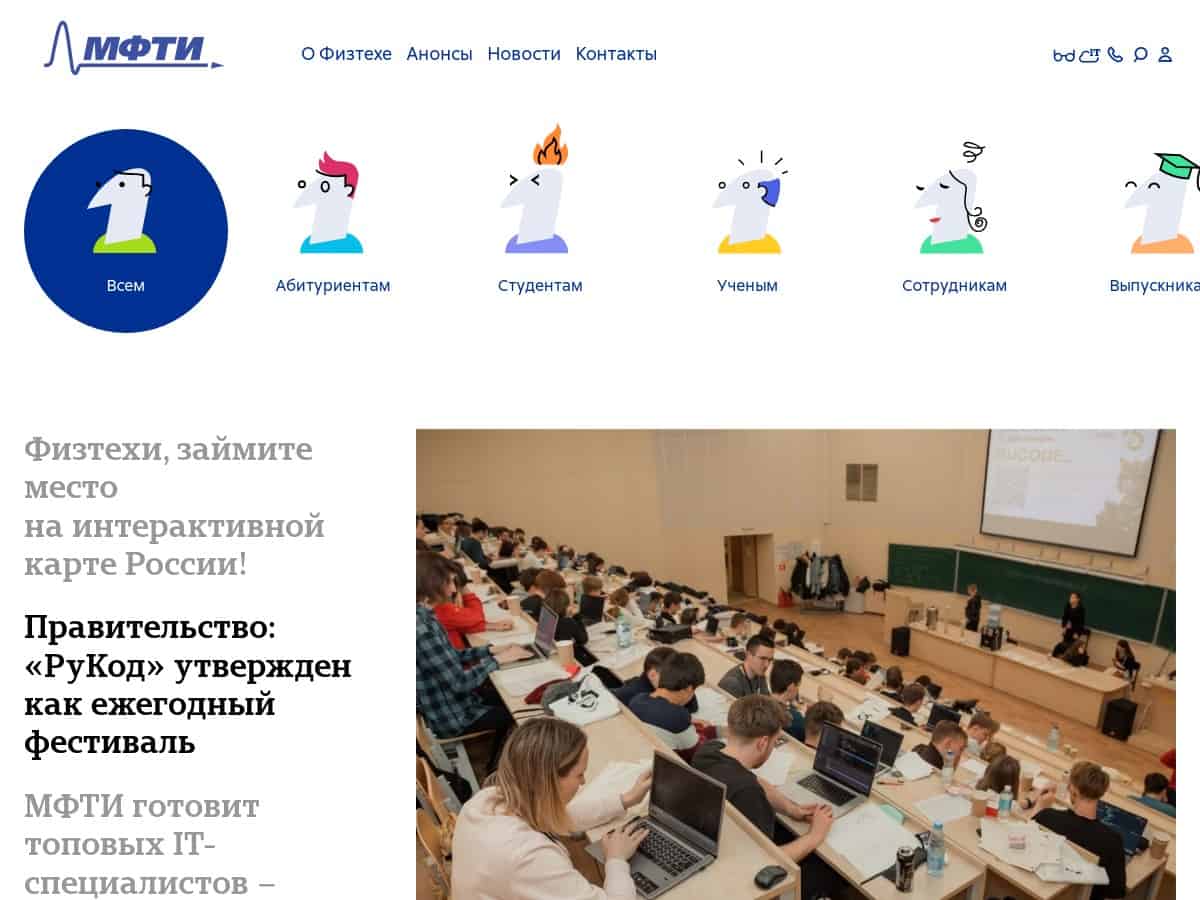
Established in 1946, MIPT is a leading Russian university specializing in physics, mathematics, and related disciplines. It is known for its unique Phystech System of education, integrating fundamental science with practical research at base institutes.
The Moscow Institute of Physics and Technology, MIPT, known as Phystech, was founded in 1946 in Dolgoprudny, a town just north of Moscow. The physicists Pyotr Kapitsa, Nikolay Semyonov and Sergey Khristianovich took part in its creation, and they designed a training system, the Phystech system, that has remained its trademark. It has about 7,000 students and 3,000 staff, and around one student in ten comes from abroad. The main campus is in Dolgoprudny, with additional buildings in Moscow and Zhukovsky.
The idea was to teach physics and mathematics at a very high level and to bring students into active research early. From the third year, students spend part of their time in research institutes, aircraft design bureaus and industrial laboratories, working with leading scientists on real projects. Entrance is highly selective, and many applicants come through national olympiads in mathematics, physics and computer science.
MIPT trained generations of specialists in theoretical physics, aerospace, radio engineering, computer science and applied mathematics. Andre Geim and Konstantin Novoselov, who received the 2010 Nobel Prize in Physics for graphene, both graduated from MIPT. The university has strong groups in condensed matter, nanotechnology, biotechnology, artificial intelligence and aerodynamics, and it works with the Russian Academy of Sciences and with technology firms.
Russian applicants enter by the Unified State Exam, olympiad results and the university’s own tests, with state-funded places and paid places. Foreign students can come through the government quota scholarship system or pay tuition. Fees vary by programme, so check the current tariff. Teaching is in Russian, with a limited number of master’s programmes in English. Since 2022, academic exchanges with institutions abroad have changed, so check the current status of agreements.
Dolgoprudny is a small town, and most students live in campus dormitories. The commuter train connects to central Moscow in about 30 minutes.
Domains taught:
Aerospace, AI and Machine Learning, Computer Vision, Mathematics, Nanotechnologies, Physics, Software Engineering
Diplomas*:
Bachelor, Doctor, Master
Status:
Public
Partnerships:
Collaborations with leading Russian Academy of Sciences institutes and international research centers; active student and researcher mobility programs.
Research:
World-class research in areas like condensed matter physics, astrophysics, biophysics, computer science, and aerospace technology. Strong emphasis on fundamental research.
Famous Alumnis:
Andre Geim, Konstantin Novoselov, Alexander Migdal
International recognition**:
Number of staff***:
3000
Current students***:
7000
Foreign students***:
10%
Cumulative former students***:
60000
Pros
Elite science and engineering education, deep integration with research institutions, highly talented student body, strong alumni network in science and tech.
Cons
Extremely rigorous and demanding academic program, high workload, campus located outside central Moscow.
Both schools build their programmes around computer vision, physics and mathematics, and Novosibirsk State University is the one to compare first within the country, since it is slightly larger, at about 8,000 students against roughly 7,000 here, and is also a public institution.
Both schools build their programmes around computer vision, physics and mathematics, and Lomonosov Moscow State University is the one to compare first within the country, since it is also a public institution, and teaches at the same levels, namely bachelor's, master's and doctoral.
For students who like the nanotechnologies, physics and AI and machine learning focus of this school but want another option nearby, National Research Nuclear University fits well: it covers process control and materials as well, and has almost the same size, at about 7,500 students.
Where this school leans on physics, mathematics and software engineering, Smolensk State University does the same, and it is also a public institution, and runs the same bachelor's, master's and doctoral programmes.
Anyone who wants a second school in the same country with a similar spread of nanotechnologies, physics and mathematics can consider Saint Petersburg State University, and it is far larger, with about 30,000 students against roughly 7,000 here, and is also a public institution.
Most Similar Schools Abroad
For aerospace, physics and mathematics outside the home country, Indian Institute of Science in India is a natural reference; it teaches at the same levels, namely bachelor's, master's and doctoral, and covers materials and life sciences as well.
In Ukraine, Oles Honchar Dnipro National University teaches much the same core subjects, aerospace, physics and mathematics, and it is larger, enrolling about 13,000 students against roughly 7,000 here, and is also a public institution.
In Ukraine, Taras Shevchenko National University of Kyiv teaches much the same core subjects, nanotechnologies, physics and mathematics, and it is also a public institution, and teaches at the same levels, namely bachelor's, master's and doctoral.
For a study option in Spain with a comparable spread of aerospace, nanotechnologies and physics, Facultad de Ciencias Físicas is the reference point: it is also a public institution, and teaches at the same levels, namely bachelor's, master's and doctoral.
Indian Institute of Science Education and Research Pune in India is the nearest foreign match on physics, mathematics and AI and machine learning; it covers geotechnics and chemistry as well, and is far smaller, with about 2,000 students against roughly 7,000 here.
*our own picks (our criteria: a mix between domains, diploma delivered, reputation and size), but obviously too many criteria for an apple-to-apple ranking.
FAQ
Where is MIPT?
In Dolgoprudny, a town just north of Moscow, Russia, at 9 Institutskiy pereulok.
When was it founded?
In 1946.
Who helped to create it?
Pyotr Kapitsa, Nikolay Semyonov and Sergey Khristianovich, among others.
How large is it?
About 7,000 students and 3,000 staff.
What is the Phystech system?
A training model in which students work in research institutes and industrial laboratories from the third year.
Which Nobel laureates graduated from MIPT?
Andre Geim and Konstantin Novoselov, who received the 2010 Nobel Prize in Physics for graphene.
How selective is it?
Entrance is highly selective, and many applicants come through national olympiads.
How do foreign students enter?
Through the government quota scholarship system or by paying tuition. Check the current tariff.
In which language are courses taught?
Mainly in Russian, with a limited number of master's programmes in English.
How far is it from central Moscow?
About 30 minutes by commuter train.
Astrophysics, Engineering, Innovation, Mathematics, Physics, Research and Development
*: without any judgment of the quality, readers are strongly encouraged to check the official status of the exact diploma envisioned as many universities have a mix of recognized diplomas, not recognized, “co-delivered,” “equivalent to”, “some pathways” (…), can change over time, and can be named differently from one country to another.
**: international reputation: is based on some criteria that do not mean much in some domains or specialties (number of researchers, of scientific publications, on budget ….). Our approximate 1-4 scale:
known locally
known locally and internationally
is listed in some of the world university’s classifications
is listed among the 20 firsts in some of world university’s classifications
***: estimated numbers, based on online sources and/or feedbacks. The numbers can vary greatly depending on school organisation (ex.: school is part of a group, it employs internal staff or external consultants or has public staff without employing them …). Refer to all the links provided to have accurate and updated numbers.
Innovation.world is not affiliated with this school/university. We recommend to contact them directly on their website for any special request.
To complete or correct any information here or share your opinion, please comment below or > send us a direct message <.