Product Design, Manufacturing & Innovation Resources
家 » 自然杀伤(NK)细胞毒性

自然杀伤(NK)细胞毒性

1975
  • Rolf Kiessling
  • Eva Klein
  • Hans Wigzell
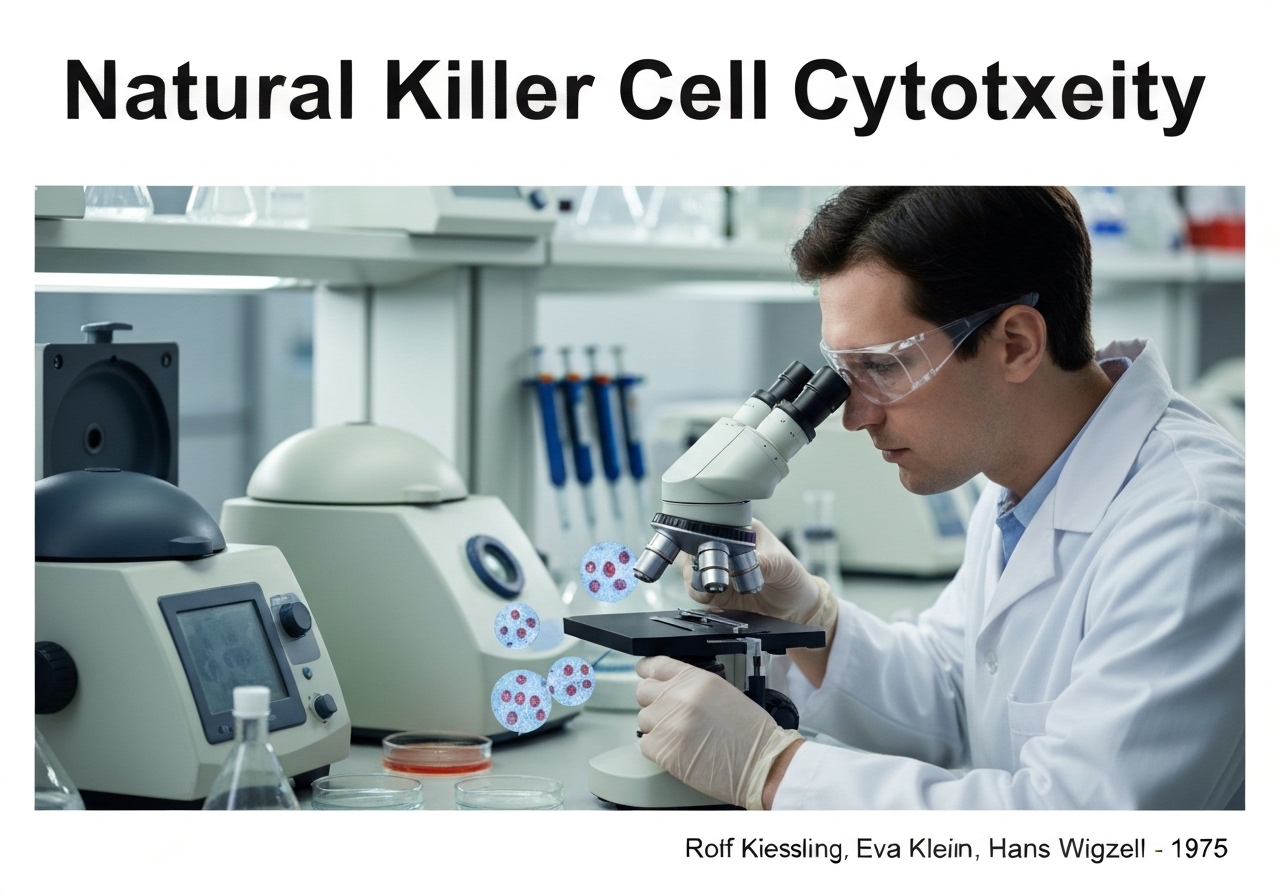
Natural Killer cells in a laboratory setting, examining cytotoxicity mechanisms.

(图片仅供参考)

Natural Killer (NK) cells are cytotoxic lymphocytes of the innate immune system, critical for early defense against viral infections and cancer. Unlike T cells, they do not require prior sensitization. NK cells identify and kill target cells that have downregulated MHC class I molecules—a common immune evasion tactic by tumors and viruses—through a “missing-self” recognition mechanism, inducing apoptosis via perforin and granzymes.
Natural Killer (NK) cells provide a rapid, first-line defense against cellular threats. Their function is governed by a balance of signals from activating and inhibitory receptors on their surface. Healthy cells express MHC class I molecules, which are recognized by inhibitory receptors on NK cells (like KIRs and NKG2A). This interaction sends a strong “don’t kill me” signal, preventing the NK cell from attacking. This is known as “missing-self” recognition: the absence of the ‘self’ MHC class I signal is what triggers the attack.

When a cell becomes cancerous or is infected by certain viruses, it often reduces the expression of MHC class I molecules to evade detection by cytotoxic T cells. This, however, makes it a prime target for NK cells. The lack of an inhibitory signal, often coupled with the presence of stress-induced ligands recognized by activating NK cell receptors (like NKG2D), tips the balance towards activation. Once activated, the NK cell’s cytotoxic mechanism is very similar to that of a CTL. It releases perforin and granzymes to induce apoptosis in the target cell. NK cells can also induce cell death through other pathways, such as the Fas/FasL interaction, and are key players in antibody-dependent cell-mediated cytotoxicity (ADCC), where they kill target cells coated with antibodies.

UNESCO Nomenclature: 2415
– Immunology

类型

Biological Mechanism

中断

重大的

用法

广泛使用

前体

  • 先天免疫和适应性免疫的区别
  • 确定淋巴细胞为关键免疫细胞
  • 干扰素的发现及其在抗病毒防御中的作用
  • 体外细胞杀伤试验的开发
  • 了解肿瘤免疫逃避机制

应用程序

  • 基于NK细胞的癌症免疫疗法
  • 病毒感染的治疗方法
  • 监测患者的免疫状态
  • understanding pregnancy immunology (NK cells are abundant in the uterus)
  • 抗体依赖性细胞介导细胞毒作用(ADCC)药物的开发

专利:

NA

潜在创新理念

  • Car-NK细胞疗法是Car-T的更安全替代方案
  • nk cell ‘engagers’ (bi-specific antibodies) to direct NK cells to tumors
  • 基于细胞因子的疗法可增强体内 NK 细胞活性
  • 开发现成的、来自脐带血或ipscs的同种异体NK细胞产品
  • engineering nk cells to resist the tumor microenvironment’s immunosuppressive effects
  • 基于NK细胞的早期癌症检测诊断
  • 利用 NK 细胞靶向并清除衰老细胞
  • NK细胞激活剂与检查点抑制剂的联合疗法
  • NK细胞治疗自身免疫性疾病
  • 通过基因改造 NK 细胞来表达特定的激活受体,从而增强靶向性
Related to: natural killer cell, NK cell, innate immunity, missing-self recognition, MHC class I, immunology, cancer surveillance, perforin, granzyme, ADCC.

历史背景

自然杀伤(NK)细胞毒性

1960
1967
1970
1975
1977
1983
1987
1958
1960
1970
1973
1975
1979
1983
1988

(如果日期未知或不相关,例如“流体力学”,则提供其显著出现的近似估计)

第十年 周年纪念日

只有注册会员才能免费获取完整尺寸的图片和下载内容。

> 登录 <