Product Design, Manufacturing & Innovation Resources
家 » 组织工程支架

组织工程支架

1990
  • Robert Langer
  • Joseph Vacanti
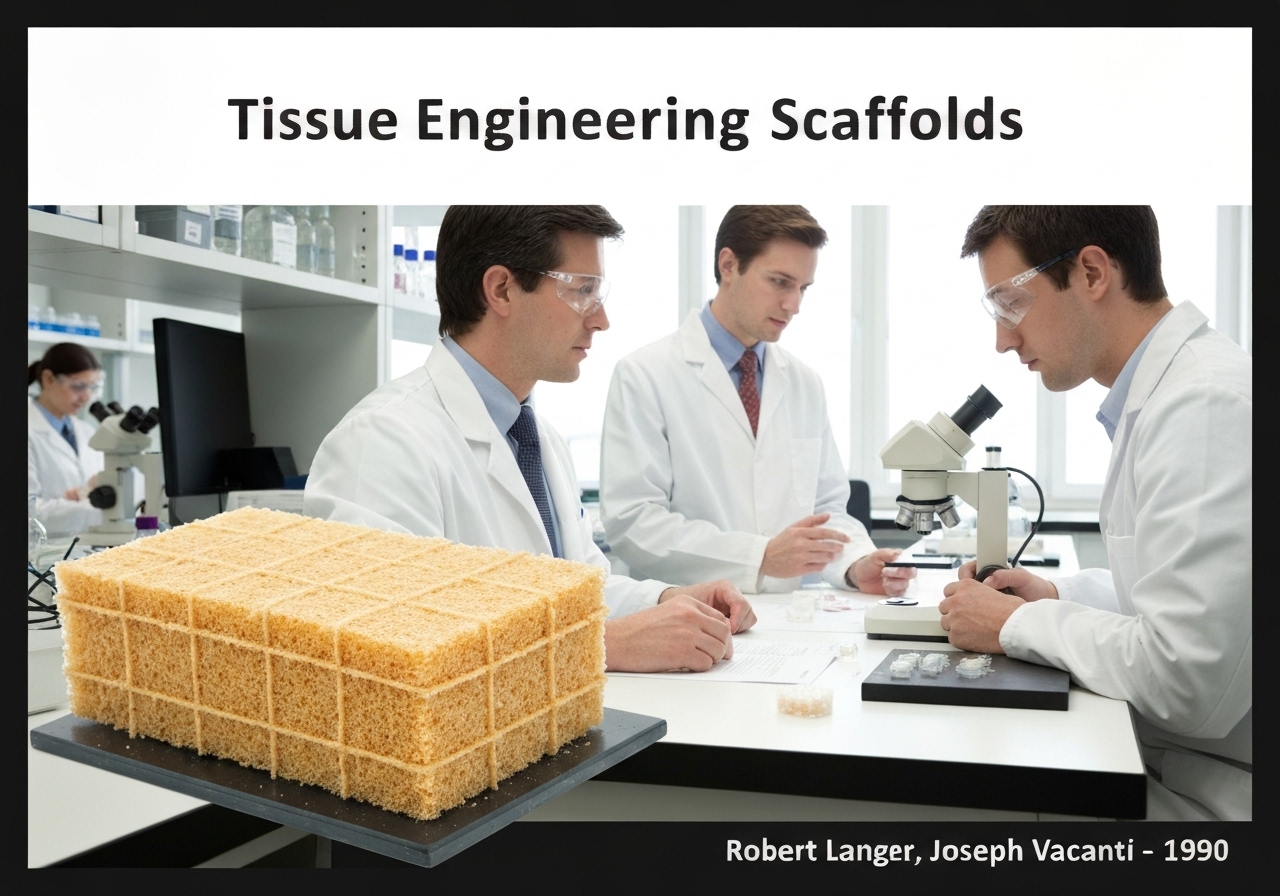
Biomaterial scaffold for tissue regeneration in medical sciences.

(图片仅供参考)

一个 tissue engineering scaffold is a porous, three-dimensional biomaterial structure that serves as a temporary template for tissue regeneration. It is designed to support cell attachment, migration, proliferation, and differentiation, guiding the formation of new functional tissue. Key properties include biocompatibility, biodegradability, appropriate mechanical strength, high porosity, and an interconnected pore network to allow nutrient and waste transport.

The design of a tissue engineering scaffold is a complex optimization problem. The material choice is critical; natural polymers like collagen and alginate offer excellent biocompatibility but may have poor mechanical properties, while synthetic polymers like poly(lactic-co-glycolic acid) (PLGA) and polycaprolactone (PCL) offer tunable degradation rates and mechanical strength. The scaffold’s architecture is equally important. High porosity and an interconnected pore structure are essential for cell infiltration and the diffusion of oxygen, nutrients, and metabolic waste. Pore size must be optimized for the specific cell type to facilitate adhesion and tissue formation. Advanced fabrication techniques are used to control these architectural features. For example, electrospinning uses a high voltage to draw a polymer solution into nanofibers that mimic the natural extracellular matrix (ECM). Additive manufacturing (3D printing) allows for the creation of patient-specific scaffolds with precise geometries derived from medical images like CT scans. Furthermore, scaffolds can be functionalized by incorporating growth factors, signaling molecules, or nanoparticles to actively direct cell behavior. The ideal scaffold degrades via hydrolysis or enzymatic action at a rate that matches the rate of new tissue formation, gradually transferring mechanical load to the nascent tissue until the scaffold is completely replaced by healthy, functional host tissue. Bioreactors are often used to mature these constructs in vitro by providing controlled flow and mechanical stimuli before implantation.

UNESCO Nomenclature: 3201
– Medical sciences

类型

Physical Device

中断

Revolutionary

用法

Emerging Technology

前体

  • 开发用于缝合线的可生物降解聚合物(如 PGA 和 PLA)
  • 细胞培养技术的进展
  • 了解细胞-细胞外基质(ecm)相互作用
  • 生长因子的发现及其在组织发育中的作用

应用程序

  • 骨和软骨的再生
  • 烧伤患者的皮肤移植工程
  • 血管和心脏瓣膜的形成
  • 使用引导导管修复神经损伤
  • 肝脏和膀胱等生物人工器官的开发

专利:

NA

潜在创新理念

  • 4d printed scaffolds that change shape over time in response to physiological stimuli
  • 具有内置生化线索梯度的支架,可模拟天然组织的复杂性
  • 预先装载内皮细胞的血管支架,以确保工程组织的血液供应
  • ‘smart’ scaffolds that release therapeutic agents on demand in response to inflammation
  • 来自供体组织的脱细胞细胞外基质(ecm)用作天然、复杂的支架
  • injectable, in-situ gelling hydrogel scaffolds for minimally invasive procedures
  • 带有集成传感器的支架,可以非侵入性地监测组织生长和健康状况
  • 利用支架技术进行药物筛选的器官芯片平台
  • 混合支架结合了合成聚合物(用于强度)和天然聚合物(用于生物活性)
  • scaffolds designed to recruit and direct the body’s own stem cells for repair
Related to: tissue engineering, scaffold, biomaterial, porous, biodegradable, cell adhesion, regeneration, 3d printing, electrospinning, plga.

历史背景

1969
1976-05-28
1980
1990
1965
1970
1980
1980
1990

(如果日期未知或不相关,例如“流体力学”,则提供其显著出现的近似估计)

第十年 周年纪念日

只有注册会员才能免费获取完整尺寸的图片和下载内容。

> 登录 <