Product Design, Manufacturing & Innovation Resources
家 » 胰岛素原加工和胰岛素生物合成

胰岛素原加工和胰岛素生物合成

1967
  • Donald F. Steiner
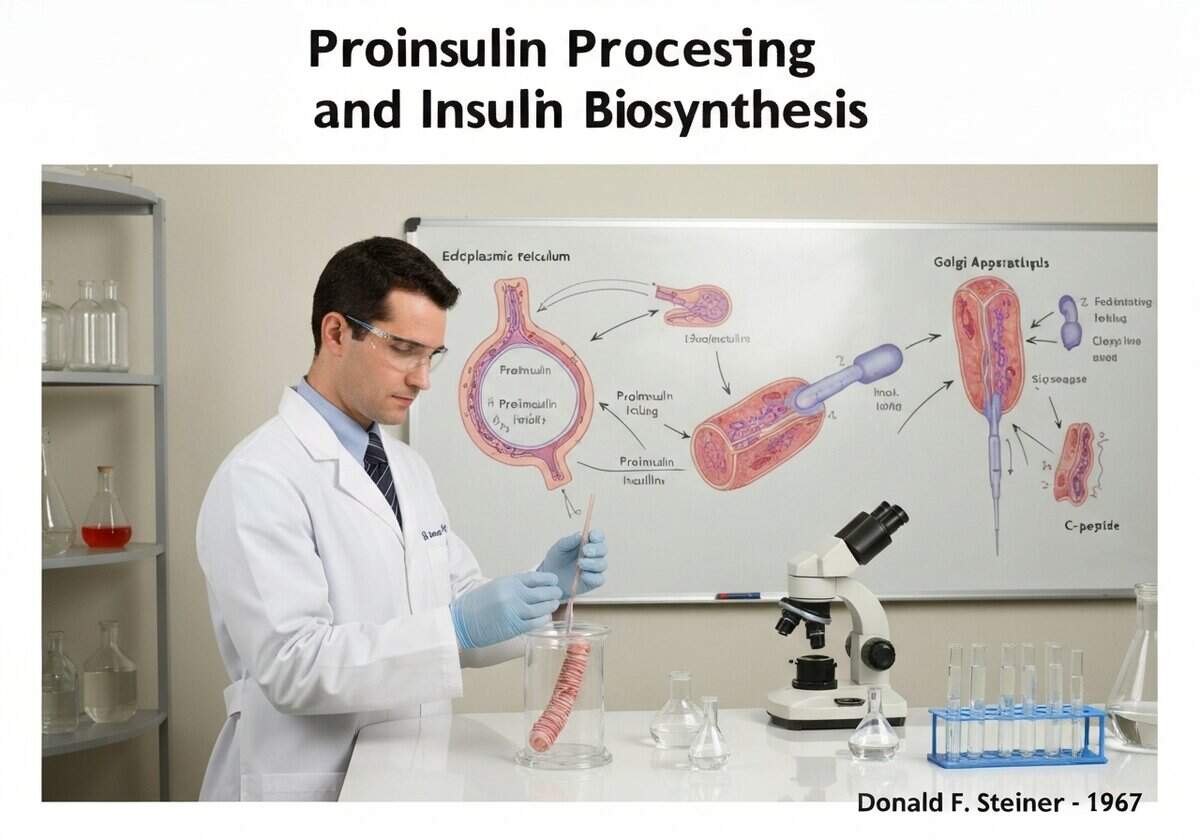
Researcher studying proinsulin processing in a laboratory for cell biology applications.

(图片仅供参考)

Insulin is synthesized in pancreatic beta cells as a single-chain precursor called proinsulin. In the endoplasmic reticulum, proinsulin folds and forms its disulfide bonds. It is then transported to the Golgi apparatus and packaged into secretory granules, where proteases (prohormone convertases PC1/3 and PC2, and carboxypeptidase E) cleave it into mature insulin and a connecting peptide, C-peptide.
The discovery of proinsulin by Donald F. Steiner in 1967 resolved a key puzzle in insulin biosynthesis. It was known that insulin consisted of two separate polypeptide chains (A and B), but the mechanism for ensuring their coordinated synthesis and correct assembly via disulfide bonds was unclear. Steiner’s research revealed that a single gene codes for a larger, single-chain precursor. This preproinsulin molecule contains a signal peptide at its N-terminus that directs it into the lumen of the endoplasmic reticulum (ER). The signal peptide is quickly cleaved off, leaving proinsulin. Proinsulin consists of the B chain, a connecting C-peptide, and the A chain, in that order (B-C-A). Within the ER, the molecule folds into its proper conformation, guided by chaperones, which brings the cysteine residues into proximity, allowing the three crucial disulfide bonds to form correctly. This folded proinsulin is then transported to the Golgi complex and packaged into immature clathrin-coated secretory vesicles. As these vesicles mature into dense-core secretory granules, the internal environment becomes more acidic, activating specific endoproteases. Prohormone convertase 1/3 (PC1/3) makes the initial cut at the B-chain/C-peptide junction, and prohormone convertase 2 (PC2) cuts at the C-peptide/A-chain junction. Finally, carboxypeptidase E (CPE) trims off basic amino acid residues at the new C-termini, resulting in the final, mature two-chain insulin molecule and the free C-peptide. Both are stored in these granules and co-secreted in equimolar amounts in response to high blood glucose.

UNESCO Nomenclature: 2403
– Cell biology

类型

Biological Process

中断

重大的

用法

广泛使用

前体

  • discovery of the protein synthesis pathway (ribosomes, er, golgi)
  • determination of insulin’s two-chain structure by sanger
  • 利用放射性氨基酸开发脉冲追踪标记技术
  • 蛋白水解酶(蛋白酶)的鉴定

应用程序

  • 测量血液中的 c 肽水平以评估内源性胰岛素的产生
  • 了解先天性高胰岛素血症,这是一种胰岛素原加工的遗传性疾病
  • 开发单链胰岛素类似物以提高稳定性
  • 细胞内蛋白质折叠和运输的研究
  • 为其他肽类激素的生物合成提供模型系统

专利:

NA

潜在创新理念

  • 基于 C 肽的成人隐匿性自身免疫性糖尿病诊断(LADA)
  • 开发蛋白酶抑制剂来研究激素加工
  • 改造胰岛素原分子,使其能够更有效地处理
  • 使用C肽作为糖尿病并发症的治疗剂
  • 构建无需裂解即可发挥活性的单链胰岛素类似物
  • 荧光标记的胰岛素原可视化活细胞中的蛋白质运输
  • 高通量分析筛选增强β细胞功能和胰岛素处理的药物
  • 分泌颗粒的蛋白质组学分析以鉴定新的调节蛋白
  • 基因治疗方法来纠正胰岛素原或加工酶的突变
  • 利用工程细胞系实现高效胰岛素原转化的生物制造策略
Related to: proinsulin, c-peptide, biosynthesis, beta cell, endoplasmic reticulum, golgi apparatus, secretory granule, protein folding, post-translational modification, donald steiner.

历史背景

胰岛素原加工和胰岛素生物合成

1950
1954
1960
1967
1970
1975
1977
1950
1951
1958
1960
1970
1973
1975
1979

(如果日期未知或不相关,例如“流体力学”,则提供其显著出现的近似估计)

第十年 周年纪念日

只有注册会员才能免费获取完整尺寸的图片和下载内容。

> 登录 <