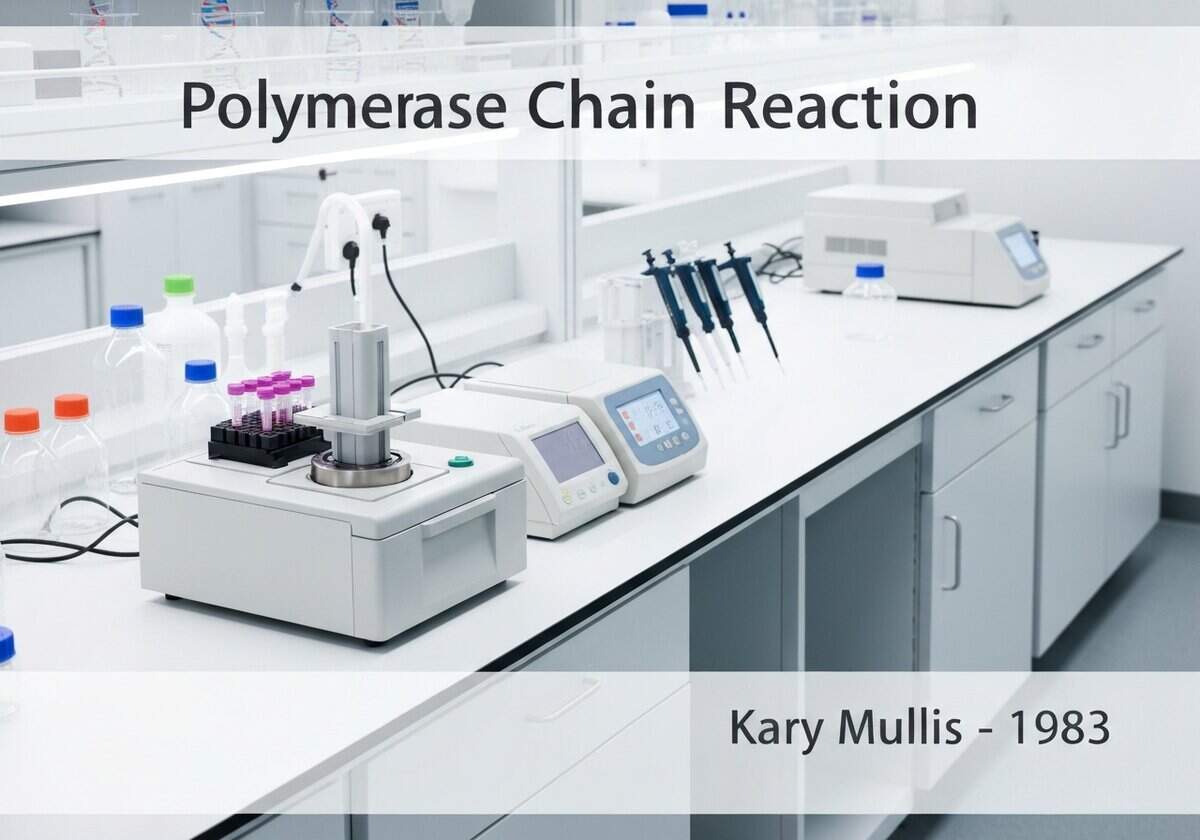
聚合酶链式反应(PCR)是一种实验室技术,用于扩增特定的DNA片段,从少量初始样本中产生数百万至数十亿个拷贝。 方法 该方法利用热循环,通过反复加热和冷却循环,使 DNA 熔解、引物退火,并使用耐热 DNA 聚合酶进行 DNA 的酶促复制,从而实现指数级扩增。
The Polymerase Chain Reaction (PCR) is a revolutionary in vitro method for exponentially amplifying a specific target DNA sequence. Its power lies in its ability to generate billions of copies from a minute starting quantity of DNA, making it possible to analyze DNA from samples as small as a single cell. The process is driven by a series of temperature changes, or thermal cycles, managed by a machine called a thermal cycler. Each cycle consists of three core steps. First, Denaturation: the reaction mixture is heated to 94–98 °C for a short period, causing the double-stranded DNA template to separate into single strands. Second, Annealing: the temperature is lowered to 50–65 °C, allowing short, single-stranded DNA primers to bind (anneal) to their complementary sequences on the now single-stranded template DNA. These primers flank the target region to be amplified. Third, Extension: the temperature is raised to 72 °C, the optimal temperature for the key enzyme, a thermostable DNA polymerase, to work. The most commonly used is Taq polymerase, isolated from the thermophilic bacterium *Thermus aquaticus*. The polymerase binds to the primer-template complex and begins synthesizing a new complementary DNA strand, extending from the primer. This three-step cycle is repeated 20-40 times. With each cycle, the number of copies of the target DNA sequence doubles, leading to an exponential amplification, mathematically described as [latex]2^n[/latex], where n is the number of cycles. The result is a solution containing a vast quantity of the specific DNA fragment, which can then be easily visualized by gel electrophoresis or used in subsequent molecular biology 例如测序或克隆等应用。
UNESCO Nomenclature: 2406
– Molecular Biology
类型
化学过程
中断
Revolutionary
用法
广泛使用
前体
DNA结构的发现
了解 DNA 复制原理
DNA聚合酶的分离
发现耐热生物及其酶(例如 Taq 聚合酶)
引物寡核苷酸合成的开发
应用程序
DNA指纹法医鉴定
medical diagnostics for infectious diseases (e.g., 新冠肺炎)
遗传性疾病基因检测
克隆基因
基因组测序
系统发育分析
专利:
US4683195
US4683202
US4965188
潜在创新理念
用于即时疾病诊断的便携式实时 PCR 设备
数字PCR(dPCR)用于核酸的绝对定量
多重PCR可同时检测多种病原体
用于 RNA 分析和基因表达研究的逆转录 PCR (RT-PCR)
原位PCR用于定位细胞或组织内的DNA/RNA
高保真PCR酶可减少测序中的扩增错误
快速 PCR 方案,几分钟内完成扩增
integration of PCR with microfluidic ‘lab-on-a-chip’ systems
using PCR for environmental DNA (eDNA) monitoring of 生物多样性
基于PCR的食品真伪检测和转基因检测
Related to: PCR, polymerase chain reaction, DNA amplification, kary mullis, taq polymerase, thermal cycling, forensics, diagnostics, molecular cloning, genetic testing.