Product Design, Manufacturing & Innovation Resources
家 » 伏打电堆中的电化学反应

伏打电堆中的电化学反应

1800
  • Alessandro Volta
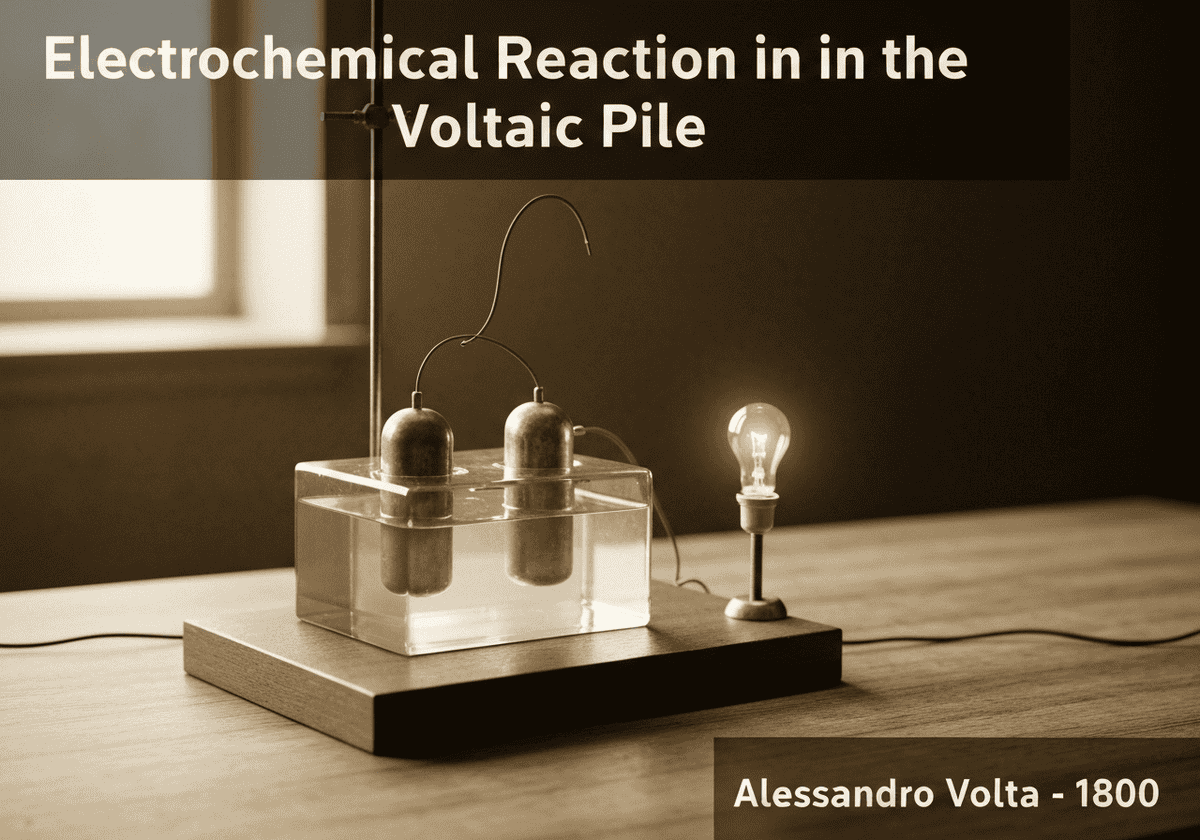
Voltaic pile demonstrating electrochemical reaction with zinc and copper electrodes.

(图片仅供参考)

The electric current in a Voltaic pile is produced by a redox reaction. At the zinc anode, zinc metal is oxidized, releasing two electrons per atom ([latex]Zn \rightarrow Zn^{2+} + 2e^{-}[/latex]). These electrons travel through the external circuit to the copper cathode. There, hydrogen ions from the aqueous electrolyte are reduced, forming hydrogen gas ([latex]2H^{+} + 2e^{-} \rightarrow H_2[/latex]).


The operation of the Voltaic pile is governed by the principles of electrochemistry. Each metal has a different electrode potential, or tendency to lose electrons. Zinc is more reactive than copper, meaning it has a more negative electrode potential and is more easily oxidized. This difference in potential is what drives the flow of electrons from the zinc (anode) to the copper (cathode) through an external wire. The electrolyte’s role is crucial; it contains ions that can move between the electrodes to balance the charge, completing the electrical circuit. In a simple brine (NaCl) or acid (H2SO4) electrolyte, water molecules provide the hydrogen ions (H+) for the reaction at the cathode.

The overall reaction for a pile using a sulfuric acid electrolyte is [latex]Zn + 2H^{+} \rightarrow Zn^{2+} + H_2[/latex]. The copper itself does not chemically react; it serves as a noble, conductive surface for the reduction of hydrogen ions. The potential of a single zinc-copper cell is approximately 0.76 volts, though this can vary with the electrolyte concentration and temperature. This fundamental mechanism of converting stored chemical energy into electrical energy is the basis for all modern batteries, albeit with different materials and more sophisticated designs to improve efficiency and 长寿.

UNESCO Nomenclature: 2203
– Electrochemistry

类型

化学过程

中断

Foundational

用法

广泛使用

前体

  • Antoine Lavoisier’s work on the role of oxygen in combustion and oxidation
  • 化学元素的概念及其反应性系列
  • 了解离子化合物及其在水溶液中的行为
  • Henry Cavendish’s identification of hydrogen gas

应用程序

  • all modern batteries (alkaline, lead-acid, 锂离子)
  • 燃料电池
  • 用于化学生产的工业电解
  • corrosion prevention through 阴极保护
  • 金属电解精炼

专利:

NA

潜在创新理念

  • bio-batteries using 微生物 oxidation of organic waste
  • 利用光驱动氧化还原反应的光电化学电池
  • 具有电解质的自修复电池,可修复内部短路
  • 针对性氧化还原反应用于中和特定的环境污染物
  • batteries using 液态金属 electrodes for grid-scale storage
  • 酶催化反应为微型生物传感器提供动力
  • 基于钠或铝等丰富元素的可充电电池
  • 用于直接捕获和转化二氧化碳的电化学系统
Related to: redox reaction, anode, cathode, oxidation, reduction, electrolyte, electrode potential, electrochemistry.

历史背景

伏打电堆中的电化学反应

1788
1800
1800
1800
1800
1801
1802
1785
1788
1800
1800
1800
1800
1802
1802

(如果日期未知或不相关,例如“流体力学”,则提供其显著出现的近似估计)

第十年 周年纪念日

只有注册会员才能免费获取完整尺寸的图片和下载内容。

> 登录 <