Product Design, Manufacturing & Innovation Resources
Lar » Reação eletroquímica na pilha voltaica

Reação eletroquímica na pilha voltaica

1800
  • Alessandro Volta
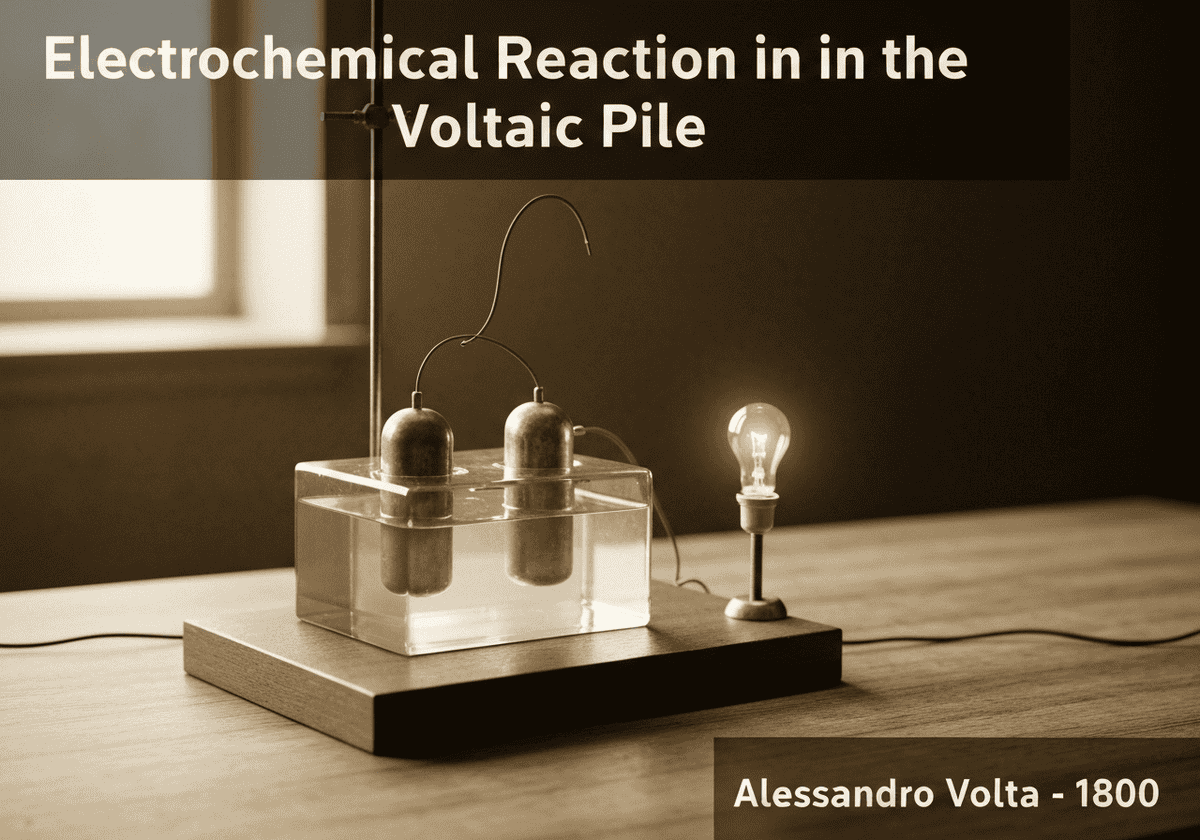
Pilha voltaica demonstrando reação eletroquímica com eletrodos de zinco e cobre.

(Imagem gerada apenas para fins ilustrativos)

A corrente elétrica em um Pilha voltaica é produzido por uma reação redox. No ânodo de zinco, o zinco metálico é oxidado, liberando dois elétrons por átomo ([latex]Zn rightarrow Zn^{2+} + 2e^{-}[/latex]). Esses elétrons viajam através do circuito externo até o cátodo de cobre. Lá, os íons de hidrogênio do eletrólito aquoso são reduzidos, formando gás hidrogênio ([latex]2H^{+} + 2e^{-} rightarrow H_2[/latex]).


The operation of the Pilha voltaica is governed by the principles of electrochemistry. Each metal has a different electrode potential, or tendency to lose electrons. Zinc is more reactive than copper, meaning it has a more negative electrode potential and is more easily oxidized. This difference in potential is what drives the flow of electrons from the zinc (anode) to the copper (cathode) through an external wire. The electrolyte’s role is crucial; it contains ions that can move between the electrodes to balance the charge, completing the electrical circuit. In a simple brine (NaCl) or acid (H2SO4) electrolyte, water molecules provide the hydrogen ions (H+) for the reaction at the cathode.

The overall reaction for a pile using a sulfuric acid electrolyte is [latex]Zn + 2H^{+} \rightarrow Zn^{2+} + H_2[/latex]. The copper itself does not chemically react; it serves as a noble, conductive surface for the reduction of hydrogen ions. The potential of a single zinc-copper cell is approximately 0.76 volts, though this can vary with the electrolyte concentration and temperature. This fundamental mechanism of converting stored chemical energy into electrical energy is the basis for all modern batteries, albeit with different materials and more sophisticated designs to improve efficiency and longevidade.

UNESCO Nomenclature: 2203
Eletroquímica

Tipo

Processo Químico

Interrupção

Fundamentais

Uso

Uso generalizado

Precursores

  • O trabalho de Antoine Lavoisier sobre o papel do oxigênio na combustão e oxidação
  • O conceito de elementos químicos e suas séries de reatividade
  • Compreensão dos compostos iônicos e seu comportamento em soluções aquosas.
  • A identificação do gás hidrogênio por Henry Cavendish

Aplicações

  • all modern batteries (alkaline, lead-acid, íon de lítio)
  • células de combustível
  • eletrólise industrial para produção química
  • corrosion prevention through proteção catódica
  • eletrorrefino de metais

Patentes:

NA

Ideias de Inovação Potencial

  • bio-batteries using microbial oxidation of organic waste
  • photoelectrochemical cells that use light to drive redox reactions
  • self-healing batteries with electrolytes that repair internal shorts
  • targeted redox reactions for neutralizing specific environmental pollutants
  • batteries using metal líquido electrodes for grid-scale storage
  • enzyme-catalyzed reactions for powering miniature biosensors
  • rechargeable batteries based on abundant elements like sodium or aluminum
  • electrochemical systems for direct carbon dioxide capture and conversion
Relacionado a: reação redox, ânodo, cátodo, oxidação, redução, eletrólito, potencial de eletrodo, eletroquímica.

Contexto histórico

Reação eletroquímica na pilha voltaica

1788
1800
1800
1800
1800
1801
1802
1785
1788
1800
1800
1800
1800
1802
1802

(Caso a data seja desconhecida ou irrelevante, por exemplo, "mecânica dos fluidos", é fornecida uma estimativa aproximada de seu surgimento notável)

10º ano aniversário

Imagens em tamanho real e downloads estão disponíveis apenas, 100% gratuitos, para membros registrados.