Product Design, Manufacturing & Innovation Resources
家 » 热力学第一定律

热力学第一定律

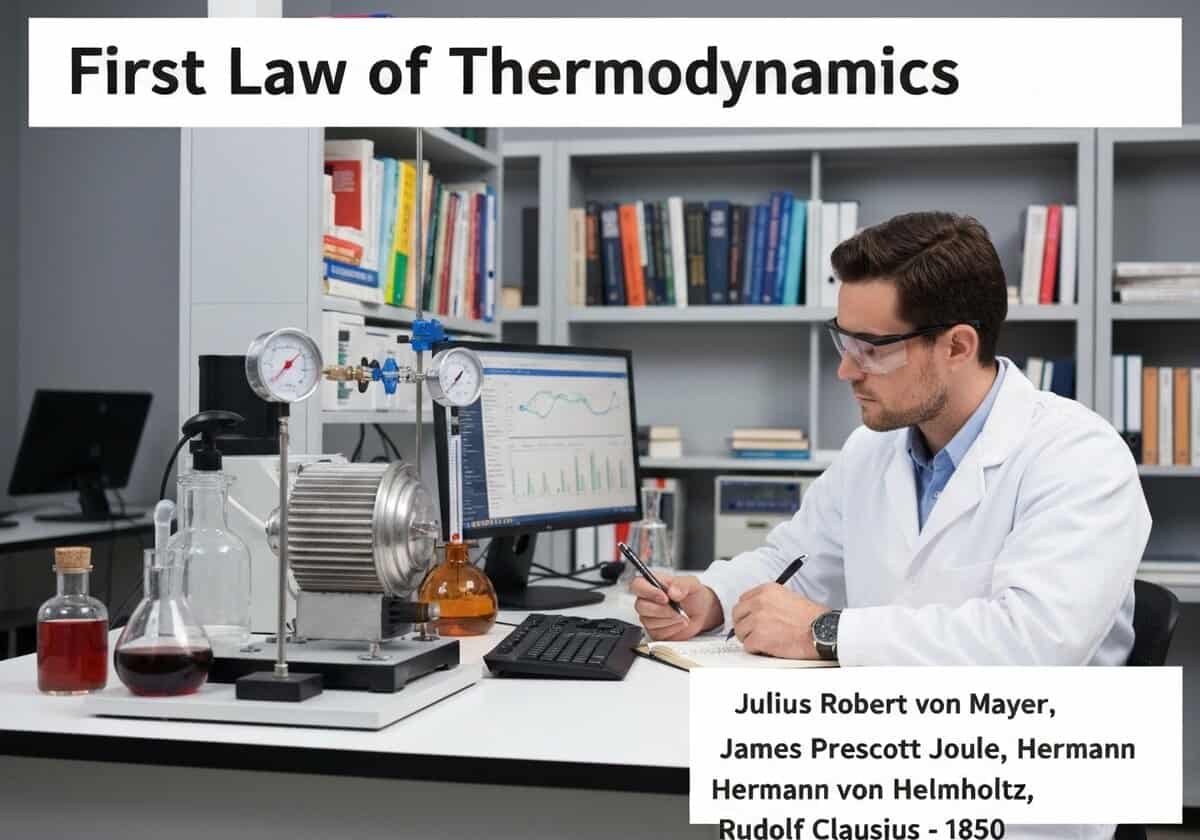
1850
  • Julius Robert von Mayer
  • James Prescott Joule
  • Hermann von Helmholtz
  • Rudolf Clausius
Laboratory experiment demonstrating the First Law of Thermodynamics with a heat engine setup.

(图片仅供参考)

The First Law is a statement of the conservation of energy. It posits that the change in a closed system’s internal energy ([latex]\Delta U[/latex]) is equal to the heat supplied to the system ([latex]Q[/latex]) minus the work done by the system on its surroundings ([latex]W[/latex]). The governing equation is [latex]\Delta U = Q – W[/latex]. This law links heat, work, and internal energy, establishing heat as a form of energy transfer.


The First Law of Thermodynamics generalized the principle of conservation of energy, which was previously known in mechanics, to include heat. Its formulation was a major step in physics, as it definitively refuted the prevailing caloric theory, which considered heat a weightless fluid. Experiments by James Joule in the 1840s, which demonstrated the mechanical equivalent of heat, were crucial in establishing that heat and work are mutually convertible.

The law introduces internal energy ([latex]U[/latex]) as a state function, meaning its value depends only on the current state of the system, not on how it got there. In contrast, heat ([latex]Q[/latex]) and work ([latex]W[/latex]) are path-dependent process quantities. The law’s differential form is [latex]dU = \delta Q – \delta W[/latex]. For a cyclic process, where the system returns to its initial state, the change in internal energy is zero ([latex]\Delta U = 0[/latex]), so the net heat supplied equals the net work done. This principle is the basis for all heat engines. The law also implies the impossibility of a perpetual motion machine of the first kind—a machine that produces work without any energy input.

UNESCO Nomenclature: 2212
热力学、统计物理学和凝聚态物质

类型

抽象系统

中断

Revolutionary

用法

广泛使用

前体

  • Sadi Carnot’s analysis of heat engines and 热力学 cycles
  • James Joule’s experiments on the mechanical equivalent of heat
  • 拒绝热质热理论
  • 莱布尼茨等人提出的力学能量守恒定律

应用程序

  • 热机(内燃机、蒸汽轮机)
  • 冰箱、空调和热泵
  • 化学反应分析(焓计算)
  • 发电厂设计和效率分析
  • 营养热量法用于计算食物能量(卡路里)

专利:

NA

潜在创新理念

  • 利用汽车尾气废热的热电发电机
  • 由细胞代谢过程驱动的纳米机器人微尺度热机
  • 先进的地热能系统,采用闭环能量循环为城市供电
  • 利用热力学循环的太阳能大气水收集器
  • 基于高效微型热泵的个人冷却和加热服装
  • 集成热存储的电动汽车动能回收系统
  • 低温 energy storage systems using liquid air as an energy vector
  • osmotic power generation plants at river estuaries, optimized by first-law principles
  • 利用放射性衰变热的深空探测器直接热电转换器
  • 通过精确管理热量和工作输出来优化微生物生长的生物反应器
Related to: first law, conservation of energy, internal energy, heat, work, thermodynamics, enthalpy, closed system, state function, perpetual motion.

历史背景

热力学第一定律

1842
1847
1850
1850
1850
1850
1850
1841
1845
1850
1850
1850
1850
1850
1851

(如果日期未知或不相关,例如“流体力学”,则提供其显著出现的近似估计)

第十年 周年纪念日

只有注册会员才能免费获取完整尺寸的图片和下载内容。

> 登录 <