Product Design, Manufacturing & Innovation Resources
Casa » Rivestimento a rotazione per deposizione di film sottili

Rivestimento a rotazione per deposizione di film sottili

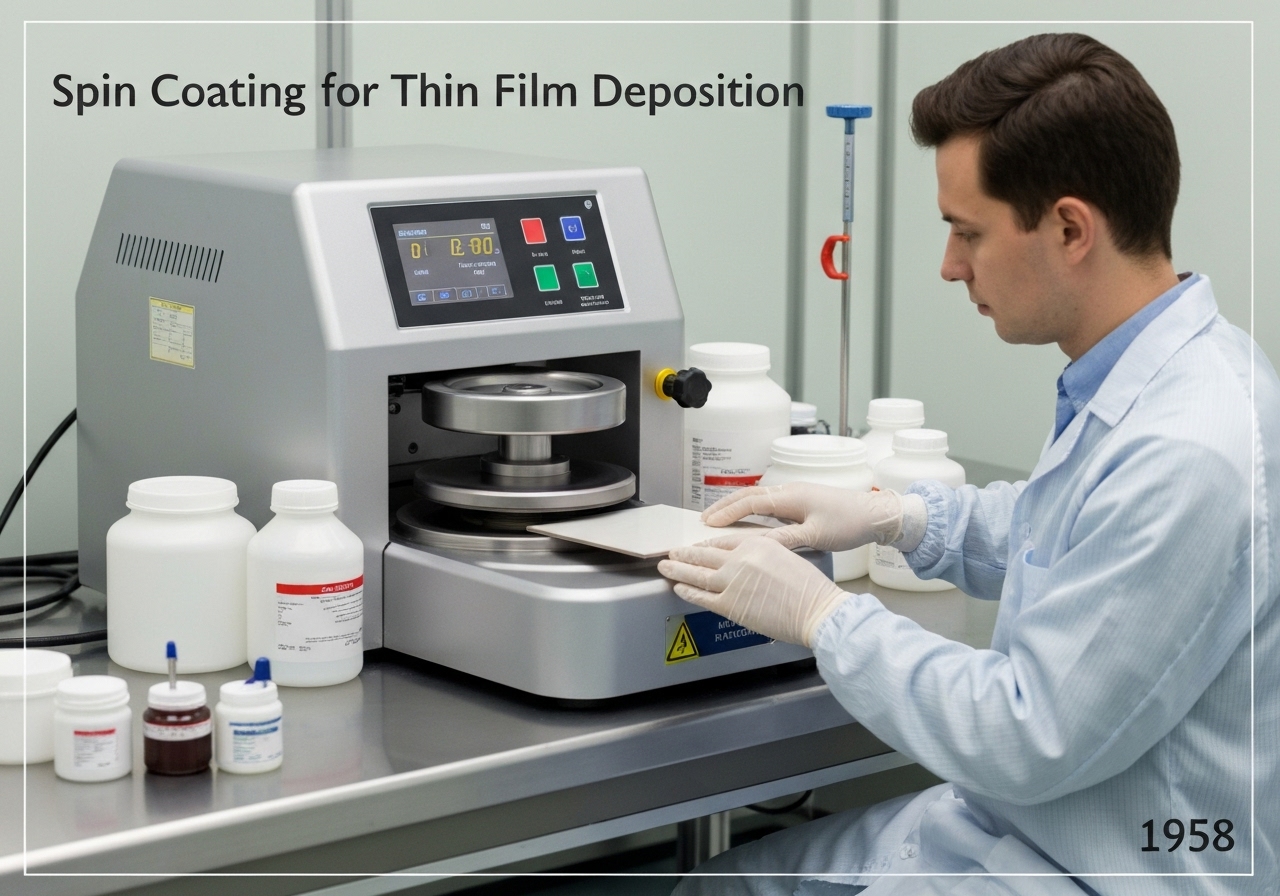
1958
Tecnico di laboratorio che esegue il rivestimento a centrifuga per la deposizione di film sottili in una camera bianca.

(Immagine generata a solo scopo illustrativo)

Spin coating is a procedure for depositing uniform thin films onto flat substrates. An excess of a coating solution is placed on the substrate, which is then rotated at high speed. Centrifugal force spreads the solution, and solvent evaporation or curing solidifies the film, with the final thickness determined by viscosità, concentrazione e velocità di rotazione.


The spin coating process is divided into four main stages: deposition, spin-up, spin-off, and evaporation. In the deposition stage, an excess of the coating fluid is dispensed onto the substrate’s surface. During the spin-up stage, the substrate is rapidly accelerated to its final, desired rotation speed, causing the fluid to flow radially outward due to forza centrifuga. The spin-off stage follows, where the excess fluid is ejected from the substrate’s edge, and the film thins. The final stage is evaporation, where the solvent evaporates from the film, leaving behind the solid coating. The thickness of the resulting film is highly dependent on several parameters. The key relationship was modeled by Emslie, Bonner, and Peck, showing that the final film thickness [latex]h_f[/latex] is proportional to the inverse square root of the angular velocity [latex]\omega[/latex], the initial solution concentration, and the solvent evaporation rate, and is also a function of the fluid viscosità [latex]\nu[/latex]. The formula is often simplified as [latex]h_f \propto \omega^{-1/2}[/latex]. This technique is favored for its simplicity, speed, and ability to produce highly uniform films with thicknesses ranging from a few nanometers to several micrometers on a laboratory scale. However, it is inherently a batch process and can be wasteful, as a significant portion of the initial solution is flung off the substrate.

UNESCO Nomenclature: 3322
- Tecnologia dei materiali

Tipo

Processo fisico

Interruzione

Incrementale

Utilizzo

Uso diffuso

Precursori

  • scoperta della forza centrifuga da parte di Christiaan Huygens
  • sviluppo del motore elettrico
  • sintesi di polimeri solubili e fotoresist
  • comprensione della dinamica dei fluidi e dei principi di evaporazione del solvente

Applicazioni

  • fabbricazione di dispositivi microelettronici e semiconduttori
  • produzione di rivestimenti ottici come strati antiriflesso
  • creazione di diodi organici a emissione di luce (OLED)
  • produzione di compact disc (CD) e dischi versatili digitali (DVD)
  • ricerca e sviluppo di nuovi materiali e sensori

Brevetti:

NA

Idee e potenziali innovazioni

  • sistemi automatizzati di rivestimento a rotazione multi-substrato per la ricerca ad alta produttività
  • monitoraggio in situ dello spessore del film durante la filatura mediante interferometria ottica
  • sviluppo di soluzioni senza solventi o a base d'acqua per il rivestimento a rotazione ecologico
  • rivestimento a centrifuga assistito da megasonic per ridurre i difetti e migliorare l'uniformità
  • rivestimento a rotazione su substrati flessibili e non planari utilizzando mandrini specializzati
  • integrazione con la stampa a getto d'inchiostro per la fabbricazione di dispositivi multistrato modellati
  • closed-chamber systems with controlled atmosphere and solvent pressione di vapore
  • development of “smart” photoresists that self-planarize during spinning
  • utilizzo di fluidi supercritici come solventi per l'evaporazione senza residui
  • spalmatori rotanti portatili a batteria per la ricerca sul campo e la diagnostica
Argomenti correlati: spin coating, film sottile, deposizione, substrato, forza centrifuga, semiconduttore, fotolitografia, soluzione polimerica, rivestimento uniforme, scienza dei materiali.

Contesto storico

Rivestimento a rotazione per deposizione di film sottili

1950
1950
1955
1958
1960
1960
1960
1950
1950
1955
1956
1960
1960
1960
1960

(se la data è sconosciuta o non rilevante, ad esempio "meccanica dei fluidi", viene fornita una stima approssimativa della sua notevole comparsa)

decimo anno anniversario

Le immagini a grandezza naturale e i download sono disponibili, gratuitamente al 100%, solo per gli utenti registrati.

> Login <