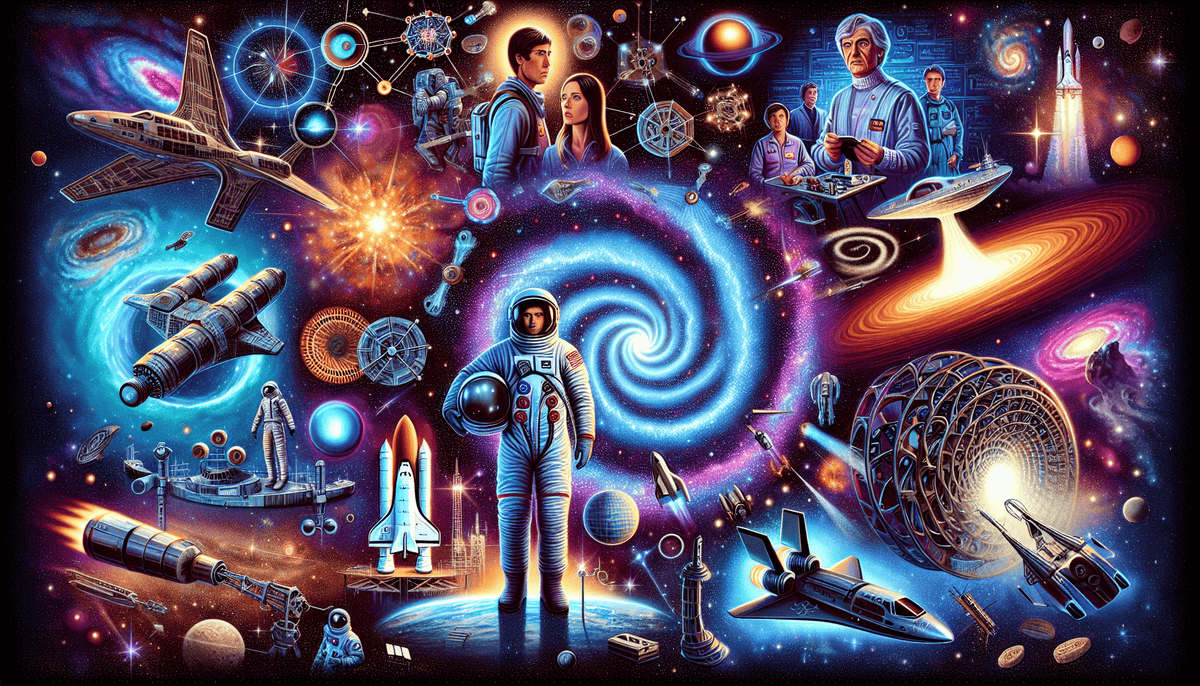
Our top 10 science‑fiction films educated picks that are especially interesting from a science and engineering perspective, focusing on realistic science, speculative engineering, or thoughtful treatment of technology.
이 10편의 공상과학 영화는 상상력이 풍부한 스토리텔링뿐만 아니라 과학적 원리와 공학적 현실에 대한 진정한 몰입을 보여줍니다. 화성 탐사 물류의 엄격함부터 생체 인식 보안의 심리학, 중력 물리학의 기초에 이르기까지 실제 지식과 가능성을 반영하는 신뢰할 수 있는 요소들이 영화 속에 녹아 있습니다. 그러나 각 영화는 극적인 속도감, 철학적 탐구 또는 시각적 스펙터클을 위해 추측, 과학적 지름길, 현재의 이해를 확장하거나 왜곡하는 발명품으로 내러티브를 겹겹이 쌓아 올립니다. 그 결과 호기심과 비판적 사고를 불러일으키는 다양한 요소가 혼합되어 시청자는 그럴듯한 이야기를 접하게 됩니다. 기술 하지만 확립된 사실과 창작물 라이선스 사이의 경계가 어디인지 항상 염두에 두어야 합니다.
메모: focusing on engineering, we have chosen not to necessary included the official trailer. Refer to online video channels for these.
Interstellar (2014) by Christopher Nolan
A team of astronauts travels through a wormhole to find a new home for humanity as Earth becomes uninhabitable.
The film stands out for its rigorous treatment of astrophysics, including time dilation near a rotating 블랙홀, gravitational lensing, and relativistic effects, all developed with physicist Kip Thorne. From an engineering perspective, it explores life‑support systems, spacecraft endurance, and mission planning under extreme uncertainty. It also examines how scientific theory, numerical simulation, and experimental data interact when confronting phenomena at the edge of known physics.
Science / Engineering:
- Gravitational time dilation is real: clocks run measurably slower deeper in a gravitational well (a core plot driver on Miller’s planet).
- Spinning structures can create “artificial gravity”: centripetal acceleration in a rotating habitat can mimic gravity (Endurance’s ring).
- Gravitational lensing is real: massive objects bend light and distort backgrounds (the black hole visuals are based on real GR ray‑tracing concepts).
- Tidal forces are real and can be extreme near massive bodies: strong gravity gradients can raise enormous tides (the film’s “giant waves” are tied to real tidal physics, even if the magnitude is debated).
More fiction than science:
- Traversable wormholes: not confirmed to exist; keeping one open/stable as a passage is completely speculative.
- Survivable proximity to a supermassive black hole for mission operations: many environmental hazards (radiation, accretion dynamics, navigation) are simplified/hand‑waved.
- “테세랙트”/벌크 존재 의사소통 메커니즘: completely imaginative fiction.
- The extreme time-dilation planet scenario as a practical habitable target: even if GR allows large dilation, the full “habitable + stable orbit + safe environment” package is highly implausible.
The Martian (2015) by Ridley Scott
An astronaut stranded on Mars must engineer his own survival using limited resources and scientific ingenuity.
This film is a masterclass in applied engineering and problem‑solving, showing how chemistry, mechanical engineering, botany, and systems integration can work together under severe constraints. It highlights redundancy, failure analysis, and 반복적인 디자인, all core principles in aerospace engineering. While not perfectly accurate, the film strongly reinforces the engineering mindset: diagnose, improvise, test, and adapt.
Science / Engineering:
- Communication delay Earth↔Mars: light-time delay causes minutes-long latency, shaping operations and messaging.
- CO₂ scrubbing with 리튬 hydroxide canisters: LiOH can chemically remove CO₂ from cabin air; the “make it work” adapter is plausible systems improvisation.
- Making water from rocket fuel chemistry (in principle): producing water via hydrogen release/combustion is chemically valid (though extremely dangerous).
- Orbital rendezvous and trajectory planning are real constraints: 타이밍 윈도우, 델타-V 및 궤도 역학 구조 타당성을 관리합니다.
More fiction than science:
- The opening Mars windstorm: Mars’ low air density makes such destructive wind forces very unlikely at the depicted level.
- Some habitat/vehicle survivability is overstated: puncture/leak/thermal behaviors and material limits are simplified for drama.
- Radiation risk is underplayed: long surface stays and transit without robust shielding would significantly increase dose.
- A few propulsion/mission details are “movie-optimized”: certain burns, masses, and margins are streamlined compared with strict engineering accounting.
Blade Runner (1982) by Ridley Scott
A detective hunts bioengineered humans while questioning what it truly means to be alive.
Blade Runner is deeply relevant to artificial intelligence, synthetic biology, and cognitive science, particularly in its exploration of consciousness and emotional intelligence. The replicants raise questions about engineered lifespans, genetic design, and memory implantation. For engineers, the film probes the ethical responsibilities tied to creating autonomous systems that are indistinguishable from humans.
Interesting to note that this futur was supposed to happen in 2019 (adapted from Philip K. Dick’s 1968 novel “Do Androids Dream of Electric Sheep?“)
Science points of interest:
- Physiological measures can indicate stress/arousal: the movies’s Voight‑Kampff test uses pupil/respiration/skin responses—real signals used in psychophysiology (though not a “truth meter”).
- Biometrics for identification are feasible: 식별 및 심사를 위해 생리적/행동적 단서를 사용하는 것은 원칙적으로 실제입니다(영화의 방법 는 가상의 인물입니다).
- Advanced forensic imaging exists (within limits): enhancement and analysis of imagery is real; extracting more information from recorded data is a genuine technique
More fiction than science:
- Bioengineered adults (“replicants”) indistinguishable from humans: 현재 생물학은 턴키 방식의 생리학으로 완전히 성장한 인간을 만들 수 없습니다.
- Implanted memories producing stable adult identity on demand: memory formation is not that writable/programmable.
- Near-human general AI in 2019 (the film’s setting): far beyond demonstrated AI capabilities.
- Flying cars as routine urban transport: possible in principle, but the energy, noise, safety, and air-traffic constraints are vastly minimized.
Blade Runner 2049 (2017) by Ridley Scott & Denis Villeneuve
A replicant investigator uncovers a secret that could destabilize the boundary between humans and artificial beings.
Building on the original from 1982 (selected here also, on the left), this sequel explores large‑scale AI deployment, industrialized bioengineering, and digital memory manipulation. It examines how engineered beings integrate into economic and social systems and how data, identity, and consciousness intersect. The film also reflects on long‑term consequences of design decisions and emergent behavior in complex engineered societies.
Science / Engineering:
- Drones for surveillance/inspection are real: small autonomous/remote aircraft are widely used and technically mature.
- Biometric identification (eye/face/voice) is real: automated recognition and tracking are established, with known accuracy/false-positive issues.
- Protein scarcity alternatives are real: 곤충 단백질 및 합성/가공 단백질 공급망은 자원에 대한 대응책 중 하나 일 수 있습니다. 압력.
- Baseline/psychometric testing is a real concept: standardized repeated prompts to detect deviation resembles real screening/monitoring (though the film’s version is dramatized).
- Large-scale industrial farming/processing automation is real: mechanized, sensor-driven production pipelines align with modern industrial trends.
More fiction than science:
- Humanlike replicants as manufactured biology: still very far beyond bioengineering capability.
- Reproduction of engineered replicants as depicted: speculative and not currently feasible in that controlled “product line” sense.
Fan bonus: Warner Bros. Pictures commissioned 3 prequels, happening inbetween the 2 movies: https://www.youtube.com/watch?v=Ffxo_6Cg0Cw
Arrival (2016) by Denis Villeneuve
A linguist races to communicate with aliens whose language reshapes human perception of time.
Scientifically, Arrival is notable for its focus on linguistics, information theory, and cognition rather than hardware. It treats science as a collaborative, hypothesis‑driven process and highlights the importance of interdisciplinary thinking. The film explores how communication protocols, symbolic systems, and mental models affect decision‑making in high‑stakes engineering and scientific contexts.
Science / Engineering:
- Establishing shared reference to communicate: grounding symbols in shared context (objects, actions, numbers) is fundamental in real field linguistics.
- Iterative hypothesis-testing is how real decoding works: propose meanings → test → revise, much like cryptanalysis and language documentation.
- Written language can be non-phonetic/logographic: real writing systems encode meaning beyond sound (the film’s logograms are fictional but the concept is real).
- 정보는 구조화된 신호에 포함될 수 있습니다. distinguishing “signal vs noise,” finding regularities, and extracting encoded data are core to communications engineering.
More fiction than science:
- Learning a language enabling perception of the future: not supported by neuroscience/linguistics (strongly fictional).
- Speed and completeness of global translation breakthroughs: real language acquisition/decoding would be slower and messier, especially without shared culture.
Ex Machina (2014) by Alex Garland
A programmer is invited to evaluate whether a humanoid robot truly possesses consciousness.
This film offers a tightly focused exploration of artificial intelligence, machine learning, and 로봇공학, particularly the limits of the Turing Test. It raises critical questions about embodiment, training data, manipulation, and alignment between creator intent and AI behavior. Engineers and computer scientists will recognize the dangers of closed systems, poor oversight, and underestimating emergent intelligence.
Science / Engineering:
- The Turing test: evaluating machine intelligence via conversational behavior is foundational real test in AI history.
- Human–AI interaction can be manipulated: social engineering, 설득, 그리고 인간을 악용하는 biases are real risks in interactive systems.
- Security/containment is a real issue: isolating powerful systems, limiting interfaces, and preventing unauthorized actions are real engineering concerns.
More fiction than science:
- Human-level general intelligence arising from “big data” alone: current ML does not reach the film’s broad reasoning, autonomy, and self-directed planning.
- Power/actuation density for a slim humanoid robot: energy storage, motors, cooling, and robustness are far harder than depicted.
- Materials and transparency of the body while maintaining strength/serviceability: highly stylized; real designs face major tradeoffs.
- “Consciousness” emergence and behavioral equivalence: the film treats consciousness as effectively demonstrable/assured, which remains unresolved scientifically.
Gattaca (1997) by Andrew Niccol
A genetically “inferior” man infiltrates a society obsessed with engineered perfection to pursue his dream of space travel.
Gattaca presents a plausible future shaped by genetic screening, gene selection, and biometric identification. The science itself is understated but realistic, emphasizing social engineering as much as biological engineering. The film remains a key reference for bioethics, showing how technically feasible innovations can produce profound societal inequality if left unchecked.
Science / Engineering:
- DNA profiling from small biological samples is real: hair roots, blood, skin cells, and saliva can enable identification.
- PCR and automated genotyping are real: rapid amplification/analysis pipelines exist and underpin modern genetic testing.
- Some preimplantation genetic testing is real: 배아는 이식 전에 특정 유전적 조건에 대해 검사를 받을 수 있습니다.
- Biometric access control is real: fingerprint/iris/blood-based authentication is widely used in security systems.
- Genetic variants can change disease risk statistically: many alleles influence probability of disease—risk is real even if not destiny.
More fiction than science:
- Near-perfect prediction of lifespan/health from genotype: real genotype→phenotype mapping is probabilistic and heavily environment-dependent.
- Single-test certainty for complex traits (intelligence, “potential,” personality): polygenic traits are not deterministically predicted as shown.
- Speed/ubiquity of flawless DNA testing everywhere: chain-of-custody, contamination, cost, and logistics are glossed over.
Genome understanding is not at that level at all yet. Social enforcement as if genetics equals fate: the film intentionally dramatizes genetic determinism beyond scientific support.
Contact (1997) by Robert Zemeckis
A scientist detects an extraterrestrial signal that leads to humanity’s first attempt at interstellar contact.
The film accurately portrays radio astronomy, signal decoding, and large‑scale international engineering collaboration. It emphasizes peer review, skepticism, and reproducibility as essential components of scientific credibility. Contact also examines how science interacts with politics, funding, and public trust when discoveries challenge humanity’s worldview.
Science / Engineering:
- SETI via radio telescopes is real: searching for narrowband, non-natural signals is a genuine scientific program.
- A signal encoded with mathematical structure is plausible: using primes or clear repetition as an “attention getter” is a sensible engineering choice.
- 신호 처리 steps are real: 탐지, 확인, RFI 거부, 재관측, 독립적 확인은 실제 사례를 반영합니다(컴퓨터를 가진 사람이라면 누구나 스트림의 일부를 해독하는 데 도움을 줄 수 있는 오픈 소스 프로젝트인 SETI의 일부로 진행되었습니다).
- Large-scale dishes/arrays and global collaboration are real: the film depicts the kind of infrastructure and coordination such a discovery would trigger.
More fiction than science:
- A buildable “machine” from alien blueprints on short timescales: materials, tolerances, verification, and safety certification would be far harder.
- Wormhole-style travel as depicted: speculative; no confirmed mechanism to build or traverse such structures.
- Certain physics/engineering details of the machine are unexplained: key aspects are intentionally “beyond us” rather than technically grounded.
Sunshine (2007) by Danny Boyle
In a dying future, a crew of astronauts flies a spacecraft dangerously close to the Sun to deliver a massive nuclear bomb intended to “restart” it and save humanity.
선샤인은 과학과 공학적 관점에서 우주선의 열 차폐, 거대한 중력체 근처의 궤도 역학, 방사선 노출, 생명 유지 장치의 제약에 초점을 맞춘 것이 특징입니다. 핵심 전제(태양 재점화)는 과학적으로 믿을 수 없지만 궤도 계획, 열 관리, 승무원 심리, 시스템 고장 등 많은 공학적 세부 사항을 진지하고 긴장감 있게 다룹니다. 극한의 환경을 사실적으로 묘사한 것으로도 자주 인용됩니다. 스트레스 하드웨어와 사람의 의사 결정 모두에 영향을 미칩니다.
Science / Engineering:
- Thermal shielding is mission-critical near high-radiation heat sources: managing radiative heat load is a central spacecraft 설계 문제. Solar intensity rises sharply as getting closer to the Sun, following the inverse-square law, driving brutal thermal constraints.
- 생명 유지는 빠듯한 시스템 엔지니어링 예산입니다. oxygen, CO₂ removal, water, power, and redundancy become mission-limiting in deep space.
- Human factors degrade under isolation and high stress: cognitive decline, conflict, and error propagation are real failure modes in extreme missions.
More fiction than science:
- “Restarting” the Sun with a bomb: scientifically impossible; the Sun isn’t a fission reactor that can be re-ignited this way (not even mentioning the size factor).
- Solar behavior portrayed as discrete, near-sentient “events”: flare dynamics and exposure effects are dramatized beyond real solar physics.
- Survivability and proximity operations near the Sun: many thermal/radiation realities would likely be mission-ending earlier than shown.
Minority Report (2002) by Steven Spielberg
A future police officer questions a system that predicts crimes before they occur.
The film anticipates modern issues in predictive analytics, surveillance, and human–computer interfaces. It explores algorithmic bias, data quality, and the dangers of assuming technological infallibility. From an engineering ethics perspective, it demonstrates how technically impressive systems can fail catastrophically when deployed without transparency or accountability.
Science / Engineering:
- Targeted advertising based on identification is real: linking identity to personalized ads is a real marketing/analytics practice.
- Retinal/iris biometrics are real: eye-based identification exists and is used for secure authentication.
- Gesture-based user interfaces are feasible and increasing: motion-tracked interaction is real (seen today in AR/VR, depth cameras, and specialty control rooms).
- Predictive analytics exists (in limited form): statistical models can forecast risk hotspots and likely patterns (as group; not individual certainties).
- Ubiquitous sensor networks raise real privacy/security issues: constant tracking increases attack surface and misuse potential.
More fiction than science:
- Precognition (“pre-cogs”) predicting specific future crimes: not scientifically supported at all.
- Deterministic, timestamp-precise prediction of human actions: human behavior isn’t predictable with that certainty from any known method
Honorable Mentions
Excellent movies, all recommended, but for our science and engineering selection, either a bit outdated, or the scientific topics has been seen already (time travel, AI and other …) :
2001: A Space Odyssey (1968) by
Humanity’s evolution is guided—and threatened—by a mysterious alien intelligence and a malfunctioning AI during deep‑space exploration. From an engineering standpoint, 2001 is remarkable for its realistic depiction of spaceflight: rotating space stations for artificial gravity, accurate orbital mechanics, and vacuum physics. HAL 9000 remains one of the most sophisticated portrayals of artificial intelligence, exploring fault tolerance, human–computer interaction, and the dangers of ambiguous goal alignment in autonomous systems. The film also anticipates modern concerns in systems engineering, such as over‑reliance on automation and the psychological effects of long‑duration space missions.
Moon (2009) by
A lone worker on a lunar mining base begins to uncover unsettling truths about his mission and identity. This film explores automation, AI supervision, and the psychological risks of isolated engineering environments. The lunar base is a believable example of closed‑loop life‑support systems and industrial resource extraction. It also raises ethical questions about labor, cloning, and the extent to which humans can be treated as replaceable components in engineered systems.
Her (2013) by
A man falls in love with an intelligent operating system that rapidly evolves beyond human limitations. The film presents a plausible trajectory for conversational AI, personalization algorithms, and emotional modeling. It explores scalability, rapid self‑improvement, and the mismatch between human cognitive speed and machine intelligence. For engineers, Her raises questions about dependency, alignment, and unintended consequences of highly adaptive AI systems.
프라이머(2004)
Two engineers accidentally invent time travel and struggle to control its consequences. Primer is famous for its dense, technically grounded approach to time travel, treating it like an engineering system with constraints, feedback loops, and failure modes. The characters behave like real engineers—documenting, iterating, and exploiting edge cases. It rewards analytical thinking and illustrates how small design choices can cascade into uncontrollable complexity.
District 9 (2009) by
A bureaucrat overseeing alien refugees becomes entangled in forbidden alien technology. The film offers a gritty look at reverse engineering, weapons development, and biotechnology, framed within a realistic political and industrial context. It shows how scientific advances are often driven by power, scarcity, and conflict rather than pure curiosity. Engineers will recognize themes of exploitation, dual‑use technology, and ethical compromise.
안드로메다 Strain (1971) 작성자
Scientists race to stop a deadly extraterrestrial microorganism from wiping out humanity. This film is unusually accurate in its depiction of laboratory protocols, containment systems, and interdisciplinary scientific 팀. It highlights failure analysis, redundancy, and risk management in bioengineering and epidemiology. The procedural focus makes it a classic example of science as a method rather than a spectacle.