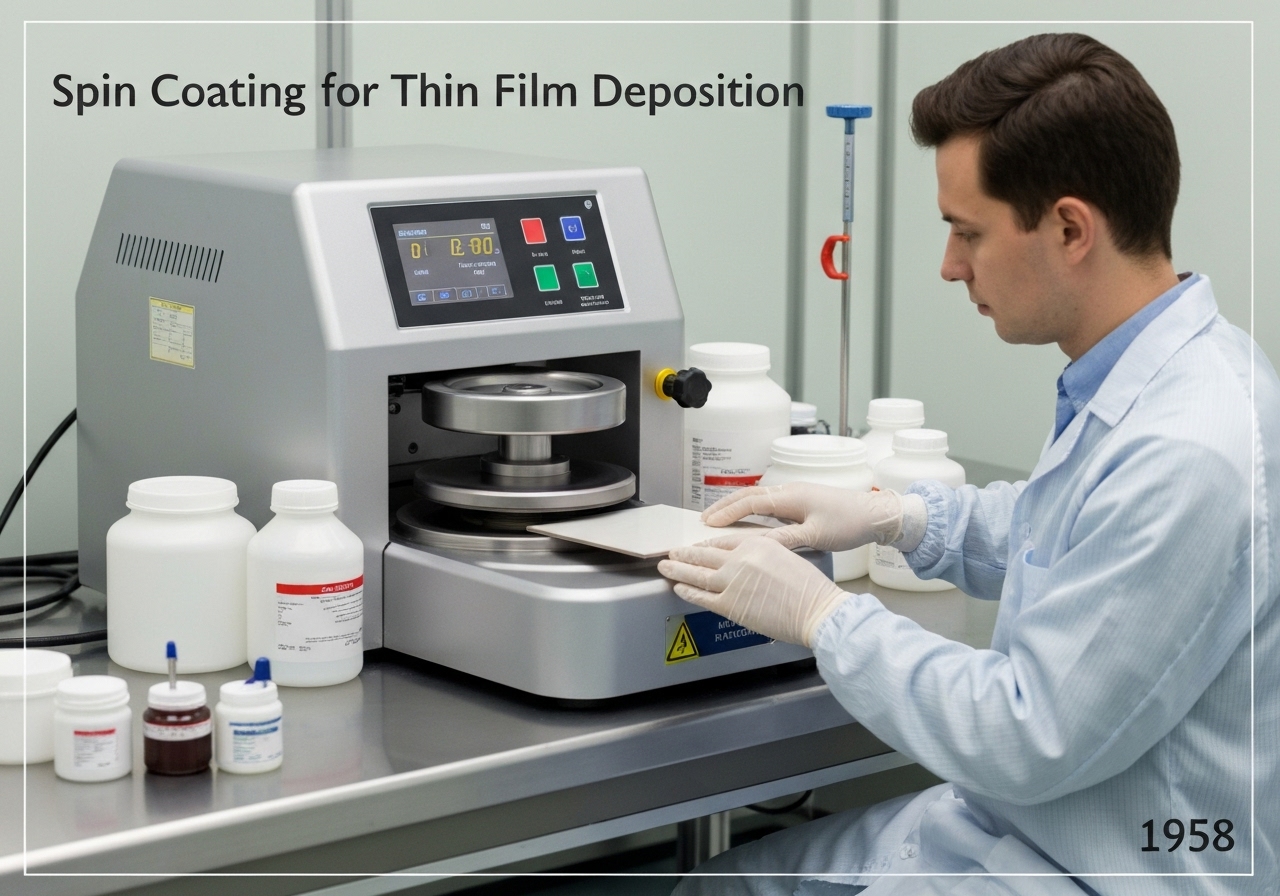
스핀 코팅은 평평한 기판 위에 균일한 박막을 증착하는 공정입니다. 코팅 용액을 기판 위에 과량으로 도포한 후 고속으로 회전시킵니다. 원심력에 의해 용액이 퍼지고, 용매 증발 또는 경화 작용으로 박막이 형성됩니다. 최종 박막의 두께는 점도, 농도 및 회전 속도에 따라 결정됩니다.

(설명을 위한 생성된 이미지입니다)
스핀 코팅은 평평한 기판 위에 균일한 박막을 증착하는 공정입니다. 코팅 용액을 기판 위에 과량으로 도포한 후 고속으로 회전시킵니다. 원심력에 의해 용액이 퍼지고, 용매 증발 또는 경화 작용으로 박막이 형성됩니다. 최종 박막의 두께는 점도, 농도 및 회전 속도에 따라 결정됩니다.
The spin 코팅 process is divided into four main stages: deposition, spin-up, spin-off, and evaporation. In the deposition stage, an excess of the coating fluid is dispensed onto the substrate’s surface. During the spin-up stage, the substrate is rapidly accelerated to its final, desired rotation speed, causing the fluid to flow radially outward due to 원심력. The spin-off stage follows, where the excess fluid is ejected from the substrate’s edge, and the film thins. The final stage is evaporation, where the solvent evaporates from the film, leaving behind the solid coating. The thickness of the resulting film is highly dependent on several parameters. The key relationship was modeled by Emslie, Bonner, and Peck, showing that the final film thickness [latex]h_f[/latex] is proportional to the inverse square root of the angular velocity [latex]\omega[/latex], the initial solution concentration, and the solvent evaporation rate, and is also a function of the fluid 점도 [latex]\nu[/latex]. The formula is often simplified as [latex]h_f \propto \omega^{-1/2}[/latex]. This technique is favored for its simplicity, speed, and ability to produce highly uniform films with thicknesses ranging from a few nanometers to several micrometers on a laboratory scale. However, it is inherently a batch process and can be wasteful, as a significant portion of the initial solution is flung off the substrate.
박막 증착을 위한 스핀 코팅
(날짜를 알 수 없거나 관련이 없는 경우, 예를 들어 "유체역학"의 경우, 주목할 만한 등장 시기를 대략적으로 추정하여 제공합니다.)

고화질 이미지 및 다운로드는 등록된 회원에게만 100% 무료로 제공됩니다.
> 로그인 <