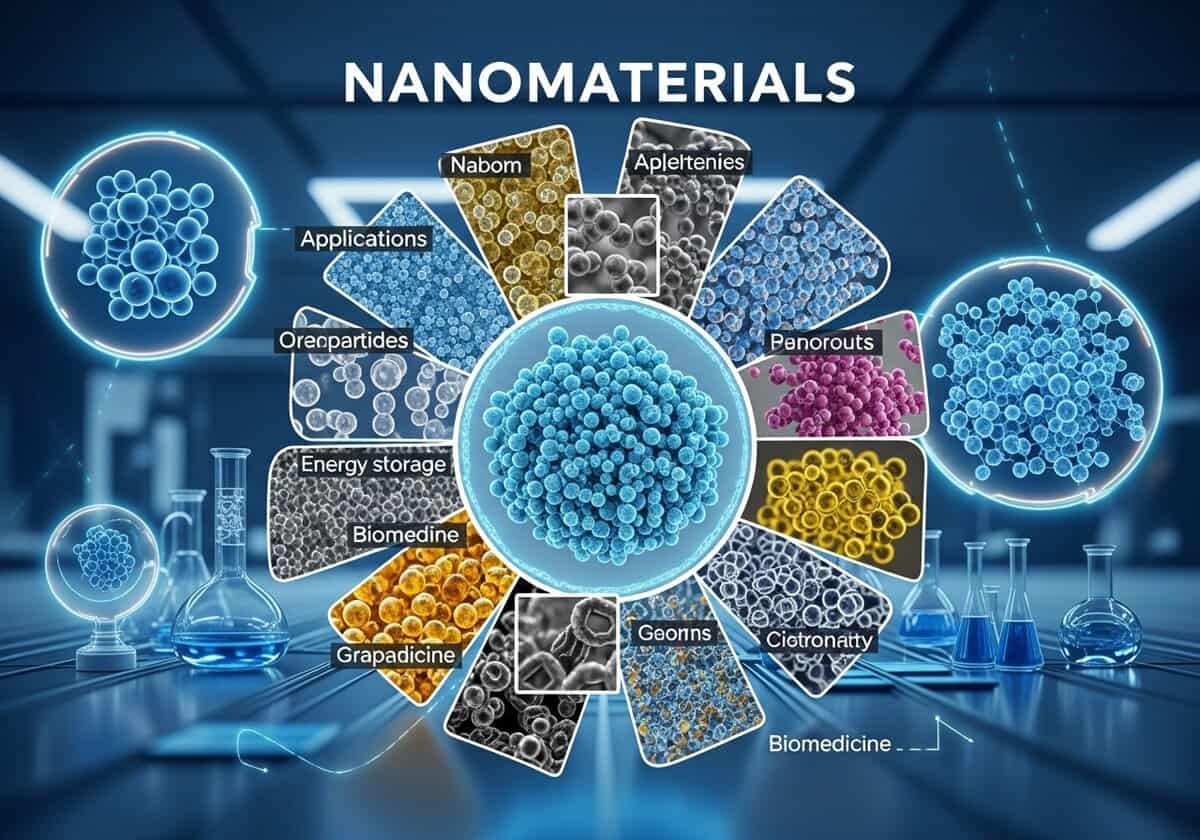
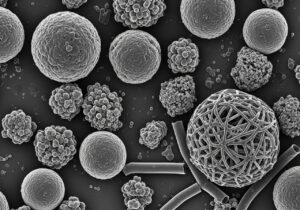
纳米材料涉及纳米尺度(通常小于100纳米)结构特征材料的设计、合成、表征和应用,这些材料展现出与其块体材料截然不同的独特物理化学性质。该领域涵盖多种材料,例如纳米颗粒、量子点、碳纳米管、石墨烯和纳米复合材料,其应用范围广泛,包括电子学、催化、储能、生物医学和环境修复等领域。可控制备技术、表面功能化和纳米尺度表征方法的进步推动了材料性能和功能的创新。以下汇编了最新的同行评审研究论文和专利成果。 技术 探讨合成方法、性能调控、集成策略以及安全评估等对纳米材料在多个行业的开发和应用至关重要的问题。
这是我们最新精选的关于纳米材料的全球出版物和专利,涉及许多科学在线期刊,分类并侧重于纳米粒子、量子点、碳纳米管、石墨烯、纳米线、纳米棒、纳米复合材料、纳米结构材料、纳米纤维、富勒烯、纳米团簇、纳米片、纳米晶体、纳米多孔材料、纳米催化剂、纳米医学、纳米毒理学、纳米制造、自组装纳米材料、表面功能化、纳米粒子合成、纳米力学、纳米光电、纳米磁性、纳米材料、纳米光刻、纳米涂层、纳米载体、纳米生物技术和纳米界面。.
Composite and method for producing composite
Patent published on the 2026-07-02 in WO under Ref WO2026140555 by CARBON FLY INC [JP] (Deng Fei [jp], Yu Fengming [jp])
Abstract: A composite which includes a base material and a carbon nanotube forest, wherein the carbon nanotube forest is provided on the base material without interposing any of a catalyst layer and an adhesive layer therebetween.[...]
Our summary: The content describes a composite consisting of a base material and a carbon nanotube forest. The carbon nanotube forest is applied directly to the base material. No catalyst or adhesive layers are used in the process.
Composite materials, carbon nanotubes, manufacturing method, catalyst-free
Patent
Perovskite solar cell and tandem solar cell comprising same
Patent published on the 2026-07-02 in WO under Ref WO2026142030 by HANWHA SOLUTIONS CORP [KR] (Jung Dong Ki [kr], Jang Eun Soo [kr], Moon Chan Su [kr], Choi In Take [kr])
Abstract: An embodiment of the present invention relates to a perovskite solar cell and a tandem solar cell comprising same, the perovskite solar cell comprising: a substrate; a first electrode disposed on the substrate; a second electrode disposed to face the first electrode; a light-absorbing layer disposed between the first electrode and the second electrode; and a hole transport layer between the second electrode and the light-absorbing layer, wherein the hole transport layer comprises a self-assemble[...]
Our summary: The invention describes a perovskite solar cell featuring a substrate, electrodes, and a light-absorbing layer. It includes a hole transport layer made of self-assembled organic material. This design enhances the performance of the solar cell device.
Perovskite, tandem solar cell, self-assembled monolayer, hole transport layer
Patent
Selective nanowire release and backfill for transistor channel stress engineering in nanowire field effect transistors
Patent published on the 2026-07-02 in US under Ref US20260190446 by INTEL CORP [US] (Ghani Tahir [us], Yeung Chun Wing [us], Xu Guowei [us], Lin Chia-ching [us], Lin Chung-hsun [us], Chu Tao [us], Zhang Yang [us], Zhang Kan [us], Hung Ting-hsiang [us], Zhang Feng [us])
Abstract: Devices, integrated circuit transistor structures, systems, and techniques are described herein related to gate all around field effect transistor circuits having an n-type transistor integrated with a p-type transistor such that each has stress engineering in the channel material thereof. The nanowires of the p-type transistor are released and surrounded by a sacrificial flowable oxide structure during source and drain material growth to apply compressive stress to the channel material. The n-t[...]
Our summary: This content discusses selective nanowire release and backfill techniques for stress engineering in n-type and p-type transistors. It describes how compressive and tensile stresses are applied to the channel materials during the growth of source and drain materials. The process involves using a sacrificial flowable oxide structure and lattice matched materials to optimize transistor performance.
nanowire transistors, stress engineering, channel material, integrated circuits
Patent
Zinc-graphite battery based on bromine chemistry enabled by water-in-salt electrolyte
Patent published on the 2026-07-02 in US under Ref US20260188757 by UNIV OF SHARJAH [AE] (Mouselly Maryam Mohd Haitham [ae], Parambath Javad Basil Marutheri [ae], Senthilkumar Sirugaloor Thangavel [ae], Alawadhi Hussain [ae], Allagui Anis [ae])
Abstract: The present disclosure discloses a zinc-graphite battery based on bromine chemistry enabled by water-in-salt electrolyte is disclosed. The battery comprises a foil selected to serve as a cathode host for the electrochemical reactions involving bromide ions, an anode selected from zinc foil or graphite foil that serves as a current collector for zinc deposition and dissolution, and water-in-salt electrolyte (WiSE) comprising lithium chloride (LiCl), zinc chloride (ZnCl2), and potassium bromide (K[...]
Our summary: The zinc-graphite battery utilizes bromine chemistry with a water-in-salt electrolyte. It features a cathode host for bromide ions and an anode for zinc deposition. The battery demonstrates high discharge capacity, efficiency, and extended cycle life.
Zinc-graphite, bromine chemistry, water-in-salt electrolyte, electrochemical reactions
Patent
Top coating composition
Patent published on the 2026-07-02 in WO under Ref WO2026139487 by MERCK PATENT GMBH [DE] (Kuwabara Shoji [jp], Hitokawa Hiroshi [jp], Kossoy Elizaveta [il], Dammel Ralph R [us], Azoubel Suzanna [il], Leader Avia [il])
Abstract: The present invention relates to a top coating composition comprising polymer (A), surfactant (B) and solvent (S). The polymer (A) comprises a side chain comprising a fused aromatic ring. The surfactant (B) comprises an aliphatic hydrocarbon portion (B1) and an alkylene oxide portion (B2). the solvent (S) comprises water (S1). The composition can be used for a top coat composition, which can exhibit at least one of properties of advanced material or high performance material. The composition can[...]
Our summary: The invention describes a top coating composition with polymer (A), surfactant (B), and solvent (S). Polymer (A) features a side chain with a fused aromatic ring, while surfactant (B) contains both aliphatic hydrocarbon and alkylene oxide portions. This composition is applicable in nanotechnology for advanced semiconductor and display devices.
top coating, polymer composition, surfactant, nanotechnology
Patent
Substrate cleaning liquid, method for producing substrate cleaned using same, and method for producing device
Patent published on the 2026-07-02 in WO under Ref WO2026139475 by MERCK PATENT GMBH [DE] (Nagahara Tatsuro [jp], Sugahara Shinji [jp], Yoshida Yuki [jp])
Abstract: [Problem] To obtain a substrate cleaning liquid capable of cleaning a substrate and removing particles. [Solution] A substrate cleaning liquid comprising a hydrophobic polymer (A), a polar compound (B), and a solvent (C): wherein the polar compound (B) is soluble in water. The substrate cleaning liquid is a highly functional material that can be used in a semiconductor device production step of a nanotechnology process, for example, a step of producing a semiconductor device that controls liquid[...]
Our summary: The content describes a substrate cleaning liquid that effectively removes particles. It includes a hydrophobic polymer, a polar compound, and a solvent. This cleaning liquid is designed for use in semiconductor device production, particularly in nanotechnology applications.
substrate cleaning, hydrophobic polymer, semiconductor device, nanotechnology
Patent
Optimal control of engineered swift equilibration of nanomechanical oscillators
Published on 2026-06-23 by Julia Sanders and Paolo Muratore-Ginanneschi @IOP SCIENCE
Abstract: Processes conveying physical information are always subject to speed limits. We explore the consequence of this in optimal control of indicators of finite-time thermodynamic transitions of nano-systems evolving according to an underdamped dynamics. Our main finding is that, in the presence of speed limits, problems like optimal engineered swift equilibration and transitions towards an out-of-equilibrium state at minimum work done to the system are well-posed. In particular, we show that there is[...]
Our summary: This study investigates optimal control for swift equilibration of nanomechanical oscillators under speed limits. It demonstrates that optimal transitions can occur without discontinuities in internal energy. The findings are relevant for experimental validation of optimal protocols in nano-systems.
Optimal control, nanomechanical oscillators, finite-time thermodynamics, underdamped dynamics
Publication
pH-responsive amphiphilic peptide nanofibers facilitate endosomal escape for cytosolic protein delivery
Published on 2026-06-16 by Tomonori Waku, Chikae Sakata, Tomoki Matsuda, Kotone Minato, Hiroyasu Takemoto, Kazuya Matsuo, Akio Kobori @NATURE
Abstract: Polymer Journal, Published online: 16 June 2026; doi:10.1038/s41428-026-01212-2We developed pH-responsive amphiphilic peptide nanofibers (NFs) that may facilitate cytosolic protein delivery by selectively destabilizing endosomal membranes. The NFs were based on β-sheet-forming peptides conjugated with oligoglutamic acid segments, and the number of Glu residues was varied to optimize pH-responsive activity. Optimized NFs showed strong membrane-destabilizing activity at mildly acidic pH but remai[...]
Our summary: The study presents pH-responsive amphiphilic peptide nanofibers designed to enhance cytosolic protein delivery. These nanofibers destabilize endosomal membranes at mildly acidic pH while remaining stable at neutral pH. When tested with ovalbumin in dendritic cells, they improved MHC class I presentation of the OVA-derived epitope.
pH-responsive, amphiphilic, peptide nanofibers, cytosolic delivery
Publication