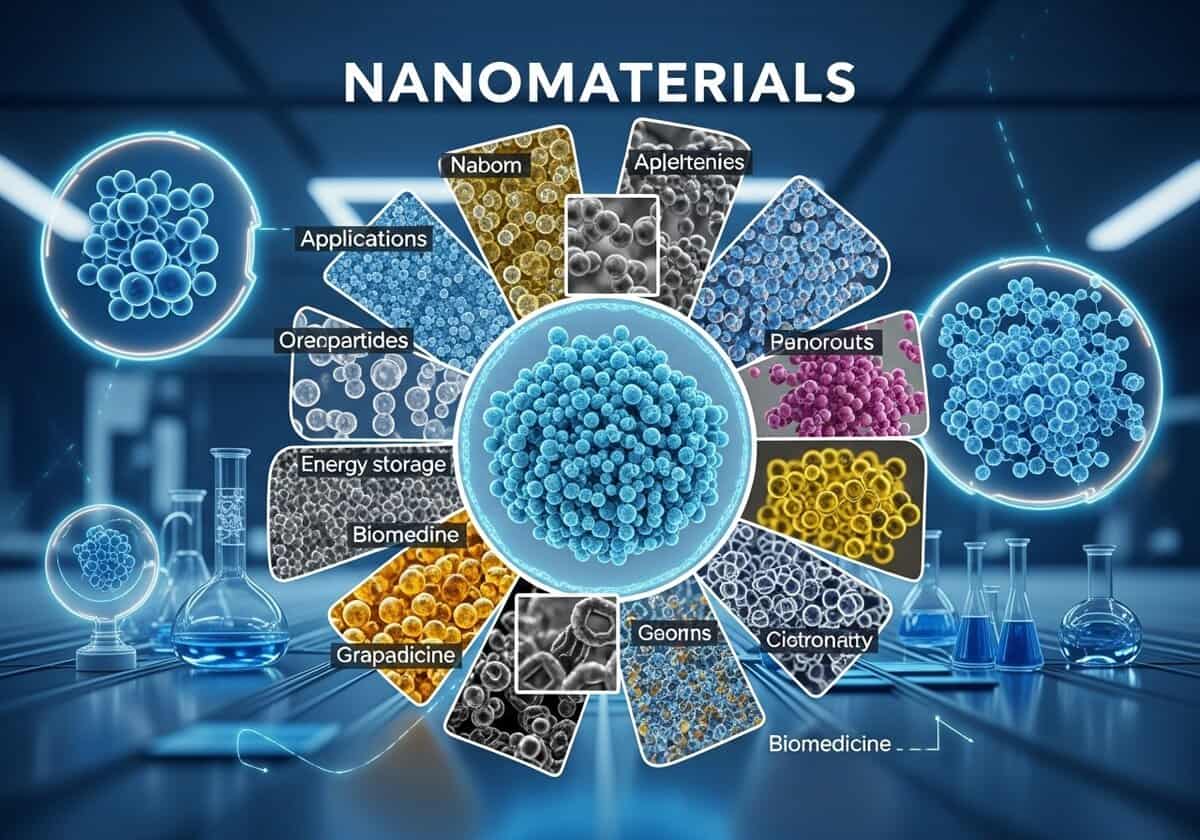
Nanomaterials involve the design, synthesis, characterization, and application of materials with structural features at the nanoscale, typically below 100 nanometers, exhibiting unique physicochemical properties distinct from their bulk counterparts. This domain includes diverse classes such as nanoparticles, quantum dots, Kohlenstoff-Nanoröhrchen, graphene, and nanocomposites, with applications spanning electronics, Katalyse, energy storage, biomedicine, and environmental remediation. Advances in controlled fabrication techniques, surface functionalization, and nanoscale characterization methods drive innovations in material performance and functionality. The following compilation presents the latest peer-reviewed research articles and patented technologies addressing synthesis methodologies, property tuning, integration strategies, and safety assessments critical for the development and deployment of nanomaterials across multiple industries.
Dies ist unsere neueste Auswahl an weltweiten Veröffentlichungen und Patenten in englischer Sprache zum Thema Nanomaterialien aus vielen wissenschaftlichen Online-Zeitschriften, klassifiziert und fokussiert auf Nanopartikel, Quantenpunkte, Kohlenstoff-Nanoröhren, Graphen, Nanodrähte, Nanostäbchen, Nanokomposite, nanostrukturierte Materialien, Nanofasern, Fulleren, Nanocluster, Nanoblätter, Nanokristall, nanoporöses Material, Nanokatalysator, Nanomedizin, Nanotoxikologie, Nanofabrikation, Selbstorganisation von Nanomaterialien, Oberflächenfunktionalisierung, Nanopartikelsynthese, Nanomechanik, Nanoplasmonik, Nanophotonik, Nanomagnetik, Nanomaterial, Nanolithographie, Nanobeschichtung, Nanoträger, Nanobiotechnologie und Nanoschnittstelle.
Coating for retaining cellular contents, encapsulation method, and application thereof
Patent published on the 2026-10-15 in US under Ref US20260317695 by NOVASTRA THERAPEUTICS INC [US] (Guo Junling [cn], He Yunxiang [cn])
Abstract: A nanocoating for retaining cellular contents, an encapsulation method, and applications thereof are disclosed. The raw materials of the nanocoating include metal ions and plant polyphenols, which form metal-polyphenol nanoparticles under acidic conditions. After binding to a cell, the metal-polyphenol nanoparticles form a nanocoating adhering to the cell surface under alkaline conditions. The nanocoating of the present invention prevents the leakage of critical intracellular substances to maint[...]
Our summary: This invention discloses a nanocoating method for retaining cellular contents using metal-polyphenol nanoparticles. The nanoparticles adhere to cell surfaces and maintain structural integrity by preventing leakage of intracellular substances. Additionally, the nanocoating protects against harmful substance leakage even after cell rupture.
nanocoating, encapsulation, metal-polyphenol nanoparticles, cellular integrity
Patent
Quantum dot layer, light-emitting element, light-emitting device, display device, quantum dot dispersion liquid, and organic ligand material
Patent published on the 2026-10-15 in WO under Ref WO2026215972 by SHARP KK [JP] (Yabuuchi Yuta)
Abstract: An organic ligand material (L1) according to the present disclosure contains a linear and unsaturated hydrocarbon group (HC). The hydrocarbon group (HC) contains a rigid and highly linear structure (RL). The number of carbon atoms contained in the rigid and highly linear structure (RL) is 40-100% of the number of carbon atoms contained in the hydrocarbon group (HC).[...]
Our summary: The content discusses an organic ligand material (L1) used in quantum dot layers for light-emitting devices. It specifies that the ligand contains a linear and unsaturated hydrocarbon group (HC). Additionally, the structure of the hydrocarbon group is characterized by a rigid and highly linear structure (RL) with a specific carbon atom ratio.
quantum dots, light-emitting devices, organic ligands, hydrocarbon groups
Patent
Plant-based milk storage
Patent published on the 2026-10-15 in US under Ref US20260314617 by XHEME INC [US] (Challa Siva Sai Ramana Kumar [us])
Abstract: Cerium oxide and zirconium dioxide films and containers for the storage of plant-based milk. More specifically, cerium oxide nanoparticles and/or nanoporous cerium oxide nanoparticle macro-structures and/or zirconium dioxide nanoparticles are dispersed within or coated onto a polymeric film or other substrate material which may be in the form of a container for storage and increased shelf-life of plant-based milk.[...]
Our summary: Cerium oxide and zirconium dioxide are used in films and containers for plant-based milk storage. These materials enhance the shelf-life of the milk. Nanoparticles are dispersed or coated onto polymeric substrates for effective storage solutions.
cerium oxide, zirconium dioxide, nanoparticle, shelf-life
Patent
Methods for quantifying polynucleotides in a lipid nanoparticle
Patent published on the 2026-10-15 in WO under Ref WO2026214999 by GLOBAL LIFE SCIENCES SOLUTIONS OPERATIONS UK LTD [GB] (Kumar Aman [ca], Crowe Adam [ca], Mayya Vinay [ca])
Abstract: Disclosed herein are methods for quantifying one or more polynucleotides in a sample, including introducing a first probe into the sample, wherein the sample comprises a first polynucleotide, and the first probe comprises a sequence complementary to a portion of the first polynucleotide, a first detection tag, and a first spacer sequence linking the complementary sequence of the first probe and the first detection tag; selectively annealing the first probe to the first polynucleotide, thereby fo[...]
Our summary: Methods for quantifying polynucleotides involve using a complementary probe to selectively bind to the target polynucleotide. The process includes separating the annealed probe from other sample components. Detection of the probe allows for quantification of the polynucleotide present in the sample.
polynucleotides, lipid nanoparticles, quantification methods, probe detection
Patent
Antimicrobial polymer technology
Patent published on the 2026-10-15 in WO under Ref WO2026215679 by ZONOVA TECH LTD [GB] (Fleet Georgia [gb], Brawn Peter [gb], Trivedi Manish [gb])
Abstract: The disclosure provides antimicrobial polymer compositions comprising a plurality of metallic nanoparticles, one or more photosensitizers, and a polymer, wherein the components are combined under high temperature or pressure conditions to form a medical device exhibiting antimicrobial activity under both light and dark conditions without requiring a light-activation source. The disclosure also provides methods of preparing an antimicrobial polymer composition and methods of manufacturing an anti[...]
Our summary: The disclosure details antimicrobial polymer compositions that combine metallic nanoparticles and photosensitizers. These compositions can be used to create medical devices with antimicrobial properties without needing light activation. Methods for preparing these compositions and manufacturing devices include techniques like extrusion and injection molding.
antimicrobial polymers, metallic nanoparticles, photosensitizers, medical devices
Patent
Furfural chitosan copper nanoparticles-based corrosion inhibitor
Patent published on the 2026-10-15 in US under Ref US20260317910 by IMAM ABDULRAHMAN BIN FAISAL UNIV [SA] (Elsharif Asma Mohammed Zamil [sa], Alyami Renad Abdulrazaq [sa])
Abstract: [0000] A corrosion inhibitor that includes copper nanoparticles and a furfural-functionalized chitosan Schiff base disposed on a surface of the copper nanoparticles and a method of forming the corrosion inhibitor. The method of forming the corrosion inhibitor includes forming the furfural-functionalized chitosan Schiff base by reacting chitosan, furfural, and an acid catalyst at 60° C. to 100° C., dispersing copper nanoparticles in a first organic acid solution to form a copper nanoparticle so[...]
Our summary: A corrosion inhibitor is created using copper nanoparticles and a furfural-functionalized chitosan Schiff base. The method involves reacting chitosan, furfural, and an acid catalyst, followed by mixing with copper nanoparticles. This inhibitor effectively prevents corrosion of metals like mild steel in acidic environments.
Furfural, Chitosan, Copper Nanoparticles, Corrosion Inhibitor
Patent
Graphene-integrated flexible films with a three-dimensional elastic network and photothermal responsiveness
Published on 2026-09-30 by Jiahui Dong, Yu-I Hsu, Hiroshi Uyama @NATURE
Abstract: Polymer Journal, Published online: 30 September 2026; doi:10.1038/s41428-026-01255-5A biodegradable PLCL-PEG-PLCL elastic network was constructed by PETMP-assisted thiol-ene photocrosslinking and integrated with graphene for photothermal functionality. The network structure regulated the mechanical deformability and degradation behavior of the films, while graphene enhanced toughness and enabled rapid light-to-heat conversion. These findings demonstrate that combining network engineering with gr[...]
Our summary: The study presents a biodegradable PLCL-PEG-PLCL elastic network integrated with graphene. This integration enhances mechanical properties and enables photothermal responsiveness. The findings highlight a strategy for developing flexible, degradable films with improved performance.
Graphene, Photothermal, Biodegradable, Elastic Network
Publication
Bright, directional electron emission from nanowire coated targets under petawatt, femtosecond irradiation
Published on 2026-09-29 by Ameya Parab, Jian Fuh Ong, Stefania Ionescu, Sagar Dam, Sk Rakeeb, Hideaki Habara, Rudrajyoti Palit, Daniel Popa, Deepak Sangwan, Klaus Spohr, Lucian Tudor, Adrian Vatcu, K Yamanaka, Prashant Kumar Singh, Kazuo A Tanaka and G Ravindra Kumar @IOP SCIENCE
Abstract: Nanostructured targets have long been explored for controlling laser absorption and particle acceleration, but whether they survive the pre-pulse of a petawatt-class laser at realistic temporal contrast remains an open question. We report an experimental and simulation study of nickel nanowire-coated targets irradiated by the ELI-NP 1-PW laser without a plasma mirror. At the built-in contrast of the nanowires increase the relativistic electron flux and redistribute the emission direction. The ef[...]
Our summary: The study investigates the effects of petawatt laser irradiation on nickel nanowire-coated targets. It finds that the nanowires enhance relativistic electron flux and alter emission direction. Three-dimensional simulations confirm that the azimuthal magnetic field from return currents drives this redistribution.
nanowire, electron emission, petawatt laser, simulations
Publication