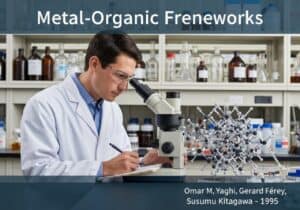
网状化学是MOF的设计原理,涉及将预定的分子结构单元(金属节点和有机连接体)组装成具有可预测拓扑结构的有序扩展结构。该原理的一个关键示例是等网状MOF的合成,其中底层网络拓扑结构得以保持,同时通过使用逐渐加长的有机连接体系统地扩展孔径。

(图片仅供参考)
网状化学是MOF的设计原理,涉及将预定的分子结构单元(金属节点和有机连接体)组装成具有可预测拓扑结构的有序扩展结构。该原理的一个关键示例是等网状MOF的合成,其中底层网络拓扑结构得以保持,同时通过使用逐渐加长的有机连接体系统地扩展孔径。
Reticular chemistry elevates the synthesis of materials from a trial-and-error process to a more deterministic, design-based science. It treats the metal clusters (Secondary Building Units, SBUs) and organic linkers as pre-defined geometric shapes (e.g., an octahedral SBU and a linear linker). By understanding the coordination preferences of the metal and the geometry of the linker, chemists can predict the resulting network topology before synthesis. The most famous example of this is the Isoreticular MOF (IRMOF) series, which is based on the archetypal MOF-5 structure. MOF-5 has a primitive cubic (pcu) topology formed from Zn4O octahedral SBUs and linear 1,4-benzenedicarboxylate (BDC) linkers.
The concept of isoreticular expansion was demonstrated by replacing the BDC linker with longer, but geometrically similar, dicarboxylate linkers like 2,6-naphthalenedicarboxylate (NDC) or 4,4′-biphenyldicarboxylate (BPDC). The resulting materials, IRMOF-8 and IRMOF-10 respectively, retained the same pcu network topology as MOF-5 but featured significantly larger pores. This systematic variation allowed for a direct correlation between linker length, pore size, and properties like gas uptake capacity, proving that MOF properties could be fine-tuned in a highly controlled manner. This principle has been extended to numerous other network topologies and building block combinations, solidifying MOFs as a prime example of programmable matter at the molecular level.
网状化学和等网状扩展
(如果日期未知或不相关,例如“流体力学”,则提供其显著出现的近似估计)
只有注册会员才能免费获取完整尺寸的图片和下载内容。
> 登录 <