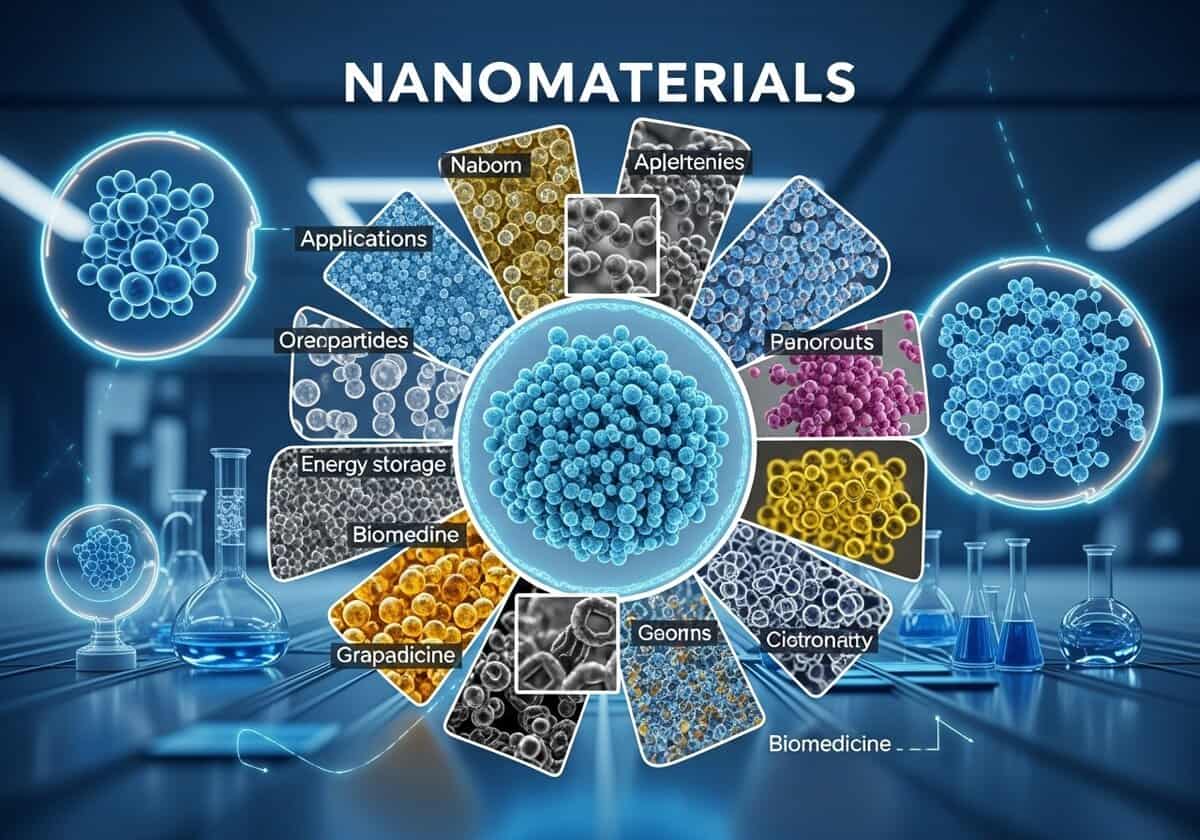
Les nanomatériaux englobent la conception, la synthèse, la caractérisation et l'application de matériaux dont les caractéristiques structurales se situent à l'échelle nanométrique, généralement inférieure à 100 nanomètres, et qui présentent des propriétés physico-chimiques uniques, distinctes de celles de leurs homologues massifs. Ce domaine comprend diverses classes de matériaux telles que les nanoparticules, les points quantiques, les nanotubes de carbone, le graphène et les nanocomposites, avec des applications dans des domaines aussi variés que l'électronique, la catalyse, le stockage d'énergie, la biomédecine et la dépollution. Les progrès réalisés dans les techniques de fabrication contrôlée, la fonctionnalisation de surface et les méthodes de caractérisation à l'échelle nanométrique sont des moteurs d'innovation en matière de performance et de fonctionnalité des matériaux. Cette compilation présente les articles de recherche les plus récents, évalués par des pairs, ainsi que les technologies brevetées, portant sur les méthodologies de synthèse, l'ajustement des propriétés, les stratégies d'intégration et les évaluations de sécurité, autant d'éléments essentiels au développement et au déploiement des nanomatériaux dans de nombreux secteurs industriels.
Cette page centralise les informations sur les matériaux dont les propriétés utiles se manifestent à l'échelle nanométrique (inférieure à 100 nanomètres). Chaque famille de matériaux possède sa propre page. graphène pour les draps, points quantiques pour l'émission de lumière et MXènes pour les carbures stratifiés. Les lecteurs de la section Processus doivent ajouter chemical vapor depositionLes témoignages d'utilisateurs se poursuivent dans nanotechnologies.
Voici notre dernière sélection de publications et de brevets mondiaux en anglais sur les nanomatériaux, parmi de nombreuses revues scientifiques en ligne, classées et axées sur les nanoparticules, les points quantiques, les nanotubes de carbone, le graphène, les nanofils, les nanorods, les nanocomposites, les matériaux nanostructurés, les nanofibres, les fullerènes, les amas de nanoparticules, les nappes de nanoparticules, nanocristal, matériau nanoporeux, nanocatalyseur, nanomédecine, nanotoxicologie, nanofabrication, nanomatériau d'auto-assemblage, fonctionnalisation de surface, synthèse de nanoparticules, nanomécanique, nanoplasmonique, nanophotonique, nanomagnétique, nanomatériau, nanolithographie, nanocoating, nanocarrier, nanobiotechnologie et nanointerface.
Aromatic aldehyde catalytic reduction mixture
Patent published on the 2026-11-19 in US under Ref US20260364584 by UNIV IMAM ABDULRAHMAN BIN FAISAL [SA] (Elsharif Asma Mohammed Zamil [sa], Almarzooq Monerah Ahmed Hassan [sa])
Abstract: A nanohybrid material includes a plurality of gold nanohybrid particles having formula (I). The gold nanohybrid particles have a gold nanoparticle (AuNPs) core and a shell of at least one fatty acid derivative at least partially disposed around the AuNPs core. The AuNPs core has a cuboidal shape and an average particle size of 20 to 60 nanometers (nm). Each R1, and R2 are independently selected from the group consisting of a hydrogen atom, and a fatty acid hydrocarbon chain having 16 to 22 carbo[...]
Our summary: A nanohybrid material consists of gold nanoparticles with a cuboidal shape and a fatty acid derivative shell. The gold nanoparticles have an average size of 20 to 60 nanometers. The material is designed for catalytic reduction of aromatic aldehydes.
Aromatic aldehyde, catalytic reduction, gold nanoparticles, nanohybrid materials
Patent
Lipid nanoparticle production apparatus
Patent published on the 2026-11-19 in WO under Ref WO2026240198 by NGK CORP [JP] (Samuel Alexander [jp], Nomura Kazuki [jp])
Abstract: Provided is a lipid nanoparticle production apparatus with which it is possible to produce lipid nanoparticles having a prescribed particle diameter and particle size distribution. A cross-flow device 3100 mixes a solution of a dispersed phase and a solution of a continuous phase, and generates lipid nanoparticles that contain a target component therein and have a prescribed particle diameter. A permeation member 3130 for liquid-tightly partitioning a first flow passage 3110 and a second flow pa[...]
Our summary: The lipid nanoparticle production apparatus enables the creation of lipid nanoparticles with specific particle diameters and size distributions. It utilizes a cross-flow device to mix dispersed and continuous phase solutions. A permeation member with pores controls the flow and dispersion of the first solution into the second solution.
lipid nanoparticles, cross-flow device, permeation member, particle diameter
Patent
Branched polymer nanoparticles
Patent published on the 2026-11-19 in WO under Ref WO2026241299 by BATTELLE MEMORIAL INSTITUTE [US] (Duong Anthony D [us], Sims Jr [us], Constantine Dean [us], Schmitz Emma K [us], Mccue Andrea D [us], Colbert Ashlee J [us], Denen Philip N [us], Andrioff Nickolas R [us], Kaufman Molly [us])
Abstract: The disclosure relates to copolymer nanoparticles for therapeutic delivery, and methods therefore. More particularly, the invention relates to polymer nanoparticles, such as reversible addition-fragmentation chain transfer (RAFT) polymer compositions, for delivering nucleic acids.[...]
Our summary: The invention discloses copolymer nanoparticles designed for therapeutic delivery. These nanoparticles utilize reversible addition-fragmentation chain transfer (RAFT) polymer compositions. They are specifically intended for the delivery of nucleic acids.
copolymer, nanoparticles, therapeutic delivery, RAFT
Patent
Flame and combustion retardant material based on boron nitride quantum dots
Patent published on the 2026-11-19 in WO under Ref WO2026240717 by MERSIN UENIVERSITESI [TR] (Altürk Rükan Genç [tr], Aktaş Batuhan [tr], Çolak Melis Özge Alaş [tr])
Abstract: The invention discloses the flame retardant and preventive properties of boron nitride quantum dots for use as coatings and fillers in various industries. These properties include the process of synthesis optimization, imparting nanomaterials their retardant and non-flammability properties.[...]
Our summary: The invention presents boron nitride quantum dots as effective flame and combustion retardants. It highlights their use as coatings and fillers across industries. The synthesis optimization enhances their non-flammability and retardant properties.
Boron nitride, flame retardant, quantum dots, nanomaterials
Patent
Biomolecule conjugated lipid nanoparticles
Patent published on the 2026-11-19 in AU under Ref AU2025270870 by SHANGHAI VITALGEN BIOPHARMA CO LTD [CN] (Zhao Xiaoping, Zhu Xi, Chen Hong, Ren Jiaming, Tian Shin-Shay)
Abstract: The present disclosure provides a biomolecule-conjugated lipid nanoparticle (LNP) and the method of preparing the biomolecule-conjugated LNP. Specifically, the present disclosure provides a nucleic acid delivery vector comprising a VHH-linker conjugate, wherein the VHH-linker conjugate comprises (a) a VHH, (b) a linker with a moiety Y and (c) a hinge, furthermore, the nucleic acid delivery vector comprises anchor-modified LNP, wherein the anchor-modified LNP comprises: (a) LNP; and (b) one or mo[...]
Our summary: The disclosure details a biomolecule-conjugated lipid nanoparticle (LNP) designed for nucleic acid delivery. It includes a VHH-linker conjugate and anchor-modified LNPs. The linkage between the linker and anchor fragment is facilitated by a bio-orthogonal click reaction.
Lipid nanoparticles, Biomolecule conjugation, Nucleic acid delivery, Bio-orthogonal click reaction
Patent
Near-field generation probe, method for manufacturing noble metal nanowire, method for fixing noble metal nanowire, and near-field infrared spectrosco
Patent published on the 2026-11-19 in WO under Ref WO2026239761 by NATIONAL INST OF ADVANCED INDUSTRIAL SCIENCE AND TECHNOLOGY [JP] (Fujita Yasuhiko [jp], Takahashi Mariko [jp])
Abstract: The present invention provides a near-field generation probe in which decreases in near-field luminance due to oxidation and sulfurization of a noble metal are suppressed, whereby changes in surface morphology images and loss of near-field signals during measurements are less likely to occur, and as a result, near-field infrared spectroscopic measurements can be stably carried out at high reproducibility and at high sensitivity at the molecular level across a broad mid-infrared range. A near-fie[...]
Our summary: The invention presents a near-field generation probe that minimizes decreases in luminance due to oxidation and sulfurization of noble metal. It features a cantilever with a surface-coated noble metal nanowire designed to maintain stability during measurements. This allows for high reproducibility and sensitivity in near-field infrared spectroscopic measurements across a broad mid-infrared range.
near-field probe, noble metal nanowire, oxidation prevention, infrared spectroscopy
Patent
Magnon-mediated cooling by heating in a spin-selective quantum dot system
Published on 2026-11-10 by Emil Siuda and Piotr Trocha @IOP SCIENCE
Abstract: We demonstrate how nonequilibrium magnons can drive the cooling by heating effect in a spin-selective quantum dot system. The mechanism relies on magnon-assisted spin-flip transitions that transfer electrons between two ferromagnetic electrodes maintained at different temperatures, with the magnetic insulator acting as the high-temperature energy source. In the limit of fully spin-polarized antiparallel electrodes, the transport enters a tight-coupling regime in which each absorbed magnon is acc[...]
Our summary: This study demonstrates how nonequilibrium magnons facilitate cooling by heating in a spin-selective quantum dot system. The mechanism involves magnon-assisted spin-flip transitions that enable electron transfer between ferromagnetic electrodes at different temperatures. The findings highlight the potential of magnons as energy carriers for enhancing cooling power in solid-state spin-caloritronic systems.
magnon-mediated cooling, spin-selective quantum dot, thermodynamic performance, energy carrier
Publication
Synthesis of polypyrrole?Laponite nanocomposite particles via surfactant-free aqueous chemical oxidative polymerization
Published on 2026-11-05 by Rojanasak Ruadroew, Takahiro Kadono, Takuto Yagishita, Atsushi Nishikawa, Makoto Ogawa, Syuji Fujii @NATURE
Abstract: Polymer Journal, Published online: 05 November 2026; doi:10.1038/s41428-026-01269-zPolypyrrole–Laponite (PPy–LAP) nanocomposite particles were directly prepared by surfactant-free aqueous oxidative polymerization without prior surface modification of LAP. Two-dimensional LAP nanosheets suppressed macroscopic aggregation of PPy and were interconnected through PPy to form colloidally dispersible, irregular nanocomposite particles. The resulting particles combine aqueous colloidal stability, el[...]
Our summary: Polypyrrole–Laponite nanocomposite particles were synthesized via surfactant-free aqueous oxidative polymerization. LAP nanosheets prevented PPy aggregation and formed colloidally stable particles. The study highlights the use of clay nanosheets as stabilizers in conducting polymer composites.
Polypyrrole, Laponite, Nanocomposite, Aqueous polymerization
Publication