Product Design, Manufacturing & Innovation Resources
家 » 高温超导

高温超导

1986
  • Johannes Georg Bednorz
  • Karl Alexander Müller
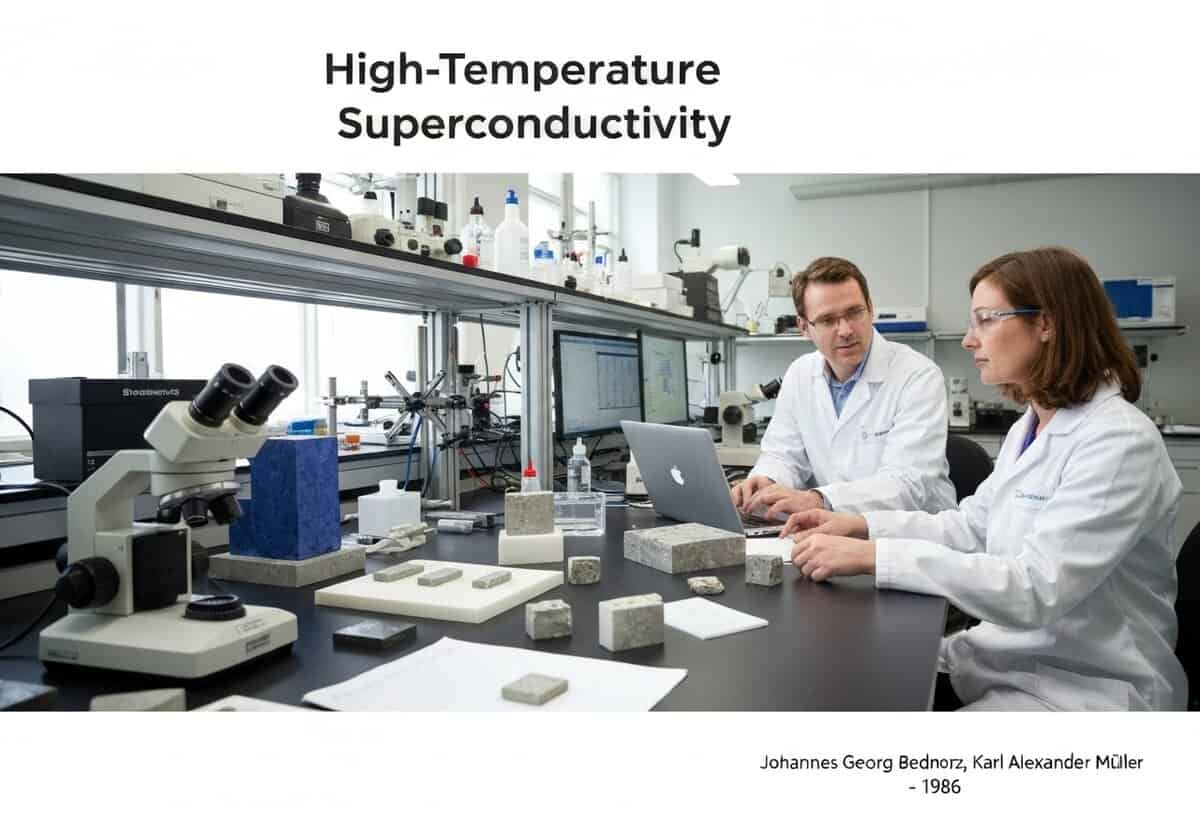
研究高温超导陶瓷材料的研究人员的实验室现场。.

(图片仅供参考)

In 1986, Georg Bednorz and K. Alex Müller discovered 超导 in a ceramic material, a lanthanum-based cuprate perovskite, at a 临界温度 of ~35 K. This was significantly higher than the ~23 K record for conventional superconductors at the time and shattered the belief that superconductivity was restricted to much lower temperatures, opening the field of high-temperature superconductivity.
The discovery by Bednorz and Müller at the IBM Zurich Research Laboratory was a major breakthrough. For decades, the progress in raising the critical temperature ([latex]T_c[/latex]) had been slow and incremental, with most physicists believing that the electron-phonon mechanism described by BCS theory had a theoretical upper limit of around 30-40 K. Bednorz and Müller decided to investigate metallic oxides, a class of materials generally considered unsuitable for superconductivity. Their discovery in lanthanum barium copper oxide (LBCO) with a [latex]T_c[/latex] of 35 K was quickly confirmed and followed by a rapid succession of discoveries of related materials with even higher critical temperatures. In 1987, Paul Chu’s group discovered yttrium barium copper oxide (YBCO) with a [latex]T_c[/latex] of 92 K. This was a particularly significant milestone because 92 K is above the boiling point of liquid nitrogen (77 K), a coolant that is far cheaper and easier to handle than the liquid helium required for all previous superconductors. This made many applications economically and practically feasible for the first time. These materials, known as cuprates, are Type II superconductors with a layered, perovskite-like crystal structure. Despite intense research for over three decades, a complete, universally accepted microscopic theory for high-temperature superconductivity in cuprates remains elusive, though it is widely believed to involve a different pairing mechanism than the conventional phonon-mediated attraction of BCS theory.

UNESCO Nomenclature: 2211
- 固体物理学

类型

物理特性

中断

递增

用法

广泛使用

前体

  • BCS理论(提供比较基准)
  • 金属氧化物和陶瓷的研究
  • 先进材料合成技术
  • 开发可靠的低温测量系统

应用程序

  • 超导输电电缆
  • 用于研究和核磁共振的高场电磁铁
  • 电网故障电流限制器
  • 蜂窝通信滤波器
  • 高性能电动机和发电机

专利:

NA

潜在创新理念

  • 使用高场磁铁的紧凑型聚变反应堆(托卡马克)
  • 采用超导互连的无损数据中心
  • high-speed maglev transport systems operating with 液氮 cooling
  • 高效轻型电动飞机推进系统
  • 大型超导轴承储能飞轮
  • 静音舰船推进系统(磁流体动力驱动)
  • 具有更高能量束的下一代粒子加速器
  • 远距离无线电力传输
  • 带有超导带的太空电梯
  • 用于暗物质搜索的超灵敏探测器
Related to: high-temperature 超导, cuprates, YBCO, critical temperature, liquid nitrogen, Bednorz and Müller, unconventional superconductivity, condensed matter physics, perovskite, ceramic superconductor.

历史背景

高温超导

1980
1984
1986
1986
1991
1994
1997
1980
1984
1985
1986
1990
1993-01-01
1995
2000

(如果日期未知或不相关,例如“流体力学”,则提供其显著出现的近似估计)

第十年 周年纪念日

只有注册会员才能免费获得 100% 的全尺寸图片和下载。.

> 登录 <