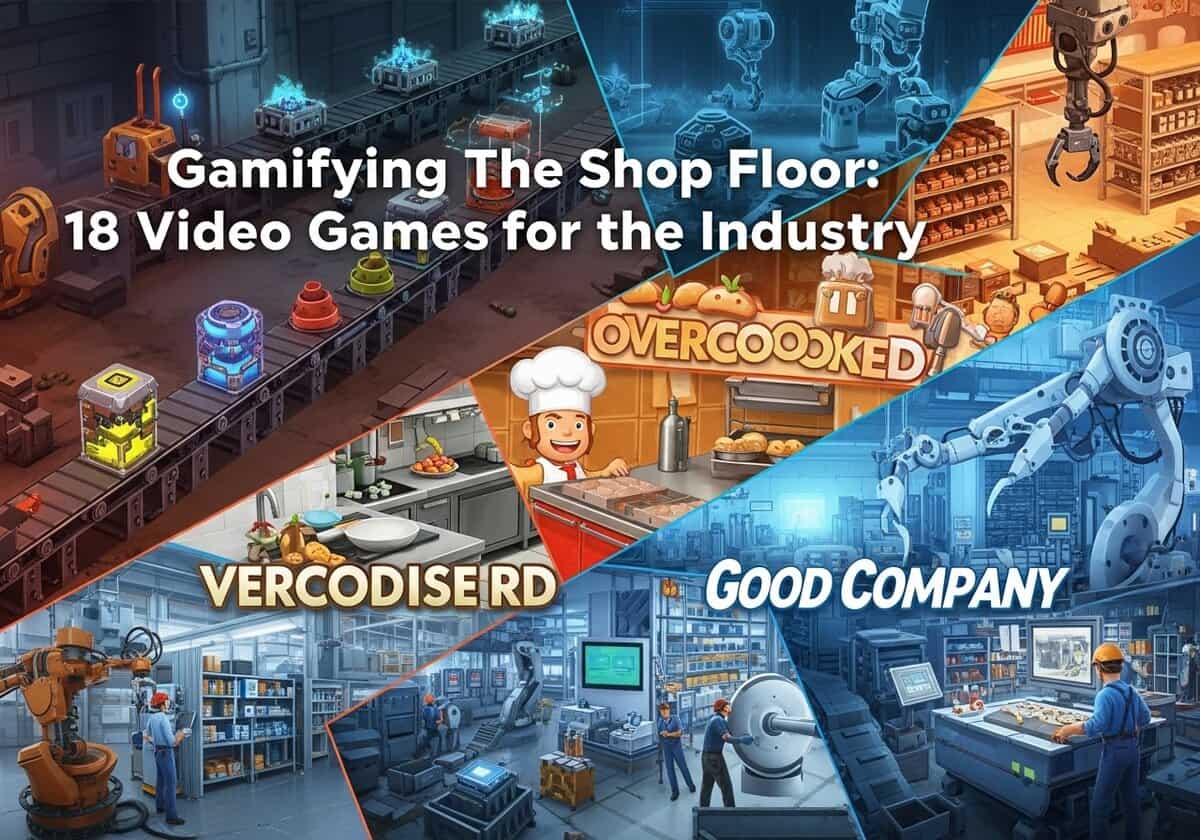
Fabricação begins in the chaos of the trabalho shop, where the primary constraint is human error and the lack of Standard Operating Procedures. The entry-level simulations in this list expose the friction of manual assembly and batch processing, forcing you to confront the immediate consequences of poor inventory management and workplace ergonomia. As you graduate to the “Fordist” tier, the focus shifts to line balancing and bottleneck analysis, demonstrating that a faster machine is useless if it simply piles inventory in front of a slower one.

Em nível especializado, essas simulações transcendem a mera produção para abordar a complexidade arquitetônica da logística global e da engenharia de sistemas embarcados. Os títulos de nível superior exigem domínio de princípios LeanIsso exige que você projete cadeias de suprimentos auto-reguláveis que abrangem continentes ou sistemas estelares. Aqui, o desafio não é mais manter as luzes acesas, mas otimizar o custo marginal de uma única porta lógica ou garantir que uma escassez de recursos a três nós de distância não desencadeie uma falha catastrófica em cascata em todo o seu império industrial.
Esses jogos têm a desvantagem de não serem jogáveis como jogos de tabuleiro em sessões de equipe — mas estão disponíveis em todo o mundo em muitos idiomas.
Nossas escolhas pessoais:
Automação e Logística Puras
Esses títulos definem o gênero moderno de automação industrial. Eles se concentram na expansão da produção, desde o trabalho manual até megaestruturas totalmente automatizadas. O ciclo principal envolve extração de recursos, cadeias de processamento complexas e gerenciamento de índices de produção.
Factorio
Simulação de construção em mundo aberto 2D com visão de cima para baixo:
- Os jogadores extraem recursos para construir um foguete automatizado enquanto se defendem de ataques alienígenas.
- O objetivo é a automação total e a escalabilidade infinita.
| Liberar: 2016 (Acesso Antecipado), 2020 (Lançamento Completo). | Disponibilidade atual: Disponível para PC (Steam, GOG) e Nintendo Switch. | Análises de jogos: "Extremamente positivo" no Steam (97% de mais de 150.000 avaliações); vendeu mais de 3,5 milhões de cópias; amplamente considerado a obra-prima que definiu o gênero. Muitas expansões. |
|
Ensina análise de gargalos e alguns princípios da produção enxuta. Os jogadores devem identificar constantemente a parte mais lenta da cadeia (a restrição) e otimizá-la, espelhando a melhoria contínua do mundo real (Kaizen) e balanceamento da cadeia de suprimentos.
Satisfactory
Construção de fábrica em mundo aberto em primeira pessoa num planeta alienígena:
- Concentra-se na verticalidade, na exploração e na organização arquitetônica das linhas de produção.
- O objetivo é construir um elevador espacial gigantesco através da montagem de peças cada vez mais complexas.
| Liberar: 2019 (Acesso Antecipado Épico), 2024 (Lançamento Completo da Versão 1.0). | Disponibilidade atual: PC (Steam, Epic); versões para console anunciadas para o final de 2024/2025. | Análises de jogos: "Extremamente positivo" no Steam (97% de mais de 150.000 avaliações); vendeu mais de 6 milhões de cópias. |
|
A perspectiva em primeira pessoa destaca a importância do layout das instalações e da logística espacial. Ela demonstra como um planejamento inadequado do espaço leva a rotas ineficientes e poluição visual, simulando os desafios de projetar ambientes de trabalho industriais acessíveis e seguros.
Dyson Sphere Program
Simulação industrial interplanetária abrangendo uma galáxia gerada proceduralmente:
- Os jogadores transportam recursos entre sistemas estelares para construir uma megaestrutura ao redor de uma estrela.
- O foco está na macrologística e na gestão de redes de energia em todo o planeta.
| Liberar: 2021 (Acesso Antecipado) | Disponibilidade atual: PC (Steam, Microsoft Store) | Análises de jogos: "Extremamente positivo" no Steam (98% de mais de 70.000 avaliações); vendeu mais de 2,5 milhões de cópias. |
|
Esta simulação representa a gestão de cadeias de suprimentos globais (ou interestelares). Ela força os jogadores a gerenciar prazos de entrega e estoques de segurança, mostrando como centros de produção distantes exigem estratégias de estoque diferentes em comparação com a produção local.
Os Simuladores do 'Fordismo'
Esses jogos simulam setores industriais específicos com foco na eficiência da linha de produção e na lucratividade. Eles enfatizam as compensações econômicas entre velocidade, qualidade e custo. A jogabilidade frequentemente espelha o desenvolvimento histórico da linha de montagem.
Production Line: Car Factory Simulation
Simulação isométrica de gestão de uma fábrica de automóveis moderna:
- Os jogadores dividem tarefas complexas em etapas menores e mais rápidas para maximizar o número de carros por hora.
- The objective is to achieve perfect flow while researching new tecnologias and competing on market price.
| Liberar: 2017 (Acesso Antecipado), 2019 (Lançamento Completo) | Disponibilidade atual: PC (Steam, GOG, Humble) | Análises de jogos: "Muito Positivo" no Steam (aproximadamente 83% de avaliações positivas); sucesso de nicho dentro do gênero de gerenciamento. |
|
Trata-se de uma simulação direta da divisão do trabalho de Henry Ford e do taylorismo. Ilustra o conceito de balanceamento de linha e a relação de compromisso entre máquinas especializadas e produção flexível, tornando-se uma excelente ferramenta para a compreensão da engenharia de processos.
Automation: The Car Company Tycoon Game
Simulação técnica detalhada da gestão de uma empresa automobilística de 1946 a 2020:
- Os jogadores projetam motores e chassis com controle preciso sobre os materiais e as especificações de engenharia.
- O objetivo é construir veículos que atendam às necessidades demográficas específicas do mercado e às margens de lucro.
| Liberar: 2015 (Acesso Antecipado) | Disponibilidade atual: PC (Steam); ainda em desenvolvimento ativo. | Análises de jogos: 'Muito Positivo' no Steam (aproximadamente 93% de avaliações positivas); altamente considerado por entusiastas de automóveis por sua física de motor. |
|
Este título se concentra principalmente no design de carros, nas restrições de engenharia e KPI, ou melhor, a montagem em linha e a própria otimização. O exercício demonstra como a escolha dos materiais (por exemplo, ferro fundido versus alumínio) impacta o custo, a confiabilidade e a dificuldade de fabricação, simulando a fase de P&D da produção industrial.
Big Pharma
quebra-cabeça isométrico de estratégia jogo Sobre a fabricação de produtos farmacêuticos:
- Os jogadores direcionam os ingredientes através de máquinas de processamento para alterar a concentração e remover efeitos colaterais.
- O objetivo é patente e vender tratamentos, gerenciando ao mesmo tempo um espaço limitado na fábrica.
| Liberar: 2015 | Disponibilidade atual: PC, PS4, Xbox One, Nintendo Switch. | Análises de jogos: "Muito Positivo" no Steam (aproximadamente 80% de avaliações positivas); elogiado por seu tema único, mas criticado pela complexidade da interface do usuário. |
|
O jogo destaca a relação entre a precisão do processo e a qualidade do produto. Ele simula os desafios de encaixar equipamentos complexos em espaços fixos e as decisões éticas/econômicas envolvidas na produção de medicamentos de alta qualidade em comparação com alternativas baratas e de qualidade inferior. O jogo 'Overcook', mais sério (menos divertido?) com alguns aspectos de mercado.
The “Zachtronics” Style (Logic & Programming)
These puzzle games treat manufacturing as a logic or programming problem. They require players to design repeatable, deterministic solutions to assembly challenges. The focus is on minimizing cycles, cost, or footprint.
Infinifactory
First-person block-based puzzle game set in an alien production facility:
- Players build conveyor networks to assemble 3D product inputs into specific outputs.
- The goal is to optimize solutions for speed and block count.
| Liberar: 2015 | Disponibilidade atual: PC (Steam, GOG) and PS4. | Análises de jogos: “Overwhelmingly Positive” on Steam (95% positive); considered a classic in the puzzle-automation genre |
|
You literally build your line with many different blocks. A “Minecraft” on assembly lines and conveyors, as a kind of puzzle. Maybe a bit hard gameplay for not enough manufacturing scenarios for to simulate real factory challenges. It teaches spatial reasoning and the logic of assembly sequences. The requirement to weld, rotate, and stamp parts in a specific order simulates the programming of CNC machines or robótica arms in a manufacturing cell.
Shenzhen I/O
Engineering puzzle game about building circuits and writing assembly code:
- Players wire microcontrollers and write code to process data inputs into outputs.
- The objective is to create working electronics with the lowest production cost and power usage.
| Liberar: 2016 | Disponibilidade atual: PC (Steam, GOG). | Análises de jogos: “Overwhelmingly Positive” on Steam (96% positive); critically acclaimed for its realism and manual. |
|
A game definitely for … engineers! This is a rigorous simulation of embedded systems engineering and component sourcing. It forces players to read datasheets and work within strict hardware limitations, mirroring the real-world constraints of electronics manufacturing and bill-of-materials (BOM) optimization. For engineer Christmas sessions ?
Opus Magnum
Alchemical engineering puzzle game using programmable mechanical arms:
- Players design machines to transmute elements through rotation, bonding, and separation.
- The goal is to create specific compounds using the most efficient or compact mechanism possible.
| Liberar: 2017 | Disponibilidade atual: PC (Steam, GOG, Microsoft Store) | Análises de jogos: “Overwhelmingly Positive” on Steam (97% positive); Zachtronics’ best-selling title. |
|
The game visualizes the kinematics of automated machinery and logic. It serves as an abstraction of robotic motion planning, showing how throughput is limited by the physical travel time of the manipulator arms and the coordination required between multiple moving parts.
The “Chaotic Manual Assembly”
These cooperative games focus on the human element of production and time management. They simulate high-pressure environments where comunicação and task delegation are critical. The gameplay emphasizes execution and crisis management over long-term planning.
Overcooked!
Cooperative cooking simulation for up to four players:
- Teams must prepare meals by chopping, cooking, and plating ingredients under strict time limits.
- The objective is to serve orders correctly while navigating dynamic, hazardous kitchen layouts.
| Liberar: 2020 (Compilation); Original Overcooked released in 2016. | Disponibilidade atual: PC, PS4/5, Xbox One/Series, Nintendo Switch. | Análises de jogos: “Very Positive” on Steam; the franchise has sold over 5 million units globally; won multiple BAFTA awards. |
|
It simulates the “human factor” in Just-In-Time manufacturing, under (heavier and heavier) pressão. It highlights how communication breakdowns and poor workspace ergonomics lead to production errors and bottlenecks, demonstrating the necessity of clear roles and standard operating procedures (SOPs).
Despite its super funny approach, except the missing “arrange your own layout” possibility, it has a lot (quality defects, supply problems, randomness, inventory, lack of space …).
Game editor: if you want our help to release a modern factory version of the overcooked game … we are here with multiple lean scenarii!
PlateUp!
Roguelite restaurant management game mixing cooking with layout design:
- Players cook and serve food while purchasing appliances to gradually automate the kitchen.
- The goal is to survive 15 days by scaling operations to meet increasing customer counts.
| Liberar: 2022 | Disponibilidade atual: PC, PS4/5, Xbox, Nintendo Switch. | Análises de jogos: “Overwhelmingly Positive” on Steam (95% of ~15,000+ reviews); sold over 1.5 million copies. |
|
Some similarities with Overcooked: somehow less entertaining rhythm and less graphics, but here you must also arrange your layout to optimize your restaurent/hotel. This game bridges manual labor and automation, showing the transition from artisanal production to mass production. It illustrates the capital investment decision-making process, where players must decide when to replace manual tasks with expensive machinery to increase capacity.
Wilmot’s Warehouse
2D puzzle game about organizing a massive inventory of abstract products:
- Players receive truckloads of stock to store and must quickly retrieve specific items for customers.
- The objective is to develop a personal classificação system that maximizes retrieval speed.
| Liberar: 2019 | Disponibilidade atual: PC, Nintendo Switch, Xbox, iOS. | Análises de jogos: “Very Positive” on Steam (96% positive); Winner of “Excellence in Design” at IGF 2021. |
|
A very good surprise: a Tetris, applied to a warehouse, in a pixel-art style. A pure simulation of warehousing logistics and SKU management. It teaches the importance of inventory categorization and floor organization, demonstrating how “chaos storage” (Amazon style) vs. “categorical storage” impacts picking efficiency.
Observação: there is a table-top game version. More on this later.
Unrailed!
Cooperative multiplayer game about building a train track on the fly:
- Players must harvest resources and craft rails to prevent the ever-moving train from crashing.
- The goal is to reach the station by maintaining a continuous supply of materials.
| Liberar: 2019 (Early Access), 2020 (Full Release) | Disponibilidade atual: PC, PS4, Xbox One, Nintendo Switch. | Análises de jogos: “Very Positive” on Steam (93% positive); popular among streamers for its chaotic co-op nature. |
|
It simulates a supply chain under “takt time” pressure. The train represents a non-stop production line; if raw material inputs (wood/iron) or sub-assembly (rails) fail to match the line speed, the system fails catastrophically.
Realistic Management & Supply Chain
These titles simulate the macroeconomic and infrastructure layers of industrial production. They focus on the integration of raw material extraction, manufacturing, and distribution networks. The gameplay involves managing complex dependencies and economic viability.
Workers & Resources: Soviet Republic
Complex city-builder and tycoon game set in a planned economy:
- Players manage every aspect of the supply chain, from mining ore to manufacturing vehicles and housing workers.
- The objective is to build a self-sufficient industrial republic.
| Liberar: 2019 (Early Access), 2024 (Version 1.0 Full Release) | Disponibilidade atual: PC (Steam) | Análises de jogos: “Very Positive” on Steam (92% of ~16,000+ reviews); widely praised as the most complex city-builder on the market. |
|
It provides a granular simulation of logistics and infrastructure dependencies. Unlike other games, goods do not teleport; every ton of steel must be physically transported, teaching the critical role of transport logistics and infrastructure maintenance in industrial success.
Captain of Industry
Colony simulation game focused on industrial survival and terraforming:
- Players mine, refine, and manufacture goods while managing waste products and terrain modification.
- The goal is to evolve a small settlement into a high-tech industrial power.
| Liberar: 2022 (Early Access) | Disponibilidade atual: PC (Steam) | Análises de jogos: “Very Positive” on Steam (93% positive); strong community engagement for its realistic physics. |
|
What could have been a classic city builder game, is here applied on technologies (architecture, mecânica, eletronics …). It uniquely emphasizes the byproducts of manufacturing, such as exhaust, wastewater, and slag. This forces players to design circular economies and waste treatment systems, simulating modern environmental engineering and sustainability challenges in factories.
Transport Fever 2
Transport tycoon simulation covering 150 years of history:
- Players construct road, rail, water, and air networks to connect industries and cities.
- The goal is to optimize cargo flow and passenger travel for maximum profit.
| Liberar: 2019 | Disponibilidade atual: PC, Mac, PS4/5, Xbox One/Series. | Análises de jogos: “Very Positive” on Steam (91% of ~25,000+ reviews); sold over 1 million copies. |
|
While not a factory builder, it simulates the external logistics required for manufacturing. It demonstrates how transportation costs, frequency, and capacity dictate production limits, highlighting that a factory is only as efficient as its inbound and outbound logistics.
Unique / Abstract Assembly
These games strip away realistic graphics to focus on specific mechanics of production and management. They isolate concepts like workforce organization, chemical precision, or pure throughput. The gameplay is often more experimental or specialized.
Shapez 2
Abstract factory building game set in an infinite 3D space:
- Players cut, rotate, stack, and paint geometric shapes to match hub requests.
- The objective is to build massive, lag-free factories to process exponential amounts of data-shapes.
| Liberar: August 2024 (Early Access) | Disponibilidade atual: PC (Steam). | Análises de jogos: “Overwhelmingly Positive” on Steam (98% positive); rapidly became the top-rated factory game of 2024. |
|
“Building Supply chains & fulfilling objectives.” All is said!
By removing realistic context, it isolates the mathematics of throughput and modular design. It is an excellent tool for teaching the concept of “scaling up” and modular architecture, where a single efficient design is copy-pasted thousands of times to meet quota.
Game editor: if you want our help to add more lean-targeted scenarii, we’re here!
Good Company
Tycoon management game focusing on workforce logistics:
- Players design production lines by assigning tasks to employees and managing their inventory zones.
- The goal is to evolve from a garage startup to a robot-assisted manufacturing corporation.
| Liberar: 2020 (Early Access), 2022 (Full Release) | Disponibilidade atual: PC (Steam, GOG) | Análises de jogos: “Mostly Positive” on Steam (73% positive); praised for concept but criticized for repetitive micromanagement. |
|
Despite a old-school design, not another city builder game, but dedicated to factories and specific problems. It focuses on human resource allocation and estação de trabalho logistics. It simulates the complexities of assigning specific tasks to workers, managing their pathing, and ensuring that hand-offs between stations are synchronized to prevent idle time.
Game editor: if you want our help to add more lean-targeted scenarii, we’re here!
Wrap-up (To your joysticks – Learn & have fun)

These simulations function as low-risk sandboxes for testing high-stakes industrial theories, allowing professionals to internalize the Theory of Constraints and Just-In-Time logistics without disrupting actual operations. By forcing the user to resolve deadlocks, balance load factors, and manage supply shortages, they cultivate the systems thinking required to identify root causes rather than merely treating symptoms. This virtual experience bridges the gap between theoretical process design and the messy reality of operational execution, validating a manager’s ability to visualize second-order effects within a complex production network.

To translate these digital competencies into tangible ROI, organizations should pair simulation training with physical “Gemba” walks and Value Stream Mapping workshops. Real-world application requires validating the simulation’s ideal state against the friction of the shop floor. Integrating these games into Seis Sigma certification tracks or continuous improvement retreats creates a common lexicon for efficiency, enabling cross-functional teams to visualize complex dependencies and test hypotheses before implementing capital-intensive changes.