Product Design, Manufacturing & Innovation Resources
بيت » تصميم المنتج » بيئة العمل » معادلة الرفع المنقحة للمعهد الوطني للسلامة والصحة المهنية في بيئة العمل

معادلة الرفع المنقحة للمعهد الوطني للسلامة والصحة المهنية في بيئة العمل

معادلة الرفع NIOSH

Overexertion injuries account for approximately 33% of all worker injuries, highlighting the need for effective lifting assessment tools such as the Revised NIOSH Lifting Equation. This comprehensive article will detail into the purpose and background of this equation, breaking down its individual components to provide a clearer understanding of how it enhances safety across varied industries such as تصنيع, healthcare, and construction. Readers will gain insights into data collection and measurement techniques for accurate assessments, how to calculate the Recommended Weight Limit (RWL), and the importance of the Lifting Index (LI) in risk assessment. We also will discuss implementing مريح controls and redesigning tasks to elevate workplace safety, while also addressing the limitations and scope of this equation in practical applications.

النقاط الرئيسية

Lifting tasks
Revised niosh equation enhances التقييم المريح of lifting tasks.


    • Revised NIOSH equation improves assessment of two-handed lifting tasks.
    • Key components include weight, distance, and posture.
    • Accurate data collection enhances lifting evaluations.
    • RWL calculation ensures safe lifting limits per task.
    • Lifting Index indicates risk levels for workers.
    • Task redesign and flows redesign is a must to mitigate ergonomic risks effectively.


About the NIOSH Institute

The National Institute for Occupational Safety and Health (NIOSH) is a federal agency in the United States that focuses on researching and providing recommendations to avert work-related injuries, illnesses, and fatalities. Established under the Occupational Safety and Health Act of 1970, NIOSH operates as part of the Centers for Disease Control and Prevention (CDC) and is dedicated to ensuring safe and healthy working environments for all employees. The agency generates new insights in occupational safety and health and applies this knowledge to enhance worker protection. NIOSH employs a diverse team of over 1,300 professionals, including specialists in areas such as epidemiology, medicine, industrial hygiene, and safety.

Background of the NIOSH Equation
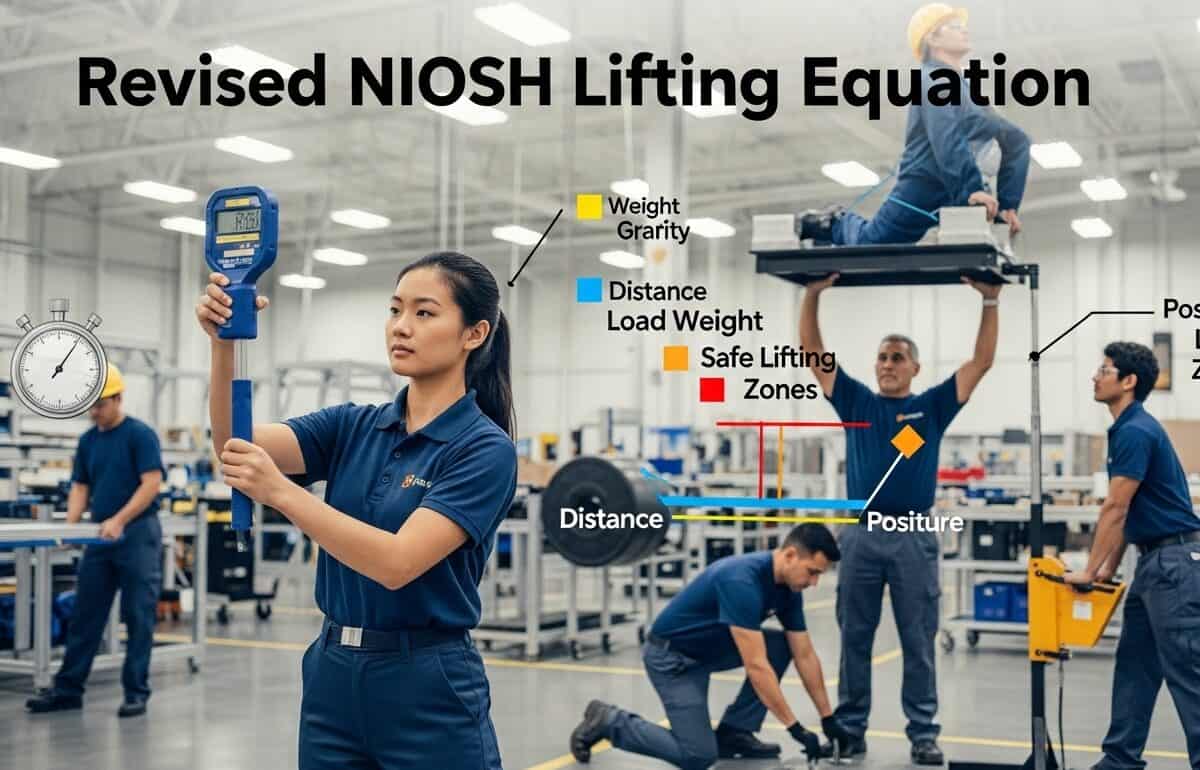
Niosh lifting equation
The revised niosh lifting equation enhances ergonomic assessments to reduce manual lifting injury risks in the workplace.


The Revised NIOSH Lifting Equation was developed to provide a scientifically grounded طريقة for evaluating and predicting the risk of injury associated with manual lifting tasks in various work environments. This evolution reflects advancements in ergonomic research, emphasizing not only the weight lifted but also factors such as lifting height, distance, frequency, and duration.

Prior to the revision, the original NIOSH Lifting Equation was often criticized for its oversimplification of lifting tasks. The updated equation addresses this by including an array of variables that affect lifting conditions, thus enhancing the predictive accuracy of potential risk.

Utilizing this comprehensive approach has been shown to reduce workplace injuries by as much as 25% in industries that implement ergonomic assessments based on this equation.

نصيحة: conducting a thorough ergonomic assessment using the Revised NIOSH Lifting Equation before implementing lifting tasks can significantly mitigate injury risks and enhance worker efficiency.

The Revised NIOSH (National Institute for Occupational Safety and Health) Lifting Equation is a tool used to assess the risk of low back injuries associated with two-handed manual lifting tasks.

The equation calculates the Recommended Weight Limit (RWL), which is the maximum weight that most healthy workers can lift over an 8-hour shift without increasing their risk of musculoskeletal disorders of the lower back.


The Equation and its Components

The Revised NIOSH Lifting Equation provides a formula for calculating the recommended weight limit (RWL) for 2-handed lifting tasks كما the primary output of the equation. The equation incorporates multiple factors that influence lifting capacity, enabling further precision in ergonomic assessments. The basic formula for RWL is defined as follows:

The equation is as follows: \(RWL = LC*HM*VM*DM*AM*FM*CM\)

A related metric is the Lifting Index (LI): it is the ratio of the actual weight lifted to the RWL. A Lifting Index of 1.0 or less is considered safe.

The value of each multiplier ranges from 0 to 1 and is determined using tables that correspond to the measured value of each variable. Here is a breakdown of each parameter in the equation:

 المعلمةوصفUnits

LC

Load Constant

This is the maximum recommended weight for lifting under ideal conditions.23 kg (or 51 lbs)

HM

Horizontal Multiplier

This factor accounts for the horizontal distance of the hands from the midpoint between the ankles: the horizontal distance (H) is the distance from the point projected on the floor directly below the midpoint of the hands grasping the object, to the midpoint of the ankles.The horizontal distance (H) is measured in centimeters.

VM

Vertical Multiplier

This factor is determined by the vertical height of the hands from the floor at the start of the lift. The vertical distance (V) is measured in centimeters.

DM

Distance Multiplier

This multiplier accounts for the vertical distance the load travels during the lift, i.e. the vertical distance the hands move between the start and end of the lift.The vertical travel distance (D) is measured in centimeters.

AM

Asymmetric Multiplier

This factor is determined by the degree of twisting or turning of the body during the lift: The asymmetry angle (A) is the angle between the asymmetry line and the sagittal line. The asymmetry line is the horizontal line that joins the midpoint between the ankles and the point projected on the floor directly below the midpoint of the hands grasping the object. The sagittal line is the line going through the midpoint between the ankles and extending straight forward from the body.The angle of asymmetry (A) is measured in degrees.

FM

Frequency Multiplier

This factor accounts for the frequency of lifting, including the number of lifts per minute and the duration of the lifting task.The lifting frequency (F) is the average number of lifts per minute over a 15-minute period.This is determined by the number of lifts per minute and the duration of the work in hours.

سم

Coupling Multiplier

This multiplier assesses the quality of the hand-to-object grip (coupling). The coupling quality is determined by the type of grip, surface, shape and size on the object. A “good” coupling has handles or cut-outs, a “fair” coupling might involve gripping a box with no handles, and a “poor” coupling would be an awkward, bulky, or slippery object.The quality of the grip is classified as “good,” “fair,” or “poor”.

The NIOSH ratio to use

Horizontal Multiplier (HM):

H = Horizontal Distance (cm)HM Factor
25 or less1.00 
300.83
400.63
500.50
600.42

Vertical Multiplier (VM):

V = Starting Height (cm)VM Factor
00.78
 30  0.87
 50 0.93 
 70  0.99 
 100  0.93 
 150  0.78 
 175 0.70
 >175 0.00

Distance Multiplier (DM):

D = Lifting Distance (cm)DM Factor
25 or less1.00
 40  0.93 
 55  0.90
 100  0.87 
 145 0.85 
 175 0.85
 >175 0.00

Asymmetric Multiplier (AM): 

A = Angle (degrees)AM Factor
90° 0.71 
 60°  0.81
 45°  0.86 
 30° 0.90
 0° 1.00

Frequency Multiplier (FM):

F = Time Between Lifts FM Factor
Lifting While Standing:OR Lifting While Stooping:
One Hour or LessOver One HourOne Hour or LessOver One Hour
5 min1.000.851.000.85
1 min 0.940.750.940.75
30 sec0.910.650.910.65
15 sec0.840.450.840.45
10 sec0.750.270.750.27
6 sec0.450.130.45
5 sec0.370.37

Coupling Multiplier (CM): (usually one of the low hanging fruit)

C = GraspCM Factor:
StandingStooping
Good (handles)1.001.00
عادلة1.000.95
فقير0.900.90

Source of these tables: Canadian Centre for Occupational Health And Safety (CCOHS), based on original NIOSH tables

Summary: close to the body, the most in front as possible, as similar height as possible to the height of hands when elbows is at 90°.

As the lift distance and body orientation change, the distance multiplier (DM) is applied to recognize the potential risk associated with how far loads are moved. This factor is essential in environments like warehouses, where heavy loads may need to be moved over varying distances.

نصيحة: when applying the equation, consistently gather accurate data for each lifting condition to ensure reliability in assessment outcomes and ergonomic interventions.

NIOSH Example: an Assembly Line Worker

سيناريو: a 30-year-old male worker is standing on an assembly line. One of is his task is to lift a car battery from a conveyor belt and place it into a chassis. He has been performing this task for the last two hours.

Applied Values

Car battery
Ergonomic assessment of repetitive lifting tasks in assembly line operations.
  • Load Weight (L): the car battery weighs 18 kg.
  • Load Constant (LC): the maximum recommended weight for lifting under ideal conditions is a constant 23 kg.
  • Horizontal Location (H): the worker reaches out to pick up the battery. The horizontal distance from the midpoint between his ankles to his hands is 40 cm. The corresponding Horizontal Multiplier (HM) for 40 cm is 0.63.
  • Vertical Location (V): the conveyor belt is at a height of 70 cm from the floor. This is the starting height of the lift. The corresponding Vertical Multiplier (VM) for 70 cm is 0.96.
  • Vertical Travel Distance (D): the worker lifts the battery from the conveyor belt (70 cm) and places it into the chassis at a height of 110 cm. The vertical travel distance is 110 cm – 70 cm = 40 cm. The corresponding Distance Multiplier (DM) for 40 cm is 0.93.
  • Asymmetric Angle (A): the worker has to twist his body slightly to move the battery from the conveyor to the chassis. The angle of the twist is 30 degrees. The corresponding Asymmetric Multiplier (AM) for 30 degrees is 0.90.
  • Lifting Frequency (F): the assembly line is moving at a steady pace, and the worker performs this lift 4 times per minute. Since he has been working for 2 hours, the Frequency Multiplier (FM) for 4 lifts/minute over a duration of more than 1 hour but less than 2 hours is 0.84.
  • Coupling (C): the car battery has built-in handles, which allows for a firm and comfortable grip. This is considered a “Good” coupling. The corresponding Coupling Multiplier (CM) for a good grip is 1.00.

Calculation: using the formula above with these values, the Recommended Weight Limit (RWL) is RWL = 23 kg x 0.63 x 0.96 x 0.93 x 0.90 x 0.84 x 1.00 = 9.79 kg

Next, the Lifting Index (LI) is calculated to assess the risk of the lifting task: \(LI = \frac{\text{Load Weight (L)}}{\text{Recommended Weight Limit (RWL)}}\)

LI = 18 kg / 9.79 kg  = 1.84

Conclusion of this Study

The Recommended Weight Limit (RWL) for this specific lifting task is 9.79 kg. This is the maximum weight that a healthy worker could safely lift under these exact conditions. The actual weight of the battery is 18 kg, which is significantly higher than the RWL.

The Lifting Index (LI) is 1.84. A Lifting Index greater than 1.0 indicates that the task is hazardous and poses an increased risk of low back injury to the worker.

An LI of 1.84 suggests a high risk, and that the task should be redesigned.

Possible modifications could include

By decreasing priority order (our view):

  • Bringing the object closer to the worker to reduce the horizontal distance, decreasing the twist angle, and reducing the delta height: bench بيئة العمل, done at start if possible, once for all.
  • Implementing mechanical lifting aids: likely possible. Either special tools, or polyvalents tools, depending on the line and factory.
  • Reducing the lifting frequency: possible, but as reducing the production is probably not the goal, that means spreading among more workers; but better suppress the problem at the root rather than creating special shifts and spreading a bad task to many. Note that in very critical and urgent cases, there may be no other option as a last resort (Tchernobyl, Fukushima …).
  • Reducing the weight of the object: probably not an easy option here, if at all, unless redesign the product or the car in the first place -what should have been done but we are in a too-late-scenario here-.
Niosh calculation example in the factory
Niosh calculation example in the factory (with a very bad asymmetric angle in this case)

Data Collection and Measurement Techniques for Ergonomic Study

Ergonomic studies
Systematic observation and measurement of lifting activities are essential for ergonomic تصميم المنتج والابتكار.

Data collection and measurement, as in most ergonomic studies, involve the systematic observation of lifting activities to identify critical parameters such as weight, height, distance, and the frequency of the lift. Real-time observations can be recorded through direct monitoring or by employing tools such as video analysis, which allows for precise measurements of body الميكانيكا during lifting. Factors such as grip type and load characteristics should also be noted, as they affect ergonomic risks. Accurate documentation is paramount to ensure comprehensive assessments.

Measurement Methodالايجابياتسلبيات
Video AnalysisHighly accurate; visual feedbackTime-consuming; requires برمجة
Force GaugesDirect weight measurementLimited to point of lift; user handling
SurveysCaptures subjective feedbackPotential bias in responses
AccelerometersTracks body movement dynamicallyRequires calibration; may need expertise

Surveys can supplement these efforts by gathering worker feedback on perceived exertion and discomfort levels.

The evaluation process must quantify fatigue, which can significantly influence lifting capabilities. Tools such as the Borg Rating of Perceived Exertion Scale provide valuable insights into this aspect. A common recommendation is to track lifting activities over a set period, for instance, analyzing a week’s worth of lifting to identify trends and peak fatigue periods. Implementing this empirical approach leads to more informed decisions regarding workload adjustments.

نصيحة: in high volumes industries (consumer goods, car industry …) integrating automated data logging systems can streamline the tracking process, reducing human error and improving overall data reliability.

Next Steps

A calculated LI value greater than 1 signifies that the lifting conditions present a potential risk for the worker, necessitating further assessment and interventions. For instance, in warehouse environments, lifts with an LI above 3 are considered high-risk, potentially leading to musculoskeletal disorders if not addressed.

Risk assessment strategies must incorporate both individual and task-related factors. Variables such as the worker’s experience, body mechanics, and environmental conditions must be considered. Employers should also monitor aggregate data to identify trends, such as increased injury reports linked to specific tasks or loads. By analyzing these datasets, corrective actions can be prioritized effectively.

نصيحة: conduct regular ergonomic assessments and يخطب with employees for continuous improvement in lifting methods.

A full ergonomic study is beyond the scope of this article, but common correctives measures include:

  • organizing the circuit of parts vs workers position (spaghettis diagram among other flow methods).
  • ergonomic equipment such as adjustable lift tables or hoists minimizes the need to lift heavy objects.
  • training programs play a significant role in enhancing employee awareness and adherence to safe lifting practices. Employees should be educated not only on how to lift correctly but also on recognizing when to seek assistance or use equipment.
Niosh lifting equation
The revised niosh lifting equation has limitations in addressing complex lifting scenarios across various industries.

Limitations of the Revised NIOSH Lifting Equation

The Revised NIOSH Lifting Equation provides a guideline for lifting tasks, but it does have limitations that vary across different industries. This equation primarily focuses on straightforward lifting scenarios without considering dynamic conditions such as lifting from awkward body postures, the presence of multiple lifts, or the need for frequent changes in task orientation. For example, in the healthcare sector, the shift from lifting weights directly to transferring patients with varying sizes complicates the applicability of the equation, potentially leading to higher injury rates.

The equation assumes ideal conditions that may not always be present in various settings. For instance, construction environments typically involve uneven surfaces and shifting loads. As a result, the application of the Revised NIOSH Lifting Equation becomes less certain in these contexts.

خاتمة

Revised niosh lifting equation
The revised niosh lifting equation enhances workplace safety by providing a structured approach to evaluate lifting tasks and reduce injury risks.

The significant statistic that overexertion injuries account for approximately 33% of all worker injuries underscores the pressing need for effective lifting assessment tools, such as the Revised NIOSH Lifting Equation. By providing a structured نطاق for evaluating and understanding lifting tasks across a variety of industries -ranging from manufacturing to healthcare- the equation serves as a robust guide in promoting worker safety and reducing injury risks. Through careful data collection, accurate weight limit calculations, and thoughtful implementation of ergonomic controls, organizations can significantly enhance the safety and well-being of their employees during manual lifting operations.

Incorporating the Revised NIOSH Lifting Equation into workplace practices is not just about compliance; it’s a commitment to a safer environment for all workers involved, which should be the number #1 priority in any company, and ultimately leading to lower injury rates and improved productivity.

الأسئلة الشائعة

What is the purpose of the Revised NIOSH Lifting Equation?

The Revised NIOSH Lifting Equation is a tool used to assess the risk of back injuries from lifting tasks. It establishes safe lifting limits, known as the Recommended Weight Limit (RWL), to prevent work-related musculoskeletal disorders. The equation also serves as a guide for designing and improving the safety of manual lifting tasks in the workplace.
 

How is the Recommended Weight Limit (RWL) calculated?

The calculated RWL provides a guideline for the maximum weight a worker should handle to minimize injury risk.The Recommended Weight Limit (RWL) is calculated by multiplying a load constant by six different multipliers. These multipliers represent various risk factors associated with lifting, such as the horizontal and vertical distance of the lift, the frequency of lifting, and the asymmetry of the lift.
 

What is the Lifting Index (LI) and how is it used in risk assessment?

The Lifting Index (LI) is a tool that provides a relative estimate of the level of physical ضغط and risk of injury associated with a manual lifting task. It is calculated by dividing the actual weight of the object being lifted by the Recommended Weight Limit (RWL). A Lifting Index value of 1.0 or less is considered safe, while a value greater than 1.0 indicates an increased risk for some workers, with the risk of injury growing as the LI value increases.
 

What are the limitations and scope of the Revised NIOSH Lifting Equation?

The Revised NIOSH Lifting Equation has a specific scope and several limitations: it is designed to assess the risk of two-handed lifting tasks, but does not apply to one-handed lifts, lifting while seated or kneeling, or carrying, pushing, and pulling. The equation assumes that lifting is the primary work activity and does not account for other significant energy expenditures. Additionally, the equation is not applicable in environments with unfavorable temperatures or humidity, and it does not consider individual worker characteristics or environmental factors.


قراءات ذات صلة

  • Human factors engineering: understanding how human capabilities and limitations affect design and task execution.
  • Task analysis methods: systematic examination of tasks to identify hazards and improve safety.
  • Posture assessment tools: evaluation techniques for determining ergonomic risk related to body positions during lifting.
  • Force measurement techniques: methods to quantify lifting forces and compare them with established thresholds.
  • محطة العمل مبادئ التصميم: guidelines for creating workstations that promote safe lifting and reduce injury risk.
  • Hazard identification processes: procedures for recognizing potential lifting hazards in workplace settings.
  • Ergonomic training programs: educational initiatives aimed at informing employees about safe lifting practices.
  • Equipment design for ergonomics: designing tools and machinery that reduce physical الإجهاد during lifting tasks.
  • وظيفة rotation strategies: implementing a system where workers switch tasks to minimize repetitive strain injuries -when no improvement in the 1st place is possible-
  • Statistical analysis in ergonomics: using statistical methods to assess the impact of lifting on worker health and safety.
  • Injury reporting systems: frameworks for documenting and analyzing lifting-related injuries to inform improvements.
  • Safety culture development: fostering an organizational environment that prioritizes safety and ergonomic considerations.
  • Prototyping and simulation: using models or software to test and refine ergonomic solutions before full-scale implementation.
  • Lean manufacturing techniques: methodologies aimed at reducing waste, including ergonomic enhancements in lifting processes.
  • Occupational health surveillance: ongoing monitoring of worker health to detect the impact of lifting tasks over time.

External Links on Revised NIOSH Equation

(حرك الرابط لرؤية وصفنا للمحتوى)

مسرد المصطلحات المستخدمة

Contract Manufacturer (CM): شركة تُنتج سلعًا نيابةً عن شركة أخرى، وعادةً ما تتبع مواصفات تصميم وجودة محددة. يتيح هذا الترتيب للشركة المُوظِّفة التركيز على كفاءاتها الأساسية، كالتسويق وتطوير المنتجات، مع الاستعانة بمصادر خارجية لعمليات التصنيع.

المواضيع المغطاة: Revised NIOSH Lifting Equation, overexertion injuries, lifting assessment tools, Recommended Weight Limit (RWL), Lifting Index (LI), ergonomic controls, task redesign, data collection, measurement techniques, risk assessment, workplace safety, ergonomic assessment, ISO 11228-1, ISO 11228-2, ANSI/ASSE Z4901, and ISO 45001..

السياق التاريخي

1941
1986
1990
2000
1950
1990
1990

(إذا كان التاريخ غير معروف أو غير ذي صلة، على سبيل المثال "ميكانيكا الموائع"، يتم توفير تقدير تقريبي لظهوره الملحوظ)

الصور بالحجم الكامل والتنزيلات متاحة فقط 100% مجاناً للأعضاء المسجلين.